
USCG Stability Practice Test
$69.00
- Buy to unlock unlimited access to all Quiz questions and Answers in this Quiz.
- After purchase you can print a PDF of the whole quiz at any point. The PDF will contain the questions and the correct answers.
About this Exam
The United States Coast Guard (USCG) Stability Practice Test is a essential preparatory tool designed for maritime professionals pursuing officer endorsements on commercial vessels of 100 gross tons or more.
This exam is designed specifically for individuals who have completed required training in vessel stability and need to validate their understanding of fundamental principles before attempting the official USCG examination modules.
It is an integral step for candidates seeking licenses such as Master, Chief Mate, or Mate, ensuring they possess the critical knowledge required to manage a vessel’s buoyancy, center of gravity, and overall dynamic stability in various sea conditions.
Ready to test your knowledge?
Buy Now to Access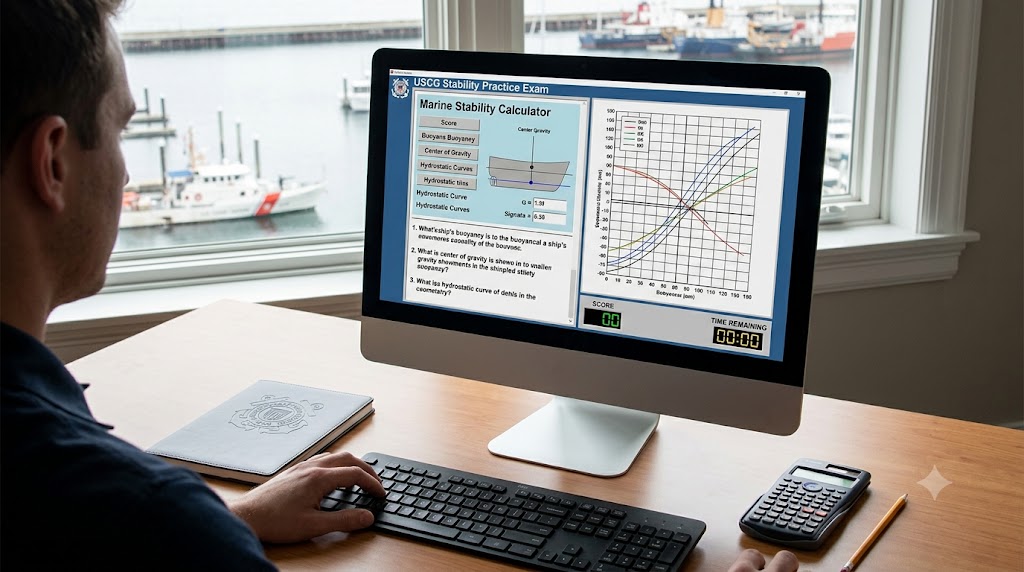
Additional Information
What the Course Entails and Exam Details
This comprehensive practice exam covers a wide range of
theoretical and practical application topics derived from the official USCG
stability syllabus.
Participants can expect detailed modules covering topics
such as basic stability definitions (buoyancy, gravity, equilibrium), the
calculation of drafts, trim, and list, and the interpretation and use of
hydrostatic curves and data tables.
The exam details often mirror the actual USCG stability
module structure, which typically utilizes randomized multiple-choice questions
focused on specific assessment areas to provide a realistic evaluation
experience.
What to Expect in
the Final Exam
While a practice test allows for flexibility, the actual
USCG stability examination is a proctored, structured event.
The final exam format is almost exclusively multiple-choice,
which candidates must complete within specified time limits, often ranging from
3 to 4 hours per specific module.
The passing score requirement is generally 70%, but it is
important to note that specific endorsements may require higher passing grades
or specific sections to be passed individually within a comprehensive
assessment block.
There are no open book portions for these specific technical
modules, requiring candidates to rely solely on their calculated knowledge and
memory of critical formulas and principles.
How to Study and
Exam Centers
Effective preparation is key. Actionable study strategies
include focusing on official USCG publications like Navigation and Vessel
Inspection Circulars (NVICs), utilizing approved marine stability textbooks,
and practicing mathematical problems until calculations are fluent.
Regularly taking the USCG Stability Practice Test is crucial
for identifying knowledge gaps and building exam-day confidence under timed
conditions.
The final official USCG exam cannot be taken online; it must
be scheduled and completed in person at a USCG Regional Examination Center
(REC). Candidates should check the National Maritime Center (NMC) website for
the nearest authorized testing location.
Job Opportunities from the Course
Passing the USCG Stability examination module is a mandatory
requirement for securing specific upper-level merchant mariner credentials.
Achieving this endorsement significantly expands career opportunities within
the maritime industry.
Specific job titles and career paths this certification
unlocks include:
- Master
(Vessels over 100 GT)
- Chief
Mate (Vessels over 100 GT)
- Mate
(Vessels over 100 GT)
- Third
Mate / Second Mate / Chief Mate (Unlimited Tonnage)
- Master
(Unlimited Tonnage)
Frequently Asked Questions
Reviews
5.0
Based on 0 reviews
Leave a Review
No reviews yet. Be the first to review!