
USCG Tactical Boat Crew (TAC Crew) Practice Exam
$69.00
- Buy to unlock unlimited access to all Quiz questions and Answers in this Quiz.
- After purchase you can print a PDF of the whole quiz at any point. The PDF will contain the questions and the correct answers.
About this Exam
The USCG Tactical Boat Crew (TAC Crew) designation is a specialized, high-level qualification within the U.S. Coast Guard, reserved for members of the Deployable Specialized Forces (DSF). These units, such as Tactical Law Enforcement Teams (TACLETs), Maritime Safety and Security Teams (MSSTs), and Maritime Security Response Teams (MSRTs), are the tip of the spear for high-risk maritime interdiction, counter-terrorism, and advanced law enforcement operations. A TAC Crew member is trained to operate as a cohesive unit in extreme conditions, executing complex tactics on high-speed response boats to intercept, board, and neutralize threats to national security and maritime safety. This practice exam is designed as a crucial tool for USCG active duty and reserve personnel, as well as authorized maritime law enforcement partners, who are preparing for the rigorous written and practical components of the official TAC Crew qualification course. It serves to reinforce the essential knowledge required for this elite role.
Ready to test your knowledge?
Buy Now to Access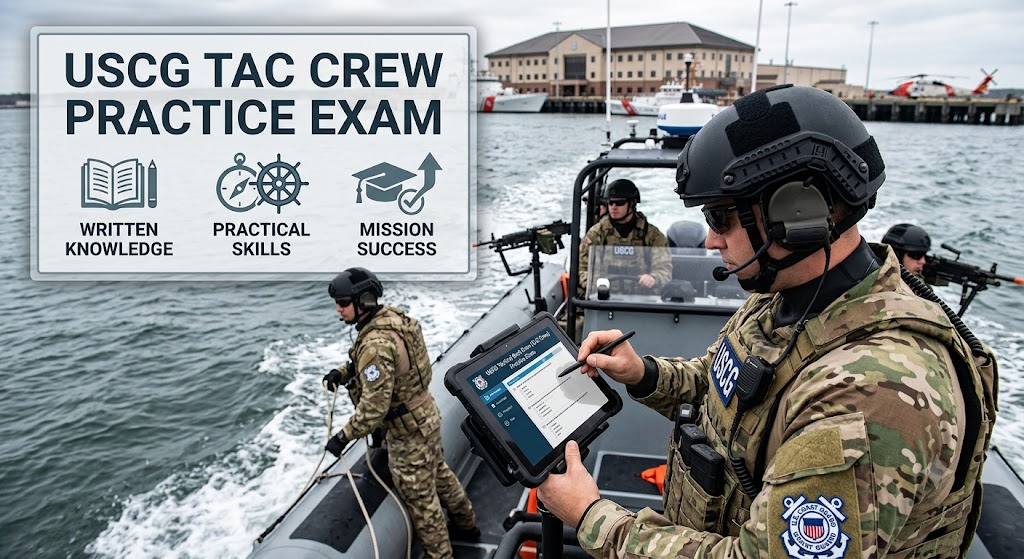
Additional Information
What the Course Entails and Exam Details
The official USCG Tactical Boat Crew course is a intensive,
multi-week program, such as the Basic Tactical Operations Course (BTOC),
designed to transition qualified Boat Crew members into the tactical
environment. The curriculum covers a wide array of advanced skills and
knowledge, ensuring proficiency in both individual and team tasks.
Key areas of study and examination include:
- Tactical
Boat Operations: High-speed maneuvering, close-quarters boat handling,
intercept techniques, shadowing, herding, and shouldering.
- Advanced
Interdiction Tactics: Planning and executing non-compliant boardings,
cooperative and non-cooperative vessel pursuits, and vertical insertion
capabilities (if applicable).
- Use
of Force (UOF): Comprehensive understanding and application of the
USCG Use of Force Policy, from non-lethal compliance measures to the
dynamic use of firearms.
- Tactical
Communications: Operating complex, encrypted communication systems
within a team and with supporting assets.
- Specialized
Weapons Proficiency: Advanced combat marksmanship with assigned
tactical weapons, such as individual service weapons and crew-served
weapons like the M240 machine gun.
- Team
Coordination (TCT) and Leadership: Critical thinking, situational
awareness, and effective decision-making in high-stress, rapidly evolving
tactical scenarios.
- Search
and Rescue (SAR) in a Tactical Context: Adapting SAR techniques to a
high-threat environment.
- Basic
and Advanced First Aid: Tactical combat casualty care and life-saving
techniques.
The practice exam mimics the structure of the official
qualification, which consists of both a Written Knowledge Test and Practical
Performance Assessments (Go/No-Go criteria) during the underway portion of
the course.
What to Expect in the Final Exam
The final qualification for USCG TAC Crew is a multi-stage
process where candidates must demonstrate absolute mastery of all required
knowledge and skills. It is not merely about a passing score, but about
operational readiness in high-risk scenarios.
Expect the final assessment to include:
- Written
Examination: A comprehensive multiple-choice and short-answer test
covering the entirety of the syllabus, including UOF policy, navigation
rules, navigation and piloting, communication procedures, and boat
engineering. Candidates must achieve a minimum score, typically 80% or
higher, to proceed.
- Physical
Fitness Assessment: Meeting stringent USCG operational fitness
standards is a pre-requisite, often tested before and during the course.
- Practical
(Go/No-Go) Underway Evaluation: This is the core of the qualification.
Candidates must successfully execute a series of simulated missions and
scenarios on the water. These tests are pass/fail ("Go" or
"No-Go") and require flawless performance in areas like high-speed
intercepts, docking, dynamic use of force application, casualty care, and
crew coordination.
- Scenario-Based
Oral Boards: A final panel evaluation may be included, where
candidates must defend their tactical decisions and demonstrate deep
understanding of their responsibilities and authority.
Failure on a critical Go/No-Go task or failing to meet the
minimum score on the written test will result in a No-Go and may require
remedial training or removal from the qualification pipeline.
How to Study and Exam Centers
Preparation for the TAC Crew qualification demands a
dedicated, multifaceted approach. While a practice exam is an excellent tool
for knowledge reinforcement, it must be paired with operational experience and
rigorous training.
Actionable study strategies include:
- Master
the Fundamentals: Thoroughly review the U.S. Coast Guard Boat
Operations and Training (BOAT) Manual, Volume III (Tactical) and all
relevant USCG instructions on Use of Force, Maritime Law Enforcement, and
Navigational Rules (COLREGS).
- Utilize
Official Practice Materials: Engage with all official study guides,
flashcards, and online training modules provided by the USCG and your
unit.
- Physical
Training: Maintain a high level of functional fitness, focusing on
dynamic strength, cardio, and agility. Tactical boat operations are
physically demanding.
- Scenario
Planning: Mentally rehearse tactical scenarios. Discuss potential
situations with your team and experienced operators.
- Seek
Mentorship: Learn from qualified TAC Crew members at your unit. Ask
for feedback during training exercises.
Exam Centers: The official written and practical
testing for the USCG Tactical Boat Crew qualification is conducted internally
by the USCG. Written tests are administered at official USCG Special
Missions Training Centers (SMTC) or by designated Unit Training Officers at
authorized units. Practical, underway evaluations are conducted by a certified qualification
board at the unit level or a designated training command. This
qualification is not administered at general Pearson VUE centers or
civilian maritime schools. For personnel seeking Merchant Mariner Credentials
(MMC) or other endorsements, these are handled separately through USCG
Regional Exam Centers (RECs) and require a different set of exams and
processes. This practice exam specifically prepares you for the operational,
dynamic requirement of the USCG TAC Crew.
Job Opportunities
from the Course
A USCG Tactical Boat Crew qualification is a highly
sought-after and respected credential, opening the door to the Coast Guard's
most challenging and impactful missions. It is a stepping stone to a career
within the specialized, high-readiness forces.
The qualification unlocks numerous career paths and job
titles, including:
- Deployable
Specialized Forces (DSF) Member
- TACLET
(Tactical Law Enforcement Team) Law Enforcement Detachment (LEDET)
Operator
- MSST
(Maritime Safety and Security Team) Tactical Coxswain or Crewman
- MSRT
(Maritime Security Response Team) Assault Team Member
- Special
Missions Training Center (SMTC) Instructor
- Unit
Training Officer for Tactical Operations
- Joint
Interagency Task Force (JIATF) Liaison Officer
- Port
Security Unit (PSU) Tactical Coxswain or Crewmember
A successful career in these roles demonstrates exceptional
skill, leadership, and dedication, making personnel highly competitive for
advancement and selection into specialized leadership positions within the USCG
and the broader Department of Homeland Security (DHS) community.
Frequently Asked Questions
Reviews
5.0
Based on 0 reviews
Leave a Review
No reviews yet. Be the first to review!