
USCG Tanker Practice Exam
$69.00
- Buy to unlock unlimited access to all Quiz questions and Answers in this Quiz.
- After purchase you can print a PDF of the whole quiz at any point. The PDF will contain the questions and the correct answers.
About this Exam
The United States Coast Guard (USCG) Tankerman endorsements are highly sought-after certifications within the maritime industry, essential for individuals looking to serve as a key individual on tank vessels or tank barges. These qualifications ensure that mariners possess the requisite knowledge, experience, and practical skills to safely manage, supervise, or assist with the transfer and handling of liquid cargoes, including dangerous liquids and liquefied gases. The different endorsements, such as Tankerman-Person in Charge (PIC), Tankerman-Assistant, or Tankerman-Engineer, have varying responsibilities and eligibility requirements based on sea service and training. This comprehensive study guide and its associated practice exams are designed to assist mariners in preparing for the rigorous USCG exams required to achieve these critical certifications, offering a vital step towards a successful career in the tanker sector.
Ready to test your knowledge?
Buy Now to Access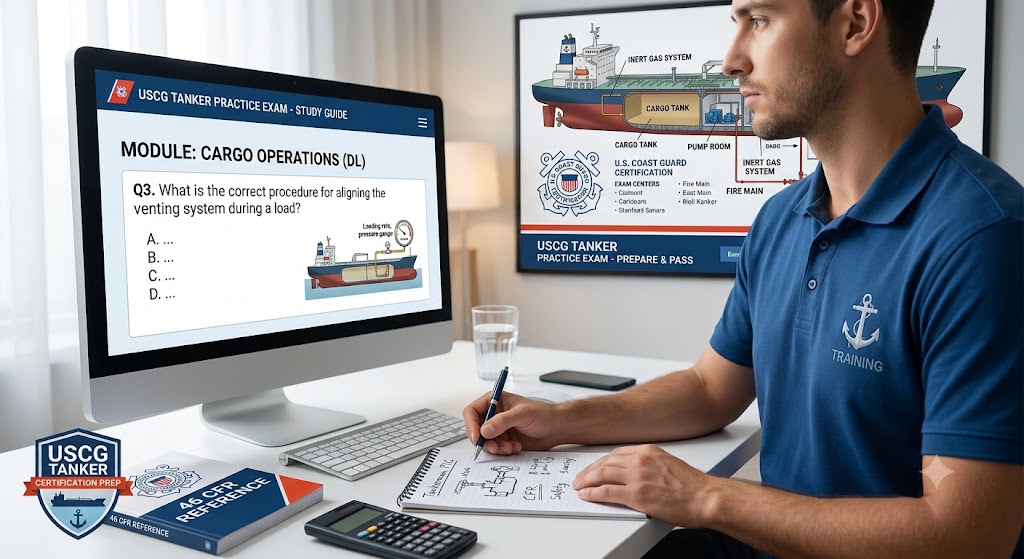
Additional Information
What the Course Entails and Exam Details
Achieving a USCG Tankerman endorsement involves substantial
preparation, including satisfying sea service requirements, completing relevant
USCG-approved courses, and passing the required USCG examinations. The course,
when referring to the entire qualification path, includes learning about a wide
array of topics crucial to the safe and environmentally sound operation of tank
vessels and barges.
Key topics covered within the qualification process and the
exams typically include:
- Cargo
Operations: A deep understanding of cargo loading, discharge, and
internal transfer procedures. This covers systems and equipment like
pumps, piping, hoses, loading arms, and the operation of venting and
inerting systems.
- Cargo
Properties and Hazards: Knowledge of the physical and chemical
properties of various liquid and gaseous cargoes, as well as the inherent
dangers, fire risks, and toxicity associated with them.
- Safety
and Health: Stringent safety protocols, including the correct use of
personal protective equipment (PPE), gas monitoring instruments, confined
space entry procedures, and the prevention of static electricity.
- Regulations:
Comprehensive familiarity with relevant national and international
regulations, including 46 CFR (Code of Federal Regulations), MARPOL, and
other applicable standards.
- Pollution
Prevention: Practical measures to prevent oil spills and cargo leaks,
the correct maintenance of oil-water separators, and the knowledge
required to respond effectively to accidental spillage.
- Emergency
Procedures: Detailed protocols for handling emergencies such as fires,
spills, and cargo-related incidents, including the understanding of
firefighting equipment and techniques.
The specific exam modules and details depend on the desired
endorsement level (PIC, Assistant, or Engineer) and the type of cargo
(Dangerous Liquids or Liquefied Gases). The official exams consist of
multiple-choice questions administered by the USCG or a designated center.
What to Expect in the Final Examinal examinations fSCGnkerman
endorsements are comprehensive, rigorous, and strictly controlled. They are
designed to thoroughly evaluate a candidate’s understanding of the topics
mentioned above and their ability to apply this knowledge practically.
- Format:
The official USCG exams for Tankerman endorsements are consistently
delivered in a multiple-choice format. This structure tests broad
knowledge across all key subject areas in a clear, standardized way.
- Passing
Score: The passing score requirement for each exam module is defined
by the USCG and typically involves achieving a minimum percentage of
correct answers (often 70% or higher, varying by module). Achieving less
than the passing score means the module must be retaken according to USCG
procedures.
- Time
Limits: While candidates are generally allowed sufficient time to
complete each module, there are established time limits in place to ensure
efficiency and fairness. These limits vary by the complexity and length of
the specific exam module.
- Rules
and Authority: The exams are typically taken at one of the USCG
Regional Examination Centers (RECs) or other authorized locations. Strict
rules are in place regarding materials allowed into the exam room,
communication, and electronic devices. The exams are administered under
the authority of the USCG National Maritime Center (NMC), and any
violation of rules can result in penalties or credentialing restrictions.
Preparing with a USCG Tanker Practice Exam of similar
format and content to the official test is crucial to simulate the actual exam
experience, understand the question structure, manage time effectively, and
boost confidence.
How to Study and
Exam Centers
Effective study is paramount for success in the USCG
Tankerman certification exams. Successful candidates usually combine
theoretical study, approved coursework, practical experience, and strategic
test preparation.
Actionable Study Strategies:
- Utilize
a [USCG Tanker Practice Exam] as a Core Tool: High-quality practice
exams are an invaluable asset. They allow you to:
- Assess
your current knowledge base across all key topics.
- Identify
specific weaknesses and areas for focused study.
- Become
familiar with the multiple-choice question format and logic.
- Simulate
the actual test environment and practice time management.
- Engage
in Approved Training: Enrollment in USCG-approved tanker safety and
cargo handling courses is usually a mandatory part of the credentialing
process. Pay close attention in these courses and review all provided
materials.
- Consult
Official USCG Resources: The USCG provides manuals, rules (CFR), and
exam content guides that are essential primary sources of information.
Regularly review the 46 CFR regulations.
- Build
Practical Experience: There is no substitute for supervised, hands-on
experience during cargo transfers. Actively participate in transfers on
tank vessels to build practical understanding and document this sea
service appropriately.
- Form
Study Groups: Collaborating with colleagues and fellow mariners can
provide diverse perspectives and help you clarify challenging concepts.
- Focus
and Discipline: Establish a consistent study routine, review materials
iteratively, and maintain focus on the long-term goal.
Taking the Exam:
- Location:
The final USCG Tankerman exams are officially administered at USCG
Regional Examination Centers (RECs) located in various major ports and key
maritime areas throughout the United States. Ensure you find the REC
closest to you or a location with available appointments. Some authorized
maritime schools may also proctor exams under specific USCG programs.
- Scheduling:
Contact your chosen REC well in advance to schedule your exam appointment.
Follow all necessary application and medical requirements before
scheduling.
- Preparation
for Test Day: Review REC procedures, dress appropriately, and bring
required identification and any pre-approved materials (such as standard
mathematical tools, but confirm this with your REC).
5. Job Opportunities from the Course
A USCG Tankerman endorsement, particularly the
Tankerman-Person in Charge (PIC) certification, opens substantial career
opportunities in the vibrant liquid cargo sector. These positions offer
competitive pay, significant responsibility, and clear paths for advancement.
The skills required are highly valued by shipping companies, barge operators,
and terminal facilities around the globe.
Potential job titles and career paths this certification
unlocks include:
- Tankerman-PIC
(Person in Charge): The individuals responsible for the entire
operation during the transfer of liquid cargoes on tank vessels and
barges. They supervise all aspects of the process, communicate with
terminals, and ensure safety and compliance.
- Tankerman-Assistant:
An entry-level role assisting the PIC during cargo transfers, gaining
essential experience and working under supervision.
- Tankerman-Engineer:
Engineering professionals specializing in the mechanical systems, pumps,
and engine rooms of tank vessels and barges.
- Tank
Vessel Officer (Deck and Engine): Achieving a Tankerman endorsement
can complement deck or engine license qualifications, enabling roles as
mates, masters, and engineers on tankships.
- Cargo/Transfer
Supervisor (Terminal): Transferable skills with liquid cargo handling
can lead to supervisory roles at marine terminals.
- Operations
Manager: Further experience can lead to shore-based operations
management positions within maritime shipping and logistics companies
focusing on liquid bulk.
- Environmental/Safety
Officer: Specializing in safety compliance and pollution prevention
within the tanker industry.
This study guide and a robust commitment to both practical
experience and preparation using resources like a USCG Tanker Practice Exam
will position you for success in achieving this critical endorsement and
unlocking diverse career paths in the maritime sector.
Frequently Asked Questions
Reviews
5.0
Based on 0 reviews
Leave a Review
No reviews yet. Be the first to review!