
USCG Watchstander Practice Exam
$69.00
- Buy to unlock unlimited access to all Quiz questions and Answers in this Quiz.
- After purchase you can print a PDF of the whole quiz at any point. The PDF will contain the questions and the correct answers.
About this Exam
The USCG Watchstander qualification is a cornerstone of operational readiness within the United States Coast Guard. A watchstander is an individual responsible for monitoring and controlling vessel systems or a specific operational area, ensuring safe navigation, effective communication, and security while underway or in port. This certification is designed for active-duty personnel, Coast Guard Auxiliary members, and civilians working on USCG vessels or in command centers. It is a mandatory step for any crew member seeking to take on a position of trust and responsibility on a ship or within an operations center. The practice exam serves as an essential preparatory tool to ensure candidates have mastered the foundational knowledge and practical skills required for this critical role.
Ready to test your knowledge?
Buy Now to Access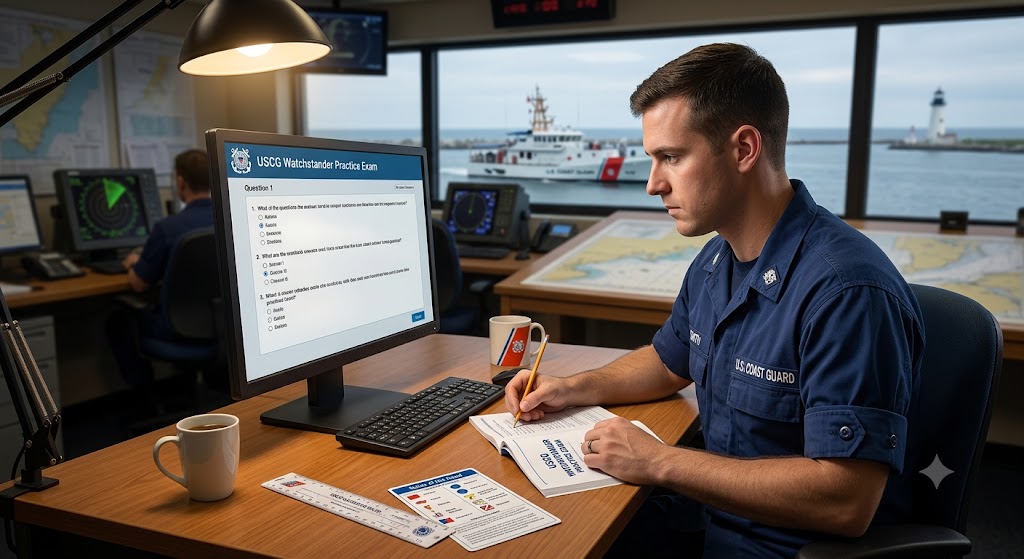
Additional Information
What the Course Entails and Exam Details
To prepare for the USCG Watchstander Practice Exam,
candidates must undergo a comprehensive course of study, which can be part of a
larger training program or a standalone qualification. The course and final
exam cover several core competencies, ensuring that every watchstander is
equipped to handle standard operations and emergencies.
Key topics included in the syllabus are:
- Rules
of the Road (COLREGs and Inland Rules): Understanding all navigational
rules, signals, and collision avoidance procedures for both international
and inland waterways.
- Navigation:
Foundational knowledge of chart reading, determining a ship’s position,
basic passage planning, and the use of navigational aids, including radar
and GPS.
- Seamanship:
Vessel terminology, mooring and line handling, basic damage control, and
ship stability.
- Communication:
Mastery of marine radio procedures, proper use of the distress signals
(MAYDAY, PAN PAN, SECURITE), and communication protocols within the ship
and with shore stations.
- Watchkeeping
Procedures: The correct methods for conducting a watch turnover,
maintaining a proper smooth log, and executing a security patrol.
- Safety
and Emergency Response: Recognition and response to heavy weather,
gale warnings, and emergency situations like fire or a man-overboard.
- Security:
Understanding security zones, access control, use of force, and defense in
depth.
What to Expect in
the Final Exam
The actual USCG Watchstander Exam is a rigorous
assessment designed to confirm operational competence. While specific formats
can vary slightly by unit or specialization (e.g., Deck Watch Officer vs.
Engineering Watchstander), a typical exam will include:
- Exam
Format: A combination of multiple-choice and short-answer questions.
For many levels, there is also a practical phase, such as an oral board,
where candidates are tested on their knowledge through situational
questions.
- Number
of Questions: The multiple-choice component generally consists of 50
to 100 questions.
- Passing
Score Requirements: To pass, candidates must achieve a minimum score,
which is typically 70% to 80%, with some high-stakes sections (like
Rules of the Road) requiring near-perfect scores of 90% or higher.
- Time
Limits: The written portion usually has a time limit of 2 to 3
hours. Oral boards vary based on performance.
- Rules:
The exam is closed-book. Electronic devices are prohibited. Scientific
calculators are often allowed for navigational problems, but programmable
ones are not.
How to Study and Exam Centers
Preparation is key to succeeding on the USCG Watchstander
Practice Exam. Candidates should treat this preparatory tool as an active
part of their learning process.
Here are actionable study strategies:
- Take
a USCG-Approved Course: Formal training, either at a Coast Guard
"C" School (like Yorktown) or an authorized, recognized
institution, provides the required in-depth knowledge and hours.
- Utilize
the Practice Exam: The practice exam should be used to simulate test
conditions. Identify weak areas, review those topics, and retake the test.
It is not just about memorization; it's about applying knowledge.
- Master
the Navigation Rules: Purchase or access the current "Navigation
Rules and Regulations Handbook" (COMDTINST M16672.2). Focus intensely
on the distinction between international and inland rules.
- Build
a Knowledge Library: Create flashcards for Rules of the Road,
navigation terms, and communication signals. Study official Coast Guard
technical manuals and standard operating procedures (SOPs).
- Simulate
Practical Skills: If you are a sea-going candidate, practice chart
plotting and Rule of the Road application with your shipmates. For
shore-based roles, use simulation software to practice radio
communications.
Regarding Exam Centers, the process is centralized:
- Military
Personnel: Training and exams are typically coordinated through
individual units and taken on-site at Coast Guard "C" schools or
designated on-base Regional Exam Centers (RECs).
- Auxiliary
Members: Work with your Flotilla Commander or Training Officer to find
approved proctors or courses. Some materials may be available online, but
practical exams must be administered by a qualified instructor.
- Civilians:
For mariners seeking specific endorsements, the written exam must be taken
at a USCG Regional Exam Center (REC). There are 17 RECs located
across the United States. You must schedule your appointment through the
National Maritime Center (NMC) portal.
Job Opportunities
from the Course
A USCG Watchstander qualification is a prerequisite
and primary requirement for numerous careers within the Coast Guard, a
multi-mission maritime agency. Successfully earning this certification and
gaining experience unlocks advanced roles and significant responsibility.
Job opportunities this qualification directly supports or
unlocks include:
- Deck
Watch Officer (DWO): The central responsible officer on the bridge of
a USCG cutter.
- Boatswain's
Mate (BM): A key petty officer role, responsible for boat operations,
seamanship, and law enforcement. BM ratings require multiple watchstander
certifications.
- Quartermaster
(QM): Specializes in navigation, chart corrections, and visual
signaling on larger ships.
- Engineering
Watchstander: Responsible for monitoring and operating the vessel's
engineering and electrical systems.
- Radio
Watchstander: Based in a command center or on a large vessel,
monitoring and managing communications.
- Command
Center Operator: A vital role ashore, coordinating Coast Guard
response operations, from Search and Rescue to Law Enforcement.
- Vessel
Traffic Service (VTS) Operator: Manages the safe movement of vessels
in busy waterways, preventing collisions.
Frequently Asked Questions
Reviews
5.0
Based on 0 reviews
Leave a Review
No reviews yet. Be the first to review!