
USHJA Horsemanship Practice Test
$69.00
- Buy to unlock unlimited access to all Quiz questions and Answers in this Quiz.
- After purchase you can print a PDF of the whole quiz at any point. The PDF will contain the questions and the correct answers.
About this Exam
The United States Hunter Jumper Association (USHJA) Horsemanship program offers a vital educational framework designed to cultivate comprehensive equestrian knowledge in riders of all levels. It goes far beyond riding skills, aiming to foster well-rounded horse people who understand and respect the animal, the rules of the sport, and the demands of quality care. This study guide is a general resource to support preparation for the knowledge-based tests within the program, including the widely used online practice quizzes. These are essential milestones for riders, including those participating in the renowned Emerging Athletes Program (EAP) or individuals looking to validate their expertise for general horsemanship and career paths. The tests are tailored to assess understanding of horsemanship fundamentals for juniors, amateurs, and professionals alike, promoting a culture of excellence and responsibility in the hunter/jumper community.
Ready to test your knowledge?
Buy Now to Access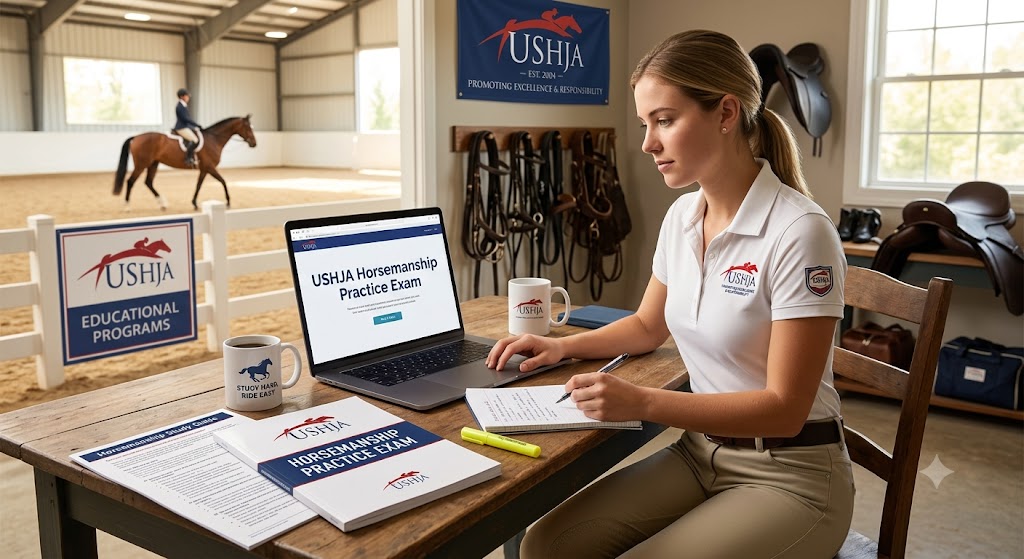
Additional Information
What the Course
Entails and Exam Details
The USHJA Horsemanship education encompasses a wealth of
knowledge crucial for both competitive success and general equine welfare. The
core areas covered include in-depth horse care, anatomy and physiology, stable
management practices, riding theory, history of the hunter/jumper discipline,
and relevant rulebook knowledge. The official USHJA Horsemanship Quiz Challenge
(HQC) study guides are extensive resources detailing these topics. The exams
themselves typically include multiple-choice and true/false questions that
directly reflect the content found in these study materials. For many
participants, the initial knowledge checks are online and consist of Level One
and Level Two quizzes, which serve as crucial prerequisites for certain
programs and the advanced National competition. Completing these quizzes
successfully demonstrates a solid foundation in essential horsemanship
knowledge. The initial knowledge is foundational, and the advanced levels
(especially for the National Final in the Quiz Challenge) incorporate broader
practical and oral assessments. The online knowledge tests are central to
moving forward, making the practice exams an invaluable tool.
What to Expect in
the Final Exam
While a final formal examination experience may vary based
on the specific context (e.g., HQC vs. generally demonstrating horsemanship at
a clinic or for certification), the widely recognized online USHJA Horsemanship
Quiz Challenge (Level 1 and Level 2) and related knowledge assessments share
general features. Participants can generally expect an online format involving
multiple-choice, true/false, and perhaps matching questions, designed to test
knowledge from the study materials. It is common that Level One requires a
specific passing score, such as 80% or above, and Level Two may require a
higher passing score, such as 90% or above. The search results explicitly note
that the specific HQC online quizzes (Level One and Two) were not strictly
timed for completion per attempt, allowing students the time to process and
answer. However, there is typically a seasonal deadline to complete the
knowledge tests in order to advance. Students must also be current USHJA
members to participate in the formal Horsemanship Quiz Challenge and advance.
The National competition for the HQC includes a written exam,
horsemanship/identification, interviews, and a practicum phase, so the core
knowledge must be extremely sound to proceed. Always consult the official USHJA
program specifications for the current competition year for the most up-to-date
and specific details.
How to Study and
Exam Centers
Effective preparation is key to mastering the USHJA
horsemanship material.
Study the Official Guides: Read and thoroughly
understand the current USHJA Horsemanship Quiz Challenge study guides and any
additional materials provided by USHJA or relevant programs. These contain the
bulk of the content you will be tested on.
Take the Practice Quizzes: Leverage the valuable
USHJA Practice Quizzes, which can often be retaken multiple times and are not
timed for completion. These are fantastic for self-assessment, identifying weak
points, and getting comfortable with the general knowledge format. Use them
alongside the study guide to check answers and reinforce learning.
Practical Experience: Actively participate in all
aspects of horsemanship, including grooming, tacking, feeding, general horse
care, and observing experienced professionals and horsemen/women. Practical
application of the concepts will make the theoretical knowledge clearer and
more memorable.
Review Rulebooks: Familiarize yourself with relevant
USEF/USHJA rulebook sections, especially regarding hunter, jumper, and
equitation disciplines and horse welfare.
Watch Educational Content: Seek out related
educational videos, webinars, and demonstrations provided by USHJA or other
reputable equestrian organizations.
Study Groups: Collaborating with peers can provide
different perspectives, support active discussion of concepts, and keep you
motivated.
The USHJA Horsemanship practice quizzes and subsequent
knowledge exams are typically accessed and taken online through the
USHJA portal. There is no standard physical "exam center" for the
initial knowledge tests. Students register, access the study materials and
quizzes, and complete them within the specified timeframe from any location
with internet access. Advanced components, such as the National competition of
the HQC, are held at a physical location, but the initial knowledge validation
is digital. Check the official USHJA website for specific instructions on
access and registration.
Job Opportunities
from the Course
A strong foundation in USHJA horsemanship principles is
highly valued in the equestrian world and can open doors to numerous career
opportunities and pathways:
Groom: A professional horse care specialist,
essential at competition barns.
Barn Manager: Overseeing all operational aspects,
staff, and equine care at a facility.
Assistant Trainer: Supporting head trainers in horse
training, client support, and lessons.
Riding Instructor (Hunter/Jumper): Teaching riders
the foundations of forward riding and horsemanship.
Equine Facilities Manager: Managing larger equestrian
centers or show grounds.
Equine Sales/Marketing: Roles within businesses
supporting the equine industry.
Therapeutic Riding Instructor: Adapting equestrian
instruction for individuals with disabilities (requires further specific
certification but horsemanship base is foundational).
Horse Show Staff: Opportunities at competitions in
various administrative and support roles.
Further Training Paths: The knowledge is a critical
stepping stone for pursuing advanced trainer certifications, the USHJA
Instructor Credential, or competing at advanced levels. A solid understanding
of equine care and management is indispensable for any potential professional
rider or trainer.
Remember to always consult the official USHJA website and current program documentation for the most accurate and up-to-date information regarding fees, deadlines, passing requirements, and specific study materials
Frequently Asked Questions
Reviews
5.0
Based on 0 reviews
Leave a Review
No reviews yet. Be the first to review!