
USMC Call For Fire Practice Test
$69.00
- Buy to unlock unlimited access to all Quiz questions and Answers in this Quiz.
- After purchase you can print a PDF of the whole quiz at any point. The PDF will contain the questions and the correct answers.
About this Exam
The United States Marine Corps (USMC) Call For Fire (CFF) Practice Test is an essential training tool designed for Marines, particularly those in combat arms occupational fields like Artillery, Infantry, and Air Naval Gunfire Liaison Companies (ANGLICO). This exam is not a certification for civilians, but rather a critical step in qualifying Forward Observers (MOS 0861) and Joint Terminal Attack Controllers (JTACs) to accurately direct indirect fire support—such as artillery, mortars, and naval gunfire—onto enemy positions. The test ensures that personnel can effectively and safely communicate coordinates, target descriptions, and engagement methods in high-stress combat environments, minimizing the risk of friendly fire while maximizing tactical impact.
Ready to test your knowledge?
Buy Now to Access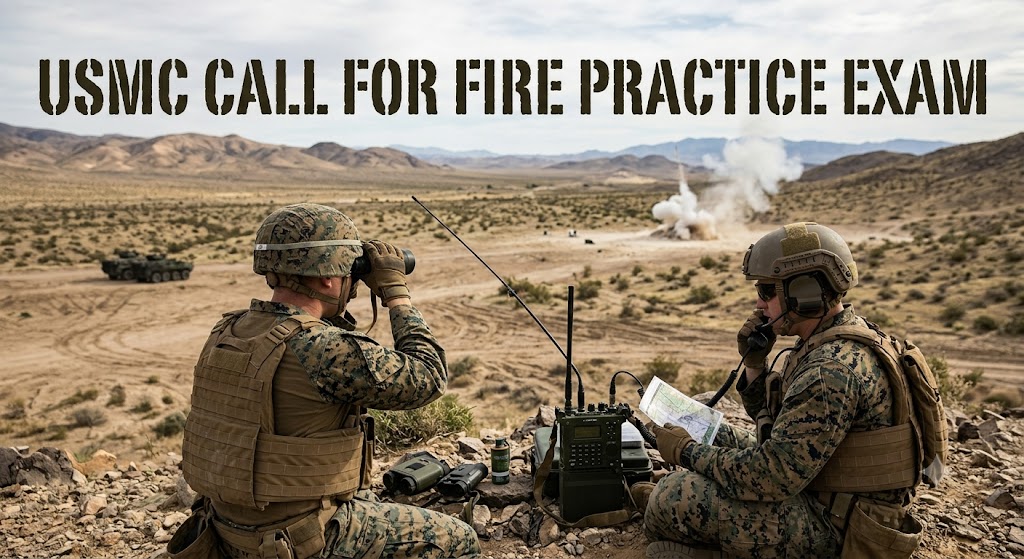
Additional Information
What the Course Entails and Exam Details
This training covers the standardized procedures needed to
request and adjust indirect fire. The curriculum focuses heavily on tactical
communication, map reading, and the technical steps of the CFF sequence.
Students must master the standard six elements of the Call For Fire request,
transmitted in three distinct distinct transmissions:
Transmission 1:
- Observer
Identification (Who you are)
- Warning
Order (Type of mission, e.g., Adjust Fire, Fire for Effect)
Transmission 2:
- Target
Location (Grid coordinates, Polar coordinates, or Shift from a Known
Point)
Transmission 3:
- Target
Description (What the target is, size, activity)
- Method
of Engagement (Type of ammunition, if necessary)
- Method
of Fire and Control (When you want the fire to hit)
Furthermore, the course and subsequent exam details involve
demonstrating proficiency in Message to Observer (MTO), Authentication
procedures, and accurately executing Adjustment of Fire using the
'successive bracketing' method based on visual impacts.
What to Expect in the Final Exam
The final Call For Fire evaluation is typically a
combination of a written examination and a practical application performance
test.
The Written Exam: This portion consists of
multiple-choice and short-answer questions. It tests your knowledge of
acronyms, standardized radio procedures, the six elements of CFF, Message to
Observer requirements, and safety protocols regarding 'danger close' distances.
You must know the capabilities and limitations of different firing platforms
(e.g., M777 howitzers, 81mm mortars).
The Practical Application (The "Sim"): This
is often the most critical component. Marines must demonstrate their ability to
'call for fire' in real-time. This can take place on a live-fire range or, more
commonly during initial training, within a high-fidelity simulator like the
Supporting Arms Virtual Trainer (SAVT) or Deployable Virtual Training
Environment (DVTE). In this environment, you will be given a tactical scenario,
identify a target, and must flawlessly transmit the three CFF transmissions
over a radio simulator, adjusting shots until the target is suppressed or
destroyed within a limited number of rounds and specific time constraints.
How to Study and Exam Centers
How to Study: Success in Call For Fire requires
memorization, procedural fluency, and practice under stress.
- Master
MCTP 3-10B: Study the Marine Corps Tactical Publication (MCTP 3-10B,
formerly MCWP 3-16.6), Supporting Arms Observer, Spotter, and Gunner.
This is the definitive manual.
- Practice
the Sequence: Memorize the six elements of CFF until they become
second nature. Write them out daily.
- Use
Simulators: If available at your unit, maximize your time in the SAVT
or DVTE. These simulators provide realistic feedback on your adjustments.
- Grid
Coordinate Drills: Practice rapid and accurate eight-digit grid
location identification on military maps.
Exam Centers: The USMC Call For Fire test is
conducted exclusively within military training commands. It is not available
through civilian centers like Pearson VUE. Primary testing locations include:
- Marine
Corps Combat Service Support Schools (MCCSSS) at Camp Lejeune, NC.
- The
Basic School (TBS) at Quantico, VA (for officers).
- MOS-specific
schools, such as the Field Artillery School at Fort Sill, OK.
- Unit
Training: Qualified Forward Observers within individual Marine Units
often conduct sustainment training and evaluations locally.
- Job Opportunities from the Course
A mastery of Call For Fire is fundamental to several
critical Military Occupational Specialties (MOS) and advanced qualification
paths within the Marine Corps. Proficiency can open doors to highly specialized
billets and career progression.
- Forward
Observer (MOS 0861)
- Fire
Support Specialist
- Joint
Terminal Attack Controller (JTAC) - Requires CFF mastery as a
prerequisite
- Joint
Forward Observer (JFO)
- Artillery
Officer (MOS 0802)
- ANGLICO
Fire Support Team Member
- Infantry
Mortar Section Leader
Frequently Asked Questions
Reviews
5.0
Based on 0 reviews
Leave a Review
No reviews yet. Be the first to review!