
USMC Casualty Assistance Calls Officer (CACO) Practice Test
$69.00
- Buy to unlock unlimited access to all Quiz questions and Answers in this Quiz.
- After purchase you can print a PDF of the whole quiz at any point. The PDF will contain the questions and the correct answers.
About this Exam
The United States Marine Corps (USMC) Casualty Assistance Calls Officer (CACO) certification is a vital qualification for officers and senior non-commissioned officers tasked with one of the military's most sensitive and solemn duties. This role involves serving as the official representative of the Commandant of the Marine Corps, personally notifying the next of kin (NOK) of a Marine’s death, injury, or illness, and subsequently assisting the family during the difficult days and weeks that follow. The comprehensive CACO course, and the prerequisite exam, are specifically designed for uniformed personnel (typically E-7 and above, W-1 and above, or O-2 and above) who are detailed to perform this essential command function. This study guide is optimized for individuals seeking to successfully complete the USMC Casualty Assistance Calls Officer Practice Exam and ultimately obtain their full qualification.
Ready to test your knowledge?
Buy Now to Access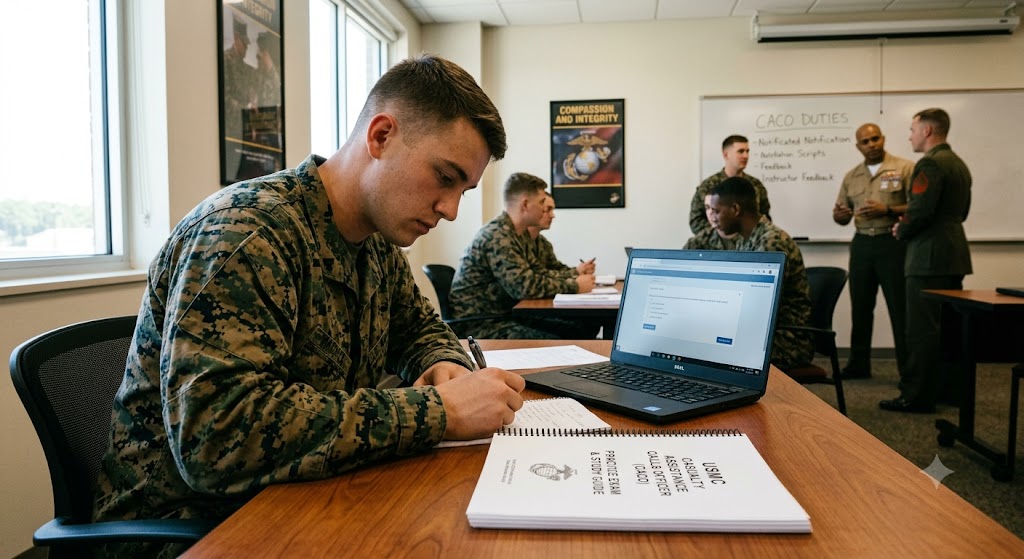
Additional Information
What the Course
Entails and Exam Details
The CACO course is a thorough program, primarily delivered
online through dedicated training modules. The curriculum covers a wide range
of essential topics, often utilizing video scenarios and interactive lessons to
simulate real-world challenges. Key areas include: official policies (such as
DoDI 1300.18 and MCO 3040.4); the entire CACO process from notification to
long-term follow-up; identifying key individuals like the PADD (Person
Authorized to Direct Disposition) and PNOK (Primary Next of Kin); understanding
unique definitions like DUSTWUN (Duty Status-Whereabouts Unknown); managing
complex family dynamics (including divorced parents, dual-military couples, and
minor children); grief and trauma awareness; and crucial self-care for the
CACO. The modules provide detailed checklists, "do's and don'ts," and
sample scripts to prepare you for every interaction.
What to Expect in the Final Exam
The final CACO exam is designed to test your mastery of
these protocols. Expect a comprehensive knowledge-based test with a mix of
question formats, including multiple-choice, true/false, and short-answer.
Questions will focus on specific timelines (e.g., initial follow-up within 24
hours), proper procedures (e.g., never performing a notification alone),
accurate definitions, and identifying the correct policy references. Practical
application is also tested, often through scenario-based questions that require
you to apply regulations to a specific situation, such as determining a PADD or
outlining the steps of a funeral escort. While passing score requirements may
vary by command, a high degree of proficiency (typically 80% or higher) is
expected, reflecting the non-negotiable nature of accuracy in this role. The
exam is usually proctored and time-limited to reflect operational pressures.
How to Study and
Exam Centers
Effective preparation is key. First, ensure you thoroughly
complete all online modules, as the test is based directly on that material.
Study the core references: DoDI 1300.18 (Department of Defense Personnel
Casualty Matters) and MCO 3040.4 (Marine Corps Casualty Assistance Calls
Program). Utilize practice exams, like this one, to familiarize yourself with
the question style and focus. Create flashcards for critical timelines, terms,
forms (like the DD Form 1375), and "order of precedence" rules. Pay
special attention to the checklists and scripting for notification. The
official USMC CACO exam is taken through the Marine Corps' online training
portal, slsp.manpower.usmc.mil, which acts as the designated exam center. Upon
successful completion, the qualification will be recorded in your official
record
Job Opportunities
from the Course
Successfully passing this course and practice exam directly
qualifies a Marine for one of the most solemn and respected positions within
the corps:
- Casualty
Assistance Calls Officer (CACO)
This is a required certification for Marines assigned to
this primary or collateral duty. A CACO assignment is a position of immense
trust, often assigned to staff non-commissioned officers and officers, that
takes priority over all other responsibilities. Completing this training
demonstrates to leadership your capacity for complex administration, sensitive
communication, and upholding the core values of the Marine Corps in a highly
visible and crucial mission. While not a new job title on your BIR (Basic Individual
Record), it is a vital skill that opens a path to high-level trust and
leadership responsibility.
Frequently Asked Questions
Reviews
5.0
Based on 0 reviews
Leave a Review
No reviews yet. Be the first to review!