
USMC Joint Light Tactical Vehicle (JLTV) Practice Test
$69.00
- Buy to unlock unlimited access to all Quiz questions and Answers in this Quiz.
- After purchase you can print a PDF of the whole quiz at any point. The PDF will contain the questions and the correct answers.
About this Exam
The USMC Joint Light Tactical Vehicle (JLTV) training and qualification program is designed for all Marines who are required to operate, maintain, or supervise the use of this next-generation light tactical vehicle. The JLTV is not simply a replacement for the Humvee; it is a significantly more capable system, featuring advanced protection, mobility, and integrated network systems. This course ensures that personnel possess the specialized knowledge and skills to leverage the JLTV's enhanced capabilities while operating safely and effectively in austere environments. Passing the required exams is a prerequisite for being licensed and authorized to deploy this pivotal asset in a wide range of combat and combat support roles.
Ready to test your knowledge?
Buy Now to Access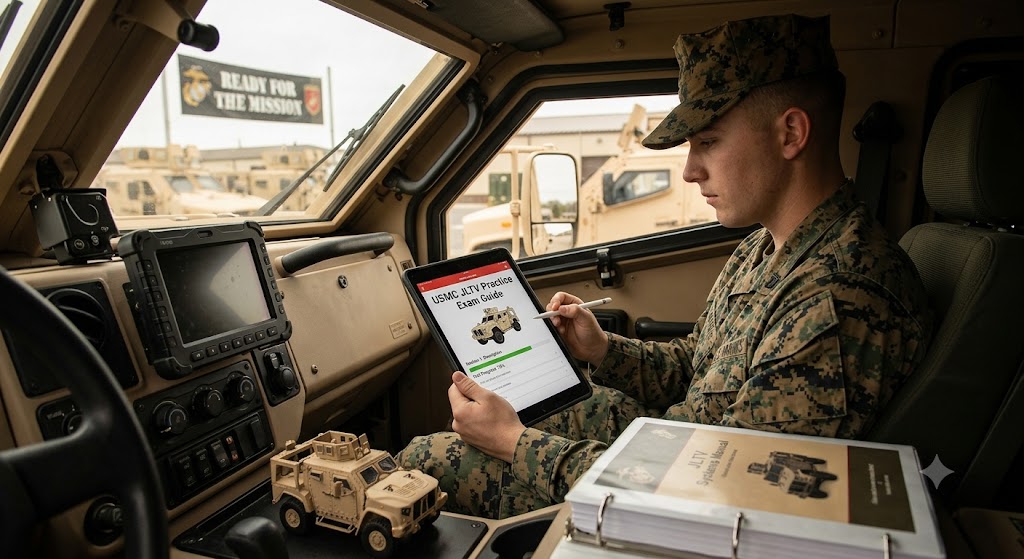
Additional Information
What the Course Entails and Exam Details
The comprehensive JLTV curriculum is structured around
distinct operator and maintenance paths. For operators, the training focuses on
safely maximizing the vehicle's unique mobility and tactical capabilities. For
maintenance personnel, it covers the technical specifications, troubleshooting,
and field-level repairs of the vehicle's complex systems. The final
qualification often involves multiple distinct assessments (e.g., Test A, Test
B, and a Practical Application).
The core topics covered in the JLTV program include, but are
not limited to:
- Vehicle
Specifications and Variants: Detailed knowledge of the four JLTV
variants (General Purpose, Heavy Gun Carrier, Close Combat Weapons
Carrier, Utility), their payloads, dimensions, turning radius, cruising
range, and engine performance.
- Central
Tire Inflation System (CTIS): Operation, limitations, and practical
application of CTIS settings (Highway, Cross-Country, Mud/Sand/Snow,
Emergency) to optimize traction across different terrain types.
- Drivetrain
and Suspension: Understanding the Banks 866T engine, transaxle lock
(High and Low settings), four-wheel steer capabilities, and the highly
capable independent suspension system, including monitoring suspension
error indicators and ride height adjustments.
- Tactical
Operations and Recovery: Winch operation, rigging procedures,
self-recovery techniques, flat towing, and operating with a fording kit.
- Safe
Vehicle Operation: Specialized techniques for navigating varying
terrain, including driving on steep grades (up to 60%), side slopes,
traversing obstacles, and executing quick stops.
- Preventive
Maintenance Checks and Services (PMCS): Conducting thorough daily,
weekly, and monthly inspections and fluid checks to maintain mission
readiness.
What to Expect in the Final Exam
The final USMC JLTV qualification is a rigorous multi-part
assessment designed to verify both theoretical knowledge and practical
proficiency. While specific exam formats may vary based on the certifying body
(e.g., individual schoolhouses vs. central training commands), candidates can
generally expect the following:
- Theoretical
Component: A written exam consisting of a combination of
multiple-choice questions, true/false statements, and short-answer
questions. The questions are designed to test your in-depth understanding
of the topics listed in Section 2, with a strong emphasis on specific
capabilities, limitations, safety procedures, and CTIS settings for
different conditions.
- Practical
Component: A hands-on evaluation of your ability to perform crucial
operator or maintenance tasks. For operators, this includes a driving
course that simulates challenging tactical scenarios, demonstrating
proficiency in PMCS, CTIS adjustment, winching, and obstacle navigation.
- Passing
Requirements: While the passing score can depend on the specific
training command, a score of 80% or higher on the theoretical portion is
often required, alongside a 'GO' on all critical steps in the practical
application.
- Time
Limits: Candidates are typically given a set amount of time to
complete the written portion, with structured stations and scenarios for
the practical evaluation.
How to Study and
Exam Centers
Preparation for the JLTV exam requires a balanced approach
that combines dedicated study of theoretical concepts with consistent hands-on
practice. An "A+ Grade" study plan should incorporate the following
actions:
Utilize the Practice Test:
The "USMC JLTV Practice Test" is an invaluable tool for assessment.
Use it to identify knowledge gaps, familiarize yourself with the type and style
of questions, and practice managing your time. Analyze your results to target
your weakest areas for further study.
Master Technical
Specifications: Create flashcards for critical vehicle specifications,
including all variants' payloads, dimensions, turn radii, the 300-mile cruising
range, and the CTIS speed and pressure limitations for each setting.
Learn the Systems: Focus
on understanding how key systems like the CTIS, suspension, and
transaxle lock work, not just that they work. For example, understand
why cycling the winch prevents overheating and how Brake Throttle Modulation is
used to regain momentum.
Seek Practical Repetition:
Request additional time with the vehicle from your unit NCOs. Practice
executing thorough PMCS, adjusting CTIS, and operating the winch and internal
controls under supervision until it becomes muscle memory.
Exam Centers and How to Register:
- Authorized
Schoolhouses: The primary locations for JLTV qualification are
authorized Marine Corps formal training centers. Key schoolhouses include
the Motor Transport Instruction Company (MTIC) at Marine Corps Combat
Service Support Schools (MCCSSS), Camp Johnson, NC, and the various
Regional Training Support Centers (RTSC) located at major bases like Camp
Pendleton, CA; Camp Lejeune, NC; and Camp Kinser, Okinawa.
- Unit-Level
Licensing: For specific operator licenses, certain Marine
Expeditionary Force (MEF) and major subordinate command (MSC) licensing
sections may have the authority to conduct portions of the qualification
and written exams, often in coordination with the local RTSCs.
- Online
Portals: Portions of the theoretical training and a formal JLTV
knowledge exam may be accessed and administered through official Marine
Corps online learning management systems, such as MarineNet, when
authorized by your command.
Job Opportunities
from the Course
Earning your JLTV qualification is a significant milestone
that directly increases your value to your unit and the Marine Corps. For
enlisted Marines, it can lead to more advanced roles and a stronger path to
promotion within many occupational fields. Furthermore, mastering a
state-of-the-art vehicle system develops skills highly transferable to the
dynamic civilian market.
Completion of the course directly supports the following
career paths:
- Motor
Transport Operator (MOS 3531)
- Motor
Transport Mechanic (MOS 3521)
- Combat
Engineer (MOS 1371)
- Logistics
Vehicle System Operator (MOS 3537)
- Vehicle
Recovery Operator (MOS 3536)
- Ordnance
Maintenance Officer (MOS 2102)
- Ground
Ordnance Weapons Mechanic (MOS 2111)
- Field
Artillery Cannoneer (MOS 0811)
- Tactical
Vehicle Fleet Manager
- DOD/Military
Contractor Operator or Maintainer
USMC JLTV Practice Exam Guide
Frequently Asked Questions
Reviews
5.0
Based on 0 reviews
Leave a Review
No reviews yet. Be the first to review!