
USMC Officer Candidates School (OCS) Knowledge Practice Test
$69.00
- Buy to unlock unlimited access to all Quiz questions and Answers in this Quiz.
- After purchase you can print a PDF of the whole quiz at any point. The PDF will contain the questions and the correct answers.
About this Exam
The United States Marine Corps Officer Candidates School (OCS) Knowledge Practice Test is not a single public exam, but rather a preparatory tool designed to help aspiring Marine Officers master the specific academic subjects required during their rigorous training at OCS in Quantico, Virginia. OCS is the fundamental screening and training ground for individuals pursuing a commission as a Second Lieutenant in the Marine Corps. The OCS program, which includes the Platoon Leaders Class (PLC) and Officer Candidate Course (OCC), evaluates candidates across three primary pillars: Leadership, Physical Fitness, and Academics. The "Knowledge" aspect is critical, demanding the memorization and application of core Marine Corps values, history, regulations, and small-unit tactics under immense stress.
Ready to test your knowledge?
Buy Now to Access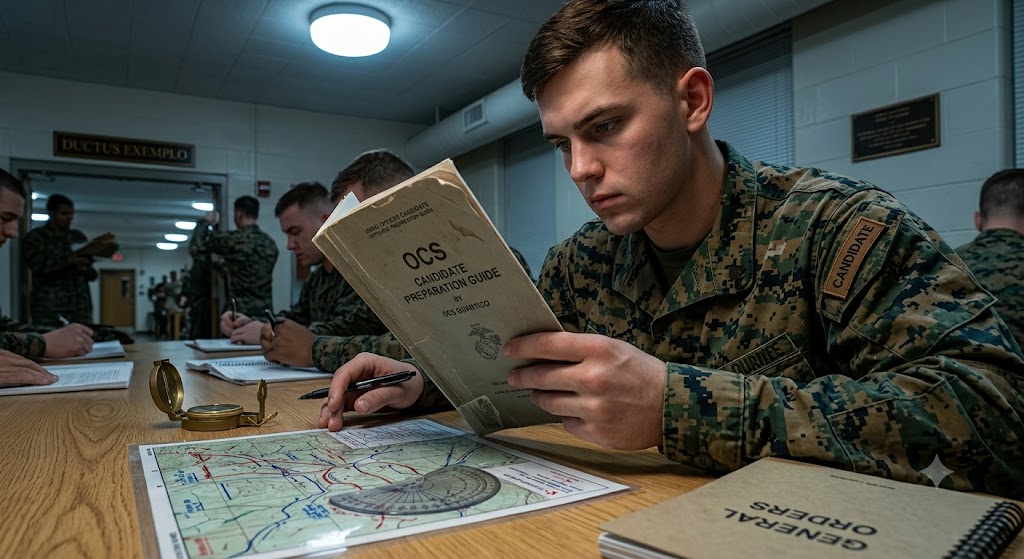
Additional Information
What the Course
Entails and Exam Details
This study guide and associated practice methods focus
purely on the academic pillar. To succeed at OCS, candidates must maintain a
minimum academic average of 80%. While the physical training is legendary, the
mental fortitude required for rapid learning and recall is equally demanding.
The academic portion of the OCS curriculum covers essential general military
subjects, which include:
- Marine
Corps History: Detailed timelines, battles, and key figures from 1775
to the present.
- Customs
and Courtesies: Saluting, military etiquette, and traditions of the
service.
- Close
Order Drill: Commands, movements, and formations of the Marine Corps.
- Interior
Guard: The PEP principle (Preserve Order, Enforce Regulation, Protect
Property) and the 11 General Orders.
- The
Uniform Code of Military Justice (UCMJ): Articles and legal procedures
relevant to non-judicial punishment and courts-martial.
- Small
Unit Tactics: Principles of offensive and defensive combat, fire team
formations, and movement to contact.
- Operation
Orders (OPORD): The five-paragraph format (Orientation, Situation,
Mission, Execution, Administration & Logistics, Command & Signal).
- Land
Navigation: Reading maps, identifying terrain features, and using a
compass (day and night).
- First
Aid: Basic lifesaving techniques and environmental injury prevention.
What to Expect in the Final Exam
While "the" final exam does not exist in the
traditional sense, OCS evaluates academic knowledge through multiple weekly
written exams and significant practical application evaluations.
The written assessments are closed-book and usually consist
of multiple choice, true/false, and short-answer questions. They are
timed and administered in a classroom setting, often after long days of
physically exhausting training.
Beyond written exams, candidates must demonstrate their
knowledge through performance-based examinations, including:
- Operation
Order (OPORD) Writing and Briefing: Candidates must write an OPORD
under pressure and effectively brief their small unit.
- Land
Navigation Courses: Successful completion of day and night compass
courses is a mandatory "must-pass" event.
- Close
Order Drill Evaluation: Demonstrating proficiency in both marching and
commanding a platoon.
- Tactics
Evaluation (SULE/LRC): Candidates must apply theoretical tactical
knowledge during field exercises like the Small Unit Leader Evaluation and
Leadership Reaction Course.
How to Study and Exam Centers
How to Study
Success in OCS knowledge requires a blend of rigorous
self-discipline and strategic study techniques. This is "rote memorization
under duress." Effective strategies include:
- Memorize
the "Required Knowledge" before arrival: Your Officer
Selection Officer (OSO) should provide you with a list of items to
memorize verbatim (11 General Orders, Marine Corps Birthday, OCS Motto).
Knowing this cold will alleviate stress.
- SQ3R
Method: Use the Survey, Question, Read, Recite, and Review method for
deep understanding, not just memorization. Turn learning objectives into
questions and try to answer them without looking.
- Flashcards
and Active Recall: Use physical flashcards or apps like Anki for
rapid-fire testing of definitions, historical dates, and OPORD paragraph
structures.
- Practice
Tactics through Drawing: Sketch out fire team formations and the steps
of an assault. This kinetic learning helps bridge theory and application.
- Study
Groups with Peers: OCS is built on teamwork. Review material with
fellow candidates, take turns giving commands, or practice briefing an
OPORD.
Exam Centers
It is important to understand that you cannot take a
official USMC OCS Knowledge Exam at a Pearson VUE center or through an online
portal before joining. All graded academic tests are taken in-person, at
Officer Candidates School in Quantico, Virginia, as a mandatory component
of your training cycle (PLC, OCC, or NROTC Marine Option "Bulldog").
Job Opportunities from the Course
Graduating OCS is the required step to receive a commission.
Upon commissioning as a Second Lieutenant, all new officers attend the
six-month The Basic School (TBS), also in Quantico, where they are assigned a
specific Military Occupational Specialty (MOS). OCS is the gateway to a career
rather than a direct qualification for a job title. Career paths for Marine
Corps Officers include, but are not limited to:
- Ground
Officer (Infantry, Artillery, Armor)
- Aviation
Officer (Pilot, Naval Flight Officer, Air Command & Control)
- Logistics
Officer
- Intelligence
Officer
- Communications
Officer
- Judge
Advocate (Law)
- Combat
Engineer Officer
- Cyber
Officer
- Public
Affairs Officer
Frequently Asked Questions
Reviews
5.0
Based on 0 reviews
Leave a Review
No reviews yet. Be the first to review!