
USMC PiCAT Practice Test
$69.00
- Buy to unlock unlimited access to all Quiz questions and Answers in this Quiz.
- After purchase you can print a PDF of the whole quiz at any point. The PDF will contain the questions and the correct answers.
About this Exam
The United States Marine Corps Pre-screening Internet-delivered Computerized Adaptive Test, widely known as the USMC PiCAT, is a critical initial assessment tool for prospective Marines. Designed to be taken in an unproctored environment before a candidate officially meets with a recruiter at a Military Entrance Processing Station (MEPS), the PiCAT provides an early indication of a recruit's potential scores on the full Armed Services Vocational Aptitude Battery (ASVAB). This comprehensive exam is meticulously crafted for individuals exploring a career in the Marine Corps, offering a low-stakes opportunity to gauge their aptitudes across various domains essential for military service and, consequently, to predict their potential Military Occupational Specialty (MOS) classifications.
Ready to test your knowledge?
Buy Now to Access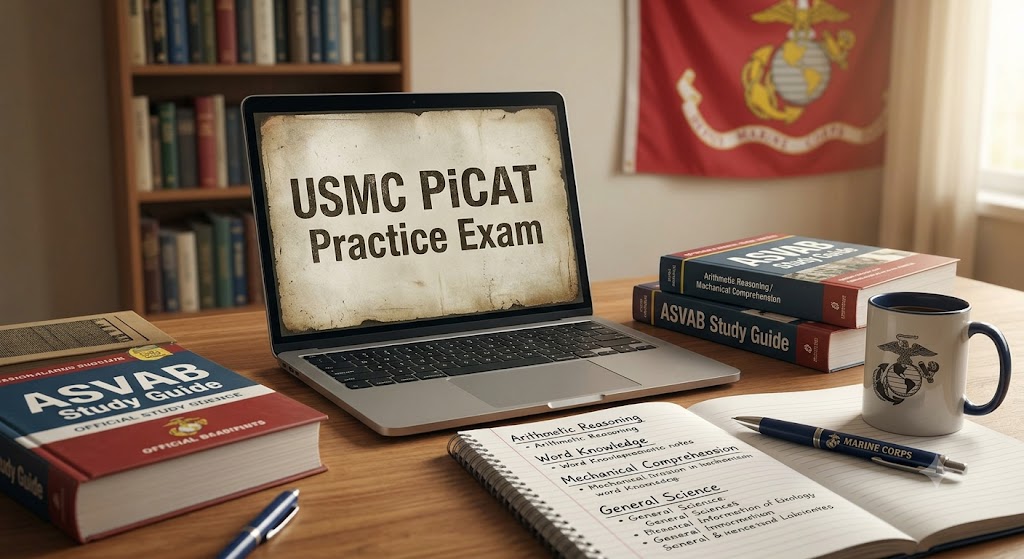
Additional Information
What the Course Entails and Exam Details
While not a conventional "course" with a fixed
syllabus, preparing for the USMC PiCAT entails thoroughly reviewing and
practicing the core knowledge areas and cognitive skills assessed by the ASVAB.
The PiCAT, and study materials associated with it, meticulously mirror the
structure and content of the standard computer-adaptive ASVAB (CAT-ASVAB). This
assessment is a computer-adaptive test, meaning the difficulty of subsequent
questions adjusts based on the examinee's performance on previous questions,
thereby providing a precise measurement of their abilities in a shorter format
than paper-and-pencil versions. The core domains covered include General
Science (GS), Arithmetic Reasoning (AR), Word Knowledge (WK), Paragraph
Comprehension (PC), Mathematics Knowledge (MK), Electronics Information (EI),
Auto and Shop Information (AS), Mechanical Comprehension (MC), and Assembling
Objects (AO). Four critical areas—Arithmetic Reasoning, Word Knowledge,
Paragraph Comprehension, and Mathematics Knowledge—combine to form the Armed
Forces Qualification Test (AFQT) score, which determines overall eligibility
for enlistment into the Marine Corps.
What to Expect in the Final Exam
When candidates take the USMC PiCAT, they can expect a
comprehensive, computer-based assessment that evaluates their skills across all
nine standard ASVAB subtests. Unlike the official ASVAB taken at MEPS, the
PiCAT is an unproctored test, typically administered via a specific access code
provided by a Marine Recruiter. Examinees should approach it with the same
diligence as the final exam, although it is intended as a predictive measure.
While there is no definitive "passing" score for the PiCAT itself, the
resulting scores across individual subtests and the computed AFQT score are
utilized by recruiters to determine a candidate's preliminary eligibility for
specific career paths (MOS) within the Marine Corps. It is important to note
that PiCAT scores are not considered official; candidates who achieve
qualifying scores on the PiCAT are generally required to take a shortened,
proctored confirmation test at a MEPS or other authorized testing facility to
validate their results before processing for enlistment. The entire PiCAT
experience, including all subtests, typically mirrors the time commitment of a
full CAT-ASVAB session, requiring focused attention and strategic time
management.
How to Study and
Exam Centers
Effective preparation for the USMC PiCAT centers on
utilizing robust study materials designed for the ASVAB, as the exam content is
identical. Candidates are encouraged to engage in structured practice, focusing
heavily on improving their skills in the core AFQT areas (math and verbal
reasoning) to ensure overall enlistment eligibility, while also dedicating time
to specialized technical and mechanics sections relevant to their desired MOS.
Utilizing reputable online practice tests, official ASVAB study guides, and
educational resources covering the assessed domains is crucial. Strategic
studying involves taking timed practice tests to simulate the exam environment
and identify areas requiring further improvement. The PiCAT itself is commonly
administered online, allowing candidates the flexibility to take the test from
any location with internet access, provided they have the access code from
their recruiter. Following the PiCAT, the mandatory, proctored confirmation
test is taken at a Military Entrance Processing Station (MEPS) or a Mobile
Processing Site (MPS), where official ASVAB testing also occurs.
Job Opportunities
from the Course
Achieving strong scores on the USMC PiCAT (and subsequent
confirmation test or full ASVAB) significantly expands a recruit's
opportunities within the Marine Corps. High scores across varied subtests
unlock access to a diverse array of Military Occupational Specialties (MOS) and
specialized career paths. Specific examples of job titles and career paths
available include Marine Infantryman, Intelligence Specialist, Cryptologic
Linguist, Avionics Technician, Computer Systems Specialist, Military Police Officer,
Combat Engineer, Aviation Mechanic, Logistics Specialist, Administrative
Specialist, and Motor Vehicle Operator. A high AFQT score not only ensures
enlistment eligibility but also positions candidates for competitive roles,
specialized training programs, and enhanced career progression opportunities
throughout their time in the United States Marie Cor
Frequently Asked Questions
Reviews
5.0
Based on 0 reviews
Leave a Review
No reviews yet. Be the first to review!