
USMC Supply Admin Requisition Management (DASF) Practice Test
$69.00
- Buy to unlock unlimited access to all Quiz questions and Answers in this Quiz.
- After purchase you can print a PDF of the whole quiz at any point. The PDF will contain the questions and the correct answers.
About this Exam
The USMC Supply Admin Requisition Management (DASF) Practice Test is a crucial diagnostic tool designed for Marines who have completed or are currently enrolled in formalized Supply Administration training. Specifically tailored for Marines in the 3043 Military Occupational Specialty (MOS), also known as Supply Administration and Operations Specialists, this exam validates their technical proficiency in managing the full lifecycle of supply requisitions. It is an essential stepping stone for entry-level Marines graduating from school and for seasoned personnel preparing for proficiency/advancement exams or supervisory roles (Supply Chiefs and Officers) where they must oversee automated supply operations. This comprehensive practice exam simulates the official Marine Corps testing environment, ensuring you can confidently handle automated supply data and logistical procedures.
Ready to test your knowledge?
Buy Now to Access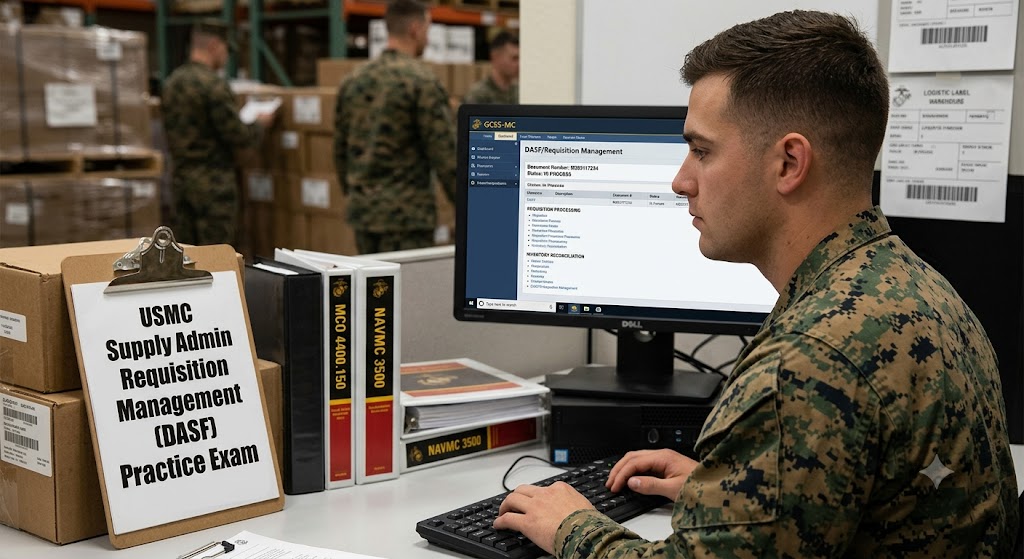
Additional Information
What the Course
Entails and Exam Details
This examination is not just a test of memorization; it
requires a practical understanding of supply chain logic within a military
framework. The associated training curriculum covers a broad array of critical
functions, all of which are reflected in the practice exam’s structure. To
succeed, you must demonstrate a deep knowledge of the official Marine Corps
system of record, currently the Global Combat Support System–Marine Corps
(GCSS-MC), which incorporates the legacy automated requisition management
logic.
Core Syllabus Areas:
- Requisition
Processing Lifecycle: Understanding the phases of a supply request,
from initial generation and authorization to submission, status tracking,
and final receipt.
- The
Automated Requisition System (DASF): Comprehensive knowledge of
inputting data, interpreting output codes (such as MILSTRIP/MILSTRAP),
managing document numbers, and resolving system discrepancies.
- Inventory
Control and Accountability: Procedures for maintaining accurate
records of unit property (T/E equipment, consumption items), processing
gains and losses, and conducting reconciliations.
- Financial
Management (Status of Funds): Monitoring unit budgets, understanding
commitment and obligation, and generating reports to advise commanding
officers of remaining fiscal capacity.
- Supply
Classes and Priorities: Differentiating between the ten classes of
military supply (e.g., Class I, II, IX) and applying the proper issue
priority designators to meet operational requirements.
- Audit
Readiness and Inspections: Navigating records to ensure compliance
with official Marine Corps Orders (MCOs), technical manuals, and command
inspections.
What to Expect in the Final Exam
While the exact number of questions can vary slightly by
training cycle, the official exam for this course is a standardized, digital
assessment designed to replicate a high-pressure, proficiency-driven
environment.
Exam Format:
- Format:
The test is composed of multiple-choice questions. It includes both
knowledge-based queries and complex scenario-based problems requiring you
to "solve" a requisition issue using simulated system data or
reference tables.
- Delivery:
It is administered via a secure military training platform (like MCTIMS)
or within the controlled environment of a Marine Corps schoolhouse
(MCCSSS).
- Passing
Score: The required passing score is typically 80%. This high
benchmark reflects the critical nature of material accountability in the
operating forces.
- Time
Limit: You will be allocated a specific time frame, typically 60 to
90 minutes, to complete the exam. Time management is a key skill
tested, especially when navigating simulated data screens or large
official references.
- Rules:
The exam is strictly closed-book. You are authorized to use blank scratch
paper. Access to any non-authorized digital or physical references will
result in immediate disqualification.
How to Study and
Exam Centers
Preparation for the DASF Requisition Management Practice
Test requires more than just reading the material. You must adopt a
"train-the-trainer" mindset to master the practical application of
supply logic.
Study Strategies:
- Master
the System Interface: If possible, spend time in a "sandbox"
or training environment for GCSS-MC. Familiarize yourself with the
requisition management workflows, specifically how to access and modify
document records. Understanding the visual flow of the automated
system is invaluable.
- Utilize
End-of-Lesson Checks: The official curriculum is broken into distinct
lessons. Treat every check on learning or review section as a mini-exam.
Do not move on until you achieve 100% on that lesson's check.
- Focus
on Source Reference Material: The core of the exam is derived from
official publications. Review MCWP 4-11.7 (MAGTF Supply Operations),
applicable MCOs regarding supply accountability, and technical
manuals (TMs) for system logic codes. Understand why the system
handles a request in a specific way.
- Create
Scenarios: Practice with mock requisition scenarios. Generate a mock
item request, assign it a document number, apply logical supply codes
(fund codes, priority), and track its simulated status through the supply
pipeline.
- Take
the Practice Test Mutiple Times: Use this practice exam as a
benchmarking tool. Take it early in your study process to identify your
weak points (e.g., system logic vs. policy knowledge). Review your
incorrect answers and retake the test until you can achieve a perfect
score within the time limit.
Exam Center Locations:
This proficiency examination is not taken at civilian sites
like Pearson VUE. It is administered through official military channels:
- MOS
Schoolhouses: Primarily the Marine Corps Combat Service Support
Schools (MCCSSS) located at Camp Johnson/Camp Lejeune, NC, for
entry-level trainees.
- MCTIMS
Portal: Advanced and proficiency training exams can often be scheduled
by unit training chiefs (S-3) and taken via secure computers accessing the
Marine Corps Training and Information Management System (MCTIMS) at
any authorized military installation or training node globally.
Job Opportunities
from the Course
A high level of proficiency in automated supply
administration, validated by successful completion of this exam and course,
unlocks crucial career paths both within the Marine Corps and in the
specialized civilian defense sector.
Internal USMC Career Progression:
- Supply
Administration Specialist (MOS 3043): This exam is a formal
requirement for this core role.
- Supply
Chief (MOS 3043): Proficiency in DASF/GCSS-MC logic is essential for
senior enlisted leaders managing the supply office of a large command.
- Logistics
Officer (MOS 0402): A strong background in administrative supply
systems is highly advantageous for commissioned officers seeking to
oversee complex logistical operations.
External and Civilian Sector Opportunities:
- Federal
Government: Logistics Management Specialist (GS-0346): Direct
government roles managing Department of Defense supply chain systems.
- Defense
Contractor: Senior Supply Chain Analyst: Analyzing material readiness
for defense companies using government supply data.
- Defense
Contractor: Military Logistics Instructor: Teaching the same automated
system logic to new generations of personnel.
- Logistics
Operations Manager: Managing complex inventory and distribution
networks for corporate entities.
Error!
Filename not specified.
Frequently Asked Questions
Reviews
5.0
Based on 0 reviews
Leave a Review
No reviews yet. Be the first to review!