
USN Airman NAVEDTRA Practice Test
$69.00
- Buy to unlock unlimited access to all Quiz questions and Answers in this Quiz.
- After purchase you can print a PDF of the whole quiz at any point. The PDF will contain the questions and the correct answers.
About this Exam
The USN Airman NAVEDTRA Practice Test is a vital stepping stone for enlisted personnel in the United States Navy who have entered the Airman Professional Apprenticeship Career Track (PACT). This undesignated path is designed for Sailors (paygrades E-1 to E-3) who are working towards a specific aviation rating (specialty) but have not yet 'struck' for one. This exam, based on NAVEDTRA manuals such as NAVEDTRA 14014, assesses a Sailor's general knowledge of Naval aviation fundamentals, safety procedures, and organizational structures. It is primarily for those seeking qualification to apply for a specialized 'striker' rating or as part of the initial advancement process to become a designated Airman. Successful completion demonstrates the foundational knowledge necessary to transition into on-the-job training and specialized Class "A" Schools.
Ready to test your knowledge?
Buy Now to Access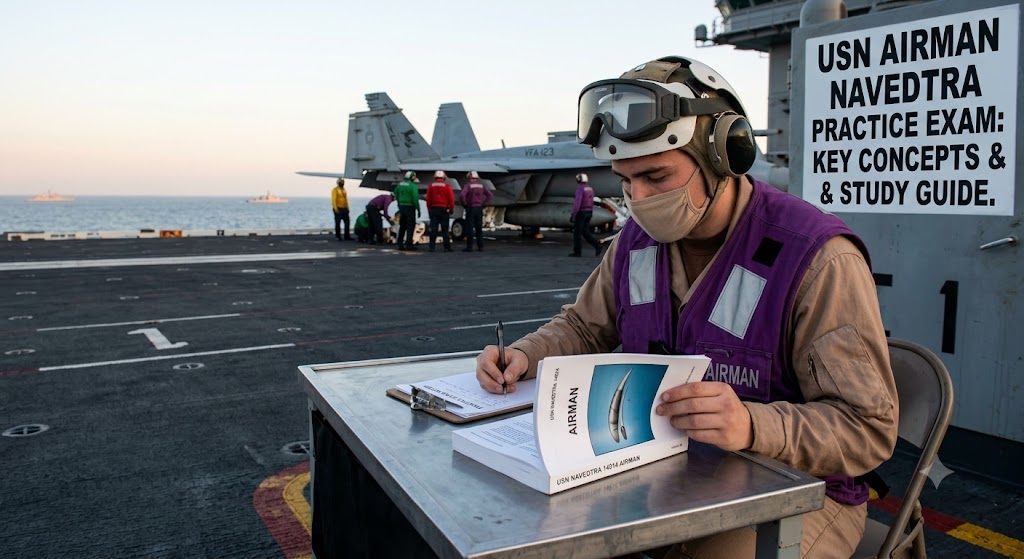
Additional Information
What the Course Entails and Exam Details
The material covered in the Airman NAVEDTRA training and
exam is comprehensive, focusing on the core principles required to safely and
effectively work within a Naval aviation environment. The course typically
covers the following key areas:
- Naval
Aviation History and Organization: Understanding the structure of
Naval aviation, the chain of command, and the roles of major commands
(e.g., NETC, CNATRA).
- Aerodynamics
and Principles of Flight: Basic physics of flight, including Newton's
laws, Bernoulli's principle, airfoils, and the four forces (lift, weight,
thrust, drag).
- Aircraft
and Engine Fundamentals: General knowledge of fixed-wing, rotary-wing,
and unmanned aircraft, as well as jet and turboprop engines.
- Safety
and Regulations: Rigorous focus on Personal Qualification Standards
(PQS), Naval Aviation Maintenance Program (NAMP), hearing conservation,
and hazmat procedures.
- Aviation
Tools and Equipment: Familiarization with standard aviation tools,
ground support equipment (GSE), and maintenance practices.
- Flight
Deck and Airfield Operations: Understanding safety protocols on active
flight decks and airfields, aircraft handling, and communication signals.
- Basic
Damage Control and Firefighting: Core training for all Sailors, but
applied to the aviation context.
What to Expect in
the Final Exam
While the exact format of a specific practice or
qualification exam can vary by command, most USN NAVEDTRA Airman-related exams
follow a standardized, multiple-choice format. This allows for objective
assessment across a large body of material. The official exam is usually
administered digitally via a command's Educational Services Officer (ESO) or at
a designated testing facility on a military base. To be considered qualified,
Sailors must achieve a passing score, which is typically around 75-80%,
reflecting a strong command of the material. There are time limits, often
between 1 to 2 hours, to simulate the conditions of an actual
advancement or striker exam. Specific rules include standard military integrity
protocols; no unauthorized study materials or electronic devices are allowed,
and test-takers must present valid military identification. Only the final
score is generally provided, rather than a detailed, question-by-question
breakdown.
How to Study and Exam Centers
Preparation for the NAVEDTRA Airman exam must be structured
and diligent. The best approach combines self-study of the primary manuals with
command-led training and practical application. Actionable strategies include:
- Study
the Primary Manual: Your single most important resource is NAVEDTRA
14014, Airman. Download a copy from the Navy Advancement Center (NAC)
or the MyNavyHR website. Create an active outline and summary notes.
- Utilize
Official PQS and Rate Training Manuals: In addition to the main
manual, review the Airman Professional Qualification Standard (PQS).
This document explicitly lists what you are expected to know and
demonstrate.
- Leverage
Online Practice Tools: Use official Navy COOL (Credentialing
Opportunities On-Line) and specific command-provided practice question
banks to simulate the exam. Mometrix or similar civilian platforms can
also be useful, but verify they align with the current USN standards.
- Engage
in On-the-Job Training (OJT): As a PACT Sailor, you are likely already
working in a general aviation environment. Relate everything you study
back to the aircraft, tools, and processes you see daily.
- Form
or Join Study Groups: Collaborate with fellow Airmen within your
command. Discussing concepts like aerodynamics or flight deck safety helps
solidify knowledge.
- Practice
with Time Constraints: Take practice quizzes under timed conditions to
get a feel for the pacing you will need.
Testing Centers: Official exams are administered
internally by your command. You must request a testing slot via your chain of
command or Educational Services Officer (ESO). They will coordinate the
testing, which may be on a physical computer station or, occasionally, paper-based,
depending on the command's resources.
Job Opportunities
from the Course
Successfully completing the Airman NAVEDTRA qualification
process is the critical gateway for a PACT Sailor to receive a specific rating
('strike'). This designation unlocks specialized training (Class "A"
Schools) and a clearly defined career path with increased responsibility and
pay. The potential career paths (Ratings) that this certification unlocks
include:
- Aviation
Machinist’s Mate (AD): Aircraft engine maintenance and repair.
- Aviation
Electrician’s Mate (AE): Aircraft electrical and power systems
maintenance.
- Aviation
Electronics Technician (AT): Aircraft communication, navigation, and
weapons electronics (avionics).
- Aviation
Structural Mechanic (AM): Aircraft airframes, hydraulics, and
structural repair.
- Aviation
Structural Mechanic - Safety Equipment (AME): Aviation life support,
oxygen, and ejection systems.
- Aviation
Ordnanceman (AO): Handling, loading, and maintenance of aviation
weapons and ammunition.
- Air
Traffic Controller (AC): Managing safe movement of Navy aircraft at
bases and on carriers.
- Naval
Aircrewman (AW): Serving as non-pilot flight crew (mechanics,
operators, rescue swimmers) on a wide range of aircraft.
- Aviation
Maintenance Administrationman (AZ): Managing clerical and
administrative duties related to aircraft maintenance.
- Aviation
Boatswain’s Mate (AB): Overseeing flight deck and airfield operations,
divided into distinct specialties: Handling (ABH), Fuel (ABF), and Launch
and Recovery Equipment (ABE).
Frequently Asked Questions
Reviews
5.0
Based on 0 reviews
Leave a Review
No reviews yet. Be the first to review!