
USN Inside Tender Practice
$69.00
- Buy to unlock unlimited access to all Quiz questions and Answers in this Quiz.
- After purchase you can print a PDF of the whole quiz at any point. The PDF will contain the questions and the correct answers.
About this Exam
The United States Navy Inside Tender is a critical specialized qualification within the Navy Diver (ND) rating. Inside Tenders (formally known as Recompression Chamber Inner Lock Tenders) are highly trained Navy Divers who work within a multi-place recompression chamber to support the treatment of diving related illnesses, such as decompression sickness (the bends), arterial gas embolism, and other hyperbaric conditions. This practice exam is specifically designed for Navy Divers, Diver candidates, and personnel within the US Navy diving community who are preparing for the rigorous practical and written evaluations required to earn this vital certification. It provides a targeted resource to build and assess the technical knowledge necessary to operate safely and effectively in a high-pressure, medical-support environment.
Ready to test your knowledge?
Buy Now to Access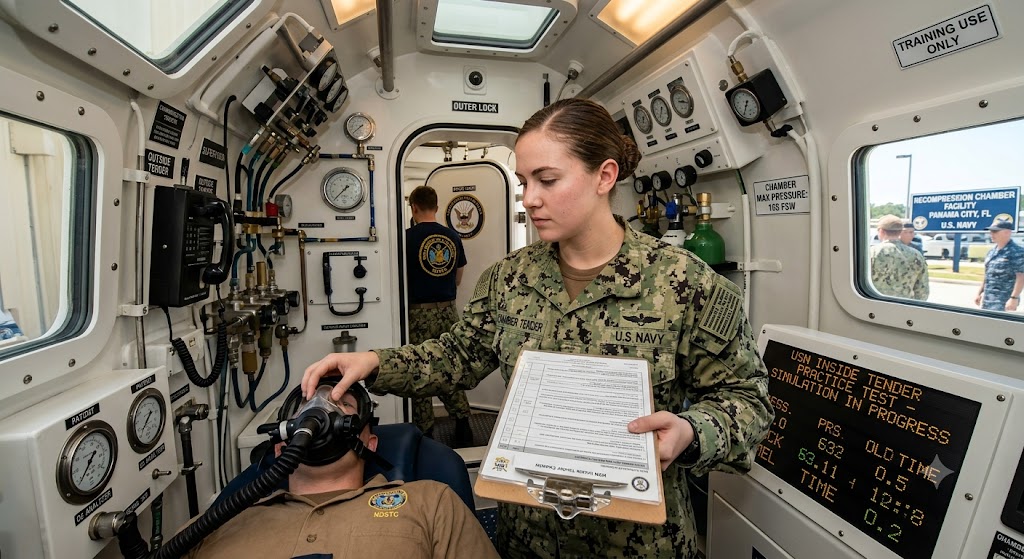
Additional Information
What the Course Entails and Exam Details
Earning the USN Inside Tender qualification is not a single
"course" but a crucial milestone achieved through extensive, hands-on
training and evaluation, typically conducted at the Naval Diving and Salvage
Training Center (NDSTC) in Panama City, Florida, or at an authorized EOD/Diver
training command. The [USN Inside Tender Practice Test] focuses on the academic
and procedures-based knowledge that is evaluated during this process. The
knowledge and skills required for this qualification are based directly on the U.S.
Navy Diving Manual (SS521-AG-PRO-010), particularly Volume 5, which covers
"Diving Medicine and Recompression Chamber Operations." The primary
objective is to develop competence in supporting hyperbaric treatment. Key
areas of study include:
- Chamber
Operations: Detailed procedures for the safe operation of multi-place
recompression chambers, including normal operations, emergency procedures,
mixed-gas operations, and environmental control systems.
- Hyperbaric
Medicine: A functional understanding of the pathophysiology of diving
maladies like Decompression Sickness (DCS Type I and II) and Arterial Gas
Embolism (AGE).
- USN
Recompression Treatment Tables: Mastery of the application and
management of U.S. Navy Treatment Tables (e.g., Table 5, Table 6, Table
6A, Table 4, Table 7, and the use of mixed gases like 50/50 and 100%
Oxygen).
- Diver
Monitoring and Care: Techniques for observing and assessing a
patient's neurological status, managing vital signs, and performing
specific medical interventions under the guidance of a Diving Medical
Officer (DMO) or Chamber Supervisor.
- Mixed-Gas
and Breathing Systems: Safe handling and monitoring of oxygen and
other treatment gases, including BIBS (Built-In Breathing Systems).
- Emergency
Procedures: Rapid and accurate responses to chamber emergencies,
including oxygen toxicity, chamber fires, loss of gas, and dynamic
pressure changes.
What to Expect in the Final Exam
While the [USN Inside Tender Practice Test] is a written
simulation, the actual Navy qualification process is split into rigorous written
examinations and comprehensive practical scenario-based evaluations.
The Final Written Exam (which the practice test
simulates):
The official written qualification exam is a closed-book
test administered by Navy instructors. It is a time-limited assessment
containing approximately 50 to 100 questions. The format consists primarily of
multi-part multiple-choice and short-answer questions. The exam is designed to
test your precision, requiring a minimum passing score of 80%. It is
heavy on calculations, requiring you to determine treatment depths, select
appropriate treatment tables, and calculate gas requirements and mission
timelines, all while using the U.S. Navy Diving Manual.
The Final Practical Evaluation:
The core of the Inside Tender qualification is the practical
simulation. Following your written success, you will be evaluated inside an
actual recompression chamber during a series of dynamic, graded scenarios
(drills). A Command-appointed Chamber Supervisor and a DMO will observe and
grade your ability to manage a "patient" (often another qualified
diver or a sophisticated manikin) during simulated treatments. You must
correctly execute all check-offs and maintain flawless communication. Failure
to respond to an "emergency" or a major safety violation in the
practical phase results in an automatic failure and a requirement to re-train.
How to Study and
Exam Centers
Preparation must be comprehensive, leveraging both
intellectual study and simulated practice.
- The
USN Diving Manual is Your Bible: The primary study text is the U.S.
Navy Diving Manual. You must study Volume 5 inside and out. Pay special
attention to Chapter 20 (Diagnosis and Treatment of Diving-Related
Injuries) and Chapter 21 (Recompression Chamber Operations).
- Memorize
and Practice Tables: You must be able to reproduce USN Decompression
and Treatment Tables from memory. Practice choosing the correct table
given a scenario and performing all time/depth calculations.
- Simulation
is Key: The [USN Inside Tender Practice Test] is an excellent tool for
simulating the pressure and type of questions in the written exam. Use it
repeatedly to build speed and accuracy in calculations.
- Drill,
Drill, Drill: Work with your command's diving team. Practice being the
Inside Tender during scheduled chamber drills and dives. Treat every drill
like a real evaluation. Practice neurological exams on your teammates.
- Peer
Review: Study in groups. Quiz each other on medical terms, symptoms,
and treatment protocols. Cross-train with individuals who are already
qualified supervisors.
Official Exam Centers:
The official testing for this qualification occurs
exclusively within authorized U.S. Navy commands and training facilities. The
initial, primary qualification path is often integrated into Navy Diver
"A" and "C" schools at the Naval Diving and Salvage
Training Center (NDSTC), Panama City, FL. For already qualified Navy
Divers, subsequent "requalification" or specialized chamber-specific
training can be conducted and evaluated at their assigned commands, provided
they have a certified recompression chamber and a qualified supervisor, and the
evaluation is approved by the Command Diving Officer.
Job Opportunities from the Course
The USN Inside Tender qualification is a foundational and
mandatory skill for specific critical roles within Navy Diving, and it provides
significant leverage for post-military careers.
Inside the U.S. Navy, this qualification unlocks and
supports assignments including:
- Navy
Diver (ND Rating)
- Recompression
Chamber Supervisor
- Saturation
Diver (SAT Diver)
- Diving
Medical Technician (DMT)
- Explosive
Ordnance Disposal (EOD) Diver
- Submarine
Rescue Chamber (SRC) Operator
Outside the military, the experience and expertise gained
are highly sought after in several technical and medical fields:
- Commercial
Diving (Life Support Technician / Chamber Operator)
- Civilian
Hyperbaric Medical Technician (CHT)
- Hyperbaric
Chamber Technician for Medical Facilities
- Diving
Safety Officer / Hyperbaric Safety Coordinator
- Clinical
Hyperbaric Oxygen Therapy (HBOT) Practitioner
- Saturation
Diving Life Support Supervisor
By utilizing this study guide and the [USN Inside Tender
Practice Test], you are taking a crucial step towards mastering this demanding
and essential Navy Diver skill. Stay focused, practice precision, and
prioritize safety in every repetition.
Frequently Asked Questions
Reviews
5.0
Based on 0 reviews
Leave a Review
No reviews yet. Be the first to review!