
USNSCC Petty Officer 1st Class (PO1) Practice Test
$69.00
- Buy to unlock unlimited access to all Quiz questions and Answers in this Quiz.
- After purchase you can print a PDF of the whole quiz at any point. The PDF will contain the questions and the correct answers.
About this Exam
The U.S. Naval Sea Cadet Corps (USNSCC) Petty Officer First Class (PO1) practice test is a critical milestone for dedicated Sea Cadets aiming to achieve the prestigious rank of E-6. This comprehensive study guide is designed for high-performing cadets who have already completed the Petty Officer Leadership Academy (POLA) and the requisite time-in-grade as a PO2. The PO1 rank is a testament to exceptional leadership, advanced technical proficiency, and a commitment to mentorship within the corps. Successfully passing the associated correspondence courses and the final exam demonstrates a cadet's readiness for the significant responsibilities and authority that accompany this senior enlisted rate, mirroring the Navy's own enlisted rate structure and leadership expectations.
Ready to test your knowledge?
Buy Now to Access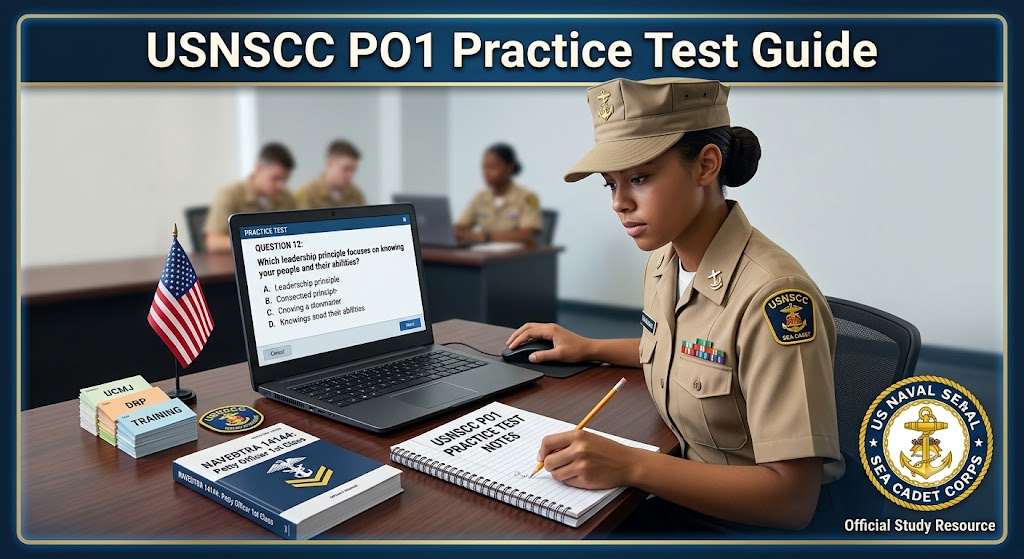
Additional Information
What the Course Entails and Exam Details
To prepare for the PO1 exam, cadets must first complete the
mandatory USNSCC PO1 Correspondence Course (often referenced as a specific
NAVEDTRA manual, such as NAVEDTRA 14144). This coursework goes beyond the
basics of seamanship and military requirements, focusing heavily on leadership,
advanced management, and practical application.
Core topics covered in the PO1 syllabus and subsequent exam
include:
- Advanced
Naval Leadership: Leading and mentoring subordinate Petty Officers
(PO2, PO3) and junior cadets; resolving conflict; counseling techniques;
and strategic planning.
- Division
and Unit Management: Overseeing division operations, organizing watch
teams, and managing administrative tasks (records, reports, advancement
procedures).
- Instruction
and Training: Conducting effective training, developing lesson plans,
and evaluating performance.
- Naval
Traditions, Customs, and Heritage: Deepened knowledge of naval
history, ceremonies, and the significance of traditions.
- Military
Requirements and Regulations: Upholding and enforcing advanced
standards of conduct, uniform regulations, and safety.
- Damage
Control and Shipboard Operations: Increased knowledge of emergency
procedures and vessel systems.
The associated correspondence course consists of multiple
assignments (usually assignments 6 through 8, following the PO3/PO2 series).
Cadets must achieve an aggregate score of at least 70% to pass the course. Once
completed, they are eligible to take the proctored PO1 exam.
What to Expect in the Final Exam
The USNSCC Petty Officer 1st Class Final Exam is a
culmination of the knowledge acquired throughout the cadet's career,
specifically from the PO1 correspondence course and advanced training. It is a
closed-book, proctored examination.
The final exam details include:
- Format:
The exam typically consists of multiple-choice questions designed to
assess comprehension and application of the PO1 curriculum.
- Question
Count: Although specific counts can vary by version, the standard PO1
exam generally includes approximately 100 to 125 questions. (Some specific
unit-level descriptions might state 50 questions, so it's critical to
confirm with your Unit Commanding Officer or Training Officer).
- Passing
Score: The USNSCC maintains a high standard, requiring a minimum
passing score of 70%.
- Time
Limit: Cadets are typically allocated three hours to complete
the exam.
- Proctoring:
The exam must be administered in a controlled environment by an authorized
adult, usually the unit's Training Officer or Commanding Officer, to
ensure academic integrity.
- Retake
Policy: If a cadet does not achieve a passing score, they must wait a
mandatory period, often two weeks, before being eligible for a retake.
How to Study and
Exam Centers
Effective preparation is key to success on the PO1 exam.
This is a rigorous test that requires a proactive and strategic approach.
Actionable study strategies include:
- In-Depth
Manual Review: The NAVEDTRA PO1 Correspondence Course manual is your
primary resource. Go beyond just looking for answers to assignments. Read
every chapter with the goal of mastery.
- Active
Recall and Spaced Repetition: Convert key concepts, definitions, and
regulations into flashcards (digital or physical). Test yourself regularly
to lock the information into your long-term memory.
- Practice
Questions: Seek out practice tests or sample questions specific to the
USNSCC PO1 or Navy PO1 exam. While not identical, they provide insight
into the types of scenarios and question styles you will face.
- Create
Your Own Scenarios: For leadership and management sections, invent
scenarios and practice applying the PO1 principles to solve them. This
transitions your knowledge from passive understanding to active
application.
- Teach
Others: Explaining the material to a junior cadet or fellow PO2 is one
of the best ways to solidify your own understanding.
- Group
Study: Collaborate with other cadets preparing for the exam. This
allows for diverse perspectives and the opportunity to clarify difficult
concepts.
Exam Centers: The PO1 exam is administered locally
through your USNSCC unit. It is not taken at commercial testing centers like
Pearson VUE. The exams are available to your Unit Commanding Officer (CO) or
Training Officer via the internal USNSCC Online Testing System (NOTS). Once you
have met all prerequisites, your command will schedule a time for you to take
the proctored exam at your designated training site.
Job Opportunities
from the Course
Earning the rank of USNSCC Petty Officer 1st Class is a
distinguished accomplishment that opens a clear path to advanced leadership
roles within the Sea Cadet Corps and provides quantifiable advantages for
future military and civilian careers.
The specific job titles and career opportunities unlocked
include:
- USNSCC
Unit Positions: Leading Petty Officer (LPO) of a division, or a major
departmental lead (e.g., Training LPO, Operations LPO, or Admin LPO).
- USNSCC
Advanced Training Leadership: Selected as a "Staff Cadet" at
major training events like Recruit Training (RT) or advanced academies,
overseeing large groups of junior cadets and managing complex evolutions.
- Advancement
to Chief Petty Officer (CPO): Completion of PO1 and the associated
exam is the final, essential step before becoming eligible for advancement
to Chief Petty Officer (E-7), the highest enlisted rank in the corps.
- Future
Military Career Benefits: For cadets who choose to enlist, the PO1
rank provides a competitive edge for advanced paygrade programs. The US
Navy, for example, often advances former senior Sea Cadets to E-3 (Seaman)
immediately upon completion of boot camp, resulting in higher starting pay
and greater responsibility. It also makes candidates significantly more
competitive for service academy appointments and ROTC scholarships.
- Civilian
and Educational Opportunities: The leadership, discipline, and
administrative experience gained are highly transferable. This rank serves
as a powerful addition to a college application or a resume for
early-career management, technical, or public service positions.
Good luck, Petty Officer! Your dedication to advanced
learning and leadership is a model for all Sea Cadets.
Frequently Asked Questions
Reviews
5.0
Based on 0 reviews
Leave a Review
No reviews yet. Be the first to review!