
USNSCC Petty Officer Second Class (PO2) Practice Exam
$69.00
- Buy to unlock unlimited access to all Quiz questions and Answers in this Quiz.
- After purchase you can print a PDF of the whole quiz at any point. The PDF will contain the questions and the correct answers.
About this Exam
The United States Naval Sea Cadet Corps (USNSCC) is a prestigious youth leadership program that mirrors the structure and values of the U.S. Navy.
The USNSCC PO2 Practice Exam is a crucial tool designed to help motivated cadets prepare for the official advancement exam. It assesses a candidate's mastery of essential leadership principles, military knowledge, and the core skills required to excel at this level. If you are a current Petty Officer Third Class aspiring to advance and broaden your impact within your squadron or division, this study guide and practice exam are your key to success.
Ready to test your knowledge?
Buy Now to Access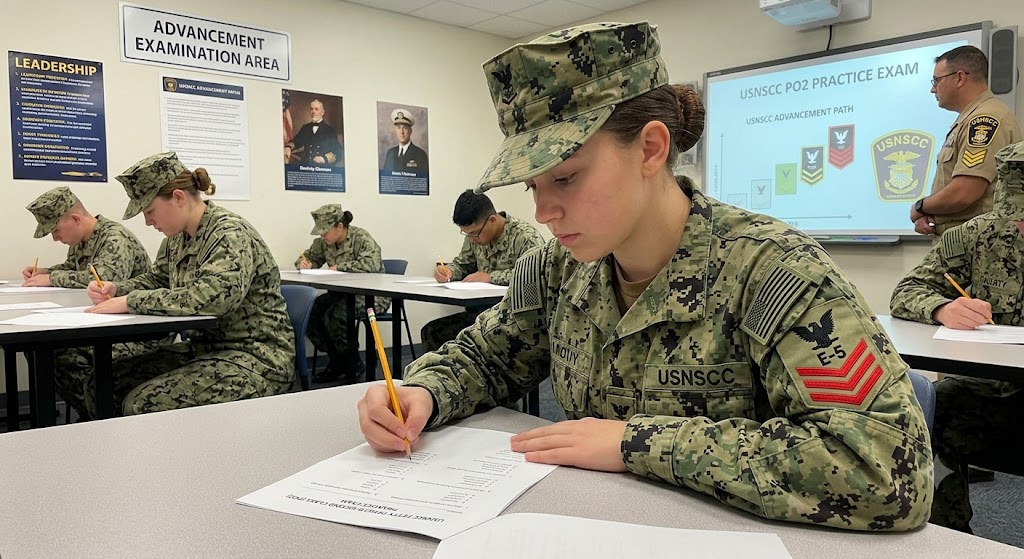
Additional Information
What the Course Entails and Exam Details
To be eligible for the official PO2 exam and subsequent
promotion, cadets must successfully complete a prescribed curriculum. This
typically involves the completion of the Naval Education and Training Command
(NAVEDTRA) correspondence courses, specifically the assignments for
"Military Requirements for Petty Officer Third and Second Class."
The core topics covered in this comprehensive course and
assessed in the PO2 exam include:
- Advanced
Leadership Theory: Understanding the fundamentals of authority,
responsibility, accountability, and ethical decision-making.
- Naval
Regulations and UCMJ: In-depth knowledge of the Uniform Code of
Military Justice, the Standard Organization and Regulations of the Navy
(SORN), and the specific authorities vested in petty officers.
- Unit
Administration and Training: Learning how to manage training
schedules, perform administrative tasks, and supervise junior personnel in
daily tasks and drill.
Grokipedia
- Conflict
Resolution and Counseling: Practical skills for identifying,
addressing, and resolving interpersonal conflicts and providing
constructive feedback and counseling.
R. D. STETHEM SEA CADETS
- Watchstanding
and Security: Understanding the duties, procedures, and
responsibilities of the Petty Officer of the Watch (POOW) and other
critical watch positions.
- Uniform
and Grooming Standards: Mastering the specific regulations for all
USNSCC and Navy-authorized uniforms.
The USNSCC PO2 examination is a comprehensive test designed
to verify this knowledge base.
What to Expect in
the Final Exam
The official USNSCC Petty Officer Second Class advancement
exam is a standardized test, usually administered within your home unit. While
specific formats can vary slightly by unit command, here is what you can
typically expect:
- Format:
The exam predominantly consists of multiple-choice and true/false
questions. These questions are drawn directly from the NAVEDTRA
correspondence course materials and official USNSCC manuals.
- Question
Count: A typical PO2 exam ranges from 50 to 100 questions.
- Passing
Score: To pass, cadets must achieve a minimum score, often a standard
60% or 70%. Your unit's specific requirements will be clearly stated.
USNSCC | Columbus Squadron
- Time
Limit: There is usually a set time limit, typically 60 to 90 minutes,
depending on the number of questions.
- Administration:
The exam is administered under closed-book, proctored conditions by a
designated USNSCC Officer, ensuring a fair and rigorous testing
environment.
It is important to remember that the written exam is just
one component of the advancement process; physical fitness tests and command
recommendations also apply.
How to Study and Exam Centers
Successful preparation for the PO2 exam requires a
structured and diligent study plan. Here are actionable strategies to ensure
your success:
- Deep
Dive into the NAVEDTRA Courses: This is your primary source. Do not
just complete the assignments to tick a box; truly understand the
"why" behind the rules. Take detailed notes, highlight key
concepts, and use the review questions at the end of each chapter.
- Use
Practice Exams: Take advantage of practice exams, like the one
associated with this title. These are excellent for diagnostic purposes,
helping you identify weak areas so you can focus your efforts. Treat them
as a real test: time yourself and do not look at materials.
- Leverage
Official Manuals: Regularly consult the USNSCC Cadet Advancement and
Training Manual, the USNSCC Administration Manual, and the U.S. Navy
Uniform Regulations. These are the governing documents you are expected to
know.
- Form
Study Groups: Collaborating with fellow PO3s can provide different
perspectives and help explain complex concepts. Quiz each other regularly.
- Practical
Application: The best way to learn leadership is to lead. Volunteer
for leadership roles in your unit, practice giving commands, and seek
opportunities to supervise.
Exam Centers: Unlike civilian certification exams,
USNSCC advancement exams are not taken at external, commercial testing centers
like Pearson VUE. They are administered internally within your authorized
USNSCC unit (squadron, division, or battalion), under the supervision of your
Commanding Officer and training staff. Coordinate with your Unit Training
Officer to schedule your official exam date once all other prerequisites are
met.
Job Opportunities
from the Course
The knowledge, discipline, and leadership experience gained
by achieving the USNSCC Petty Officer Second Class rank unlock specific, quantifiable
advantages and prepare you for various prestigious career paths. It is
important to remember that the USNSCC carries no mandatory military service
obligation, but the benefits are clear for those who choose that path.
FDR Sea Cadets
The skills and rank you earn are directly recognized and
open doors to:
- Advanced
Enlistment Rank (E-2/E-3): Cadets who reach PO2 (E-5 equivalent within
USNSCC) and choose to enlist in the U.S. Navy, U.S. Coast Guard, and
sometimes other branches, are typically eligible to enter at an advanced
pay grade (E-2 or E-3). This provides immediate higher pay, increased
responsibility, and a significant head start in their military careers
compared to non-cadet counterparts.
- Competitive
Service Academy Appointments: Achieving a leadership rank like PO2
significantly strengthens your application for highly competitive programs
like the U.S. Naval Academy (USNA) and the U.S. Coast Guard Academy
(USCGA). It demonstrates proven leadership potential, military discipline,
and dedication, traits highly valued by admissions boards.
- ROTC
Scholarships: Similarly, your experience will make you a more
competitive candidate for Navy/Marine Corps and other ROTC scholarships,
potentially funding your college education while preparing you for a
commission as an officer.
- Civil
Leadership and Career Readiness: For cadets not pursuing a military
career, the demonstrated leadership, organizational skills, and discipline
are highly attractive to college admissions officers and civilian
employers. The ability to lead peers and manage responsibilities is a
universal asset.
FDR Sea Cadets
- Internal
USNSCC Opportunities: As a PO2, you are eligible to hold higher
leadership positions within your unit and serve as staff cadets at
Advanced Training (AT) evolutions, such as Recruit Training and Petty
Officer Leadership Academy (POLA).
By mastering the material for this exam and excelling as a
PO2, you are investing directly in your future leadership and career potential.
Good luck with your studies!
Frequently Asked Questions
Reviews
5.0
Based on 0 reviews
Leave a Review
No reviews yet. Be the first to review!