
USNSCC Petty Officer Third Class (PO3) Practice Exam
$69.00
- Buy to unlock unlimited access to all Quiz questions and Answers in this Quiz.
- After purchase you can print a PDF of the whole quiz at any point. The PDF will contain the questions and the correct answers.
About this Exam
The U.S. Naval Sea Cadet Corps (USNSCC) is a premier youth leadership organization that instills strong values and basic naval knowledge in its participants.
Ready to test your knowledge?
Buy Now to Access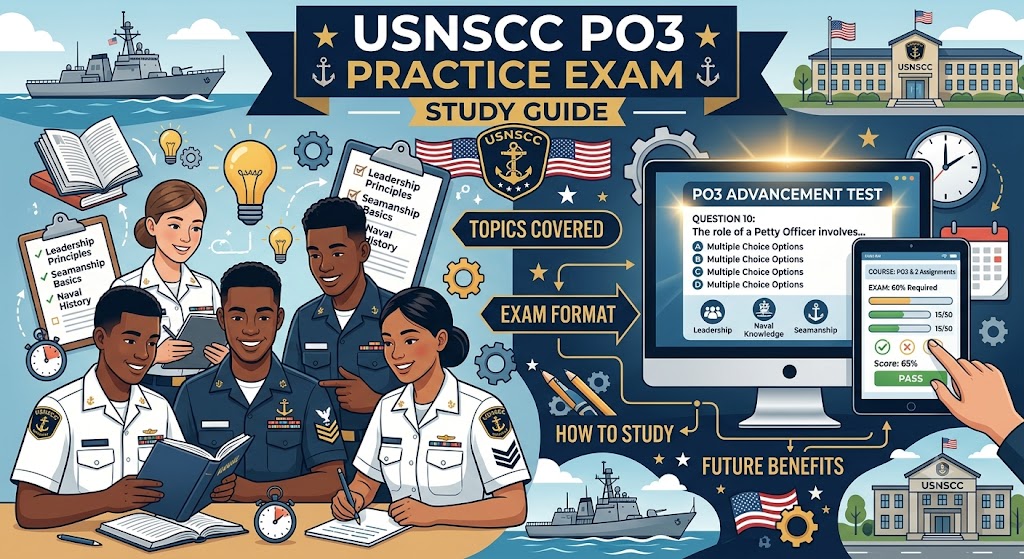
Additional Information
What the Course
Entails and Exam Details
Advancing to PO3 is not just about passing one test; it is
the culmination of demonstrated commitment and learned knowledge. The entire
"course" to advancement is structured around a combination of
requirements, often integrated into a specific program like Polaris:
- Required
Training: Cadets must successfully complete both USNSCC Recruit
Training (often called "boot camp") and a subsequent authorized
Advanced Training (AT) to be eligible for advancement.
- Time-in-Rate:
Cadets must serve a minimum of six months as a Seaman/Airman (E3).
- Academic
Coursework: To qualify for the PO3 exam, cadets must first complete
specified coursework. Historically, this has involved assignments from the
Petty Officer 3 & 2 Course, designed to cover essential naval and
leadership topics. This curriculum is often delivered online, ensuring
consistency. Topics you must master include:
- Leadership
Principles: Ethical leadership, effective communication, and team
management within a military structure.
- Naval
History and Customs: Key historical events, traditions, etiquette,
and protocol of the U.S. Navy.
- Drill
and Ceremonies: Proper execution of basic military drill and
understanding ceremonial customs.
- First
Aid and Safety: Basic medical knowledge and safety protocols
essential for any environment.
- Seamanship
Basics: Fundamentals of navigation, line handling, signaling, and
shipboard operations.
- Uniform
and Regulations: Strict adherence to uniform standards and general
organization regulations.
Once these requirements are met and the coursework is
completed, the cadet is ready to attempt the official advancement examination,
which is a pivotal part of the overall process. The final exam content is
directly drawn from the curriculum you have already studied.
What to Expect in
the Final Exam
The final USNSCC PO3 Advancement Exam is a structured,
formal assessment designed to verify that you possess the core knowledge
required of a Petty Officer Third Class. While specific exam details, passing
scores, and exact formats can be subject to official USNSCC regulatory updates,
you can generally expect:
- Format:
The exam typically consists of multiple-choice questions. These questions
will cover the broad spectrum of the coursework, from leadership
principles to historical facts and practical seamanship concepts.
- Administration:
The exam is administered via the official NSCC/NLCC Online Testing System
(NOTS). Access to the test is typically granted once all your prior
prerequisites and course assignments are completed and recorded in the
system.
- Supervision:
You will take the exam under formal supervision, which is typically
provided at your local unit by authorized adult leaders. Standard testing
rules, including limits on time and resources, will apply to ensure a fair
and rigorous testing environment.
- Passing
Score: Historically, a passing score for this first level of Petty
Officer exam has been in the range of 60% or higher, reflecting the
standard academic requirements. Always check with your unit chain of
command for the most current regulation.
This exam is your opportunity to demonstrate that you have
not just completed assignments but have truly mastered the foundational
principles that define a Petty Officer.
How to Study and
Exam Centers
Preparation is paramount to success. Here are actionable
study strategies and information on where you will take the official test:
- How
to Study effectively for the PO3 Advancement:
- Master
the Core Material: Start with the official manuals and coursework.
Review the PO3 & 2 coursebooks thoroughly. Take detailed notes,
highlighting key definitions, dates, leadership theories, and practical
steps.
- Utilize
Polaris & Unit Resources: Leverage the online learning platform
(Polaris) for quizzes, interactive content, and structured assignments.
Don't hesitate to ask your senior cadets and unit leaders for study
guides, local practice quizzes, or unit-level study sessions.
- Create
Flashcards: Flashcards are excellent for memorizing terms, military
customs, historical figures, and seamanship knowledge.
- Form
Study Groups: Collaborating with other cadets preparing for the same
exam can make learning more engaging and help reinforce complex ideas.
Discussing leadership scenarios is particularly beneficial.
- Focus
on the Core Competencies: Ensure you have a balanced understanding of
all subjects. Don't neglect naval history or leadership principles.
- Take
Unit-Level Practice Tests: If your unit has developed practice
resources, use them. Simulating the exam environment will help you manage
time and anxiety.
- Where
to Take the Exam (Exam Centers): The official USNSCC PO3 Advancement
Exam is administered within the USNSCC's proprietary online testing system
(NOTS). It is not taken at public testing centers like Pearson VUE.
Instead:
- At
Your Unit: The exam is typically administered at your local USNSCC
unit during drill periods or a designated time, under the direct
supervision of a commissioned Sea Cadet officer or an approved adult
volunteer. Your chain of command will guide you on the scheduling and
location for your official exam.
Job Opportunities
from the Course
While earning the rank of USNSCC Petty Officer Third Class
does not translate directly into immediate civilian or military jobs, it
provides significant advantages and demonstrates leadership and dedication that
are highly valued in any career. The rank and associated training open doors to
the following future benefits and opportunities:
- Leadership
Roles within USNSCC: Gain immediate opportunities for leadership
within your local unit, supervising and mentoring more junior cadets.
- Advancement
Prerequisites: Earning PO3 is the essential foundation for further
advancement to higher Petty Officer rates (PO2, PO1, and Chief Petty
Officer), unlocking progressively more responsibility and specialized
advanced training opportunities.
- Demonstrable
Leadership Skills: You can showcase real-world leadership, teamwork,
and responsibility on your college applications and professional resume.
- Future
Military Advantages: For those considering a military career, successful
service and high rank within the USNSCC can often result in higher initial
pay grades, points towards advancement, or a competitive edge in
enlistment. (Consult with a recruiter for specific, current military
policies).
- Strong
Foundation for any Career: Develop crucial transferable skills like
discipline, time management, problem-solving, and professional
communication that are vital in all professional environments.
Achieving the PO3 rank is an excellent way to start building
your professional profile and demonstrate your capability to lead and excel
under challenging conditions.
Frequently Asked Questions
Reviews
5.0
Based on 0 reviews
Leave a Review
No reviews yet. Be the first to review!