
USPA Skydiving A License Practice Exam
$69.00
- Buy to unlock unlimited access to all Quiz questions and Answers in this Quiz.
- After purchase you can print a PDF of the whole quiz at any point. The PDF will contain the questions and the correct answers.
About this Exam
The USPA A License represents the first major milestone for any aspiring solo skydiver. It signifies that a student has mastered the foundational skills required to jump independently, join others in formation skydiving, and continue their progression in the sport. This study guide is designed specifically for student skydivers who have completed their initial student status jumps (typically 25 jumps through methods like AFF or IAD) and are now preparing for the comprehensive written exam that forms the final step in their license certification process. It helps validate knowledge and practical applications learned during the Integrated Student Program (ISP).
Ready to test your knowledge?
Buy Now to Access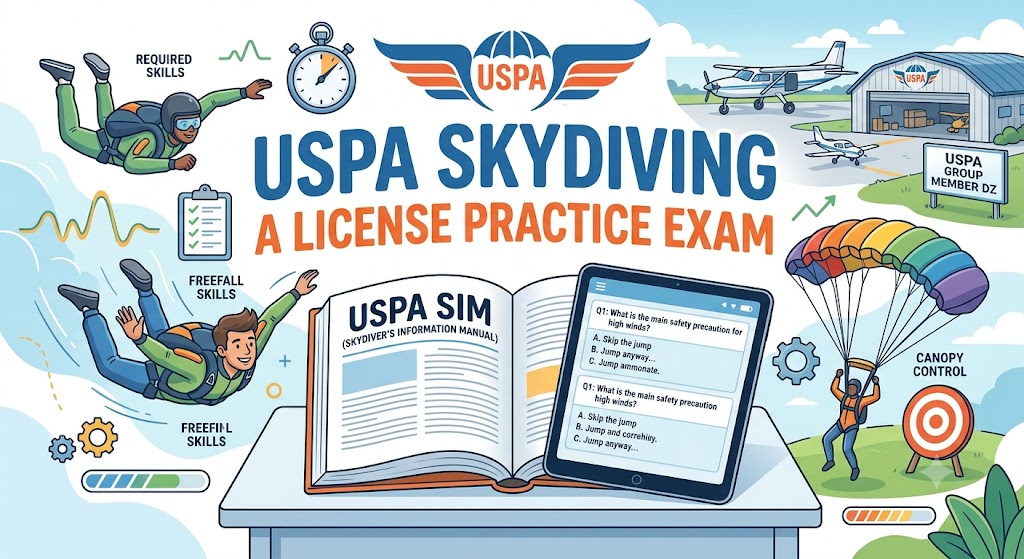
Additional Information
What the Course Entails and Exam Details
Obtaining your A License is not just about passing one exam; it is a full course of study combining practical proficiency and theoretical knowledge. The study material covers several core domains essential for safe skydiving, all drawn from the USPA Skydiver's Information Manual (SIM). The syllabus includes deep dives into Equipment and Principles (parachute parts, deployment, packing rules), Flight Operations and Emergency Procedures (spotting, exits, relative work, high-altitude considerations, aircraft safety, and malfunctions), Canopy Flight (flight patterns, landing accuracy, and wind analysis), and USPA Governance (bylaws, ratings, and regulations). The exam verifies understanding of the information presented throughout the entire progression.
What to Expect in the Final Exam
The formal written exam is a multiple-choice assessment designed to test practical knowledge rather than rote memorization. Candidates must achieve a minimum passing score of 75% or higher to be eligible for licensing. While there is no strict time limit imposed, most drop zones expect candidates to complete the test under supervision within a reasonable timeframe (typically 30-45 minutes). The exam usually takes place at your local drop zone, often immediately after your 25th jump or prior to your solo graduation dive, and is administered by an S&TA or USPA instructor.
How to Study and Exam Centers
Effective studying requires a focused review of the USPA Skydiver’s Information Manual (SIM). Focus intensely on the most recent edition, specifically Sections 2 (Basic Safety Requirements), 4 (Integrated Student Program/ISP), 5 (General Recommendations), 6 (Advanced Progression), and 9 (USPA Governance). Practice applying emergency procedures mentally; visualize malfunctions and review the Harness-Hold and PLF procedures in detail. Seek clarification on complex rules from your instructors. Unlike some certifications, the USPA A License written exam is not taken at dedicated Pearson VUE centers. You must contact a USPA Group Member Drop Zone. The final exam is always in-person and administered by an authorized USPA Safety and Training Advisor (S&TA) or USPA instructor. There are no official online portals for the final A License written exam.
Job Opportunities from the Course
While the A License itself is the lowest recreational skydiving credential, achieving it is the absolute prerequisite for any professional path in the industry. It does not unlock jobs, but it unlocks the career pathway for:
Fun Jumper (Recreational Solo Skydiving)
Joining formation skydiving teams and relative work groups
Learning advanced skills such as freefly and eventually wingsuit flying
Pathway to becoming a Skydiving Coach (after earning a B license)
Pathway to becoming a Demonstration Jumper (after earning a C license)
Pathway to becoming a USPA Skydiving Instructor (later, after fulfilling flight experience requirements and earning B, C, and D licenses)
Pathway to becoming a Tandem Instructor (later)
Frequently Asked Questions
Reviews
5.0
Based on 0 reviews
Leave a Review
No reviews yet. Be the first to review!