
USPAP 15-Hour Course Practice Test
$69.00
- Buy to unlock unlimited access to all Quiz questions and Answers in this Quiz.
- After purchase you can print a PDF of the whole quiz at any point. The PDF will contain the questions and the correct answers.
About this Exam
The USPAP 15-Hour Course Practice Test is an essential study tool meticulously designed for anyone aiming to become a state-licensed or certified appraiser in the United States. The 15-Hour National Uniform Standards of Professional Appraisal Practice (USPAP) course is the foundational introduction to the ethical and performance standards recognized across the appraisal profession. This course is a mandatory step for all new appraiser trainees and must be completed to obtain a credential, covering real property, personal property, mass appraisal, and business valuation. Our comprehensive practice test is engineered to simulate the official final exam, helping you to evaluate your understanding, identify knowledge gaps, and build the confidence needed to pass your official course exam on the first attempt.
Ready to test your knowledge?
Buy Now to Access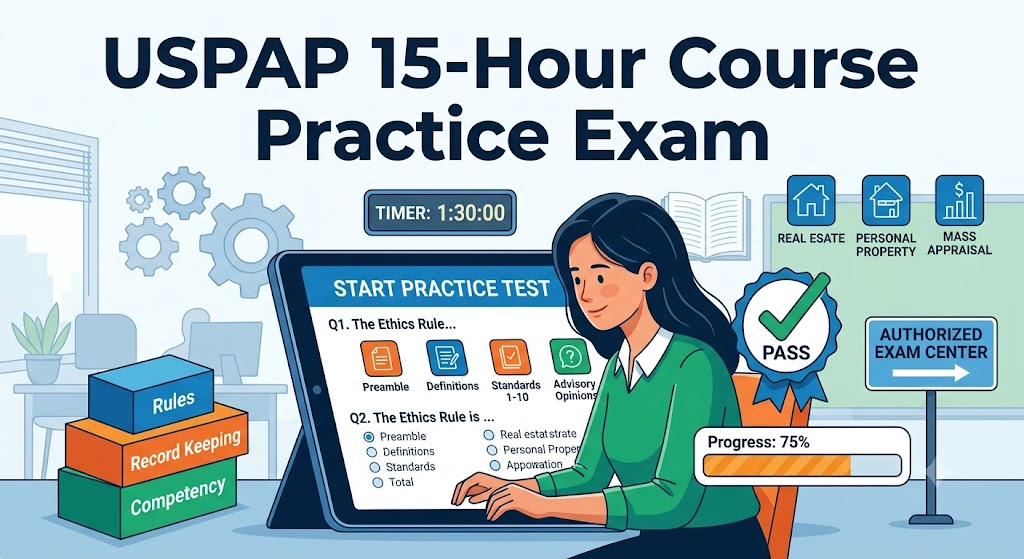
Additional Information
What the Course Entails and Exam Details
The full USPAP 15-Hour course is structured into distinct modules that provide a thorough overview of the complete USPAP publication.
The course entails in-depth study of the following key areas:
The USPAP Preamble and key Definitions that establish the document's framework.
Fundamental rules, including the Ethics Rule, Record Keeping Rule, Competency Rule, Scope of Work Rule, and Jurisdictional Exception Rule.
The application of Standards 1 through 10, which detail requirements for developing and reporting various appraisal types (real property, mass appraisal, personal property, and business valuation).
Understanding the proper use of USPAP Advisory Opinions and Frequently Asked Questions (FAQs).
A practice test allows you to encounter these topics in a simulated exam format, mirroring the structure, length, and depth of the official proctored test.
What to Expect in the Final Exam
While this guide focuses on the practice test, it is vital to know exactly what the official proctored final exam for the USPAP 15-Hour Course requires.
The official exam is typically a closed-book, multiple-choice assessment designed to ensure you can apply the concepts learned during the 15-hour course.
You can expect approximately 30 to 50 questions, covering all major rules and standards discussed during the instruction.
The passing score for the official exam is set by the specific course provider but generally ranges between 70% and 75%.
You will have a generous but specific time limit, often around 1 to 2 hours, to complete the exam. It is mandatory that the final exam be proctored to verify your identity and ensure academic integrity.
How to Study and Exam Centers
Mastering the USPAP material requires active engagement with the content. The best approach is to use the USPAP 15-Hour Course Practice Exam iteratively.
Start by reading the current USPAP publication thoroughly. The practice test will help you pinpoint which exact rules and definitions require more focus.
Create detailed flashcards for key definitions and the six primary rules. Practice applying the Scope of Work Rule and ethical obligations to real-world scenarios. Many successful students find that joining online study groups can provide valuable clarity and support.
The practice test is taken on your own time within your chosen study platform. The official final exam, however, must be formally scheduled and proctored.
You can take the official exam through several authorized channels, including online proctoring services (such as those offered by McKissock or the Appraisal Institute), the physical testing centers of providers like Pearson VUE, or a physical authorized school location. Be sure to check your state's specific requirements before scheduling.
Job Opportunities from the Course
Successfully completing the 15-Hour National USPAP Course and passing the final proctored exam is the crucial first milestone for many prestigious career paths in valuation.
This mandatory credential unlocks initial roles and sets you on the path to high-level appraisal specialization, including:
Real Estate Appraiser Trainee: The essential entry point into the appraisal field, working under a certified appraiser.
State-Licensed Real Estate Appraiser: Authorized to appraise non-complex 1-4 unit residential properties up to a certain value.
State-Certified Residential Real Estate Appraiser: The industry standard for residential appraisal, allowing you to appraise complex residential properties and high-value transactions.
State-Certified General Real Estate Appraiser: The highest residential credential, opening opportunities in commercial, industrial, agricultural, and complex multi-use property valuation.
Review Appraiser: Analyzing third-party appraisal reports for compliance and quality control for lenders, government agencies, or institutional investors.
Mass Appraisal Specialist: Developing complex valuation models and assisting in the ad valorem tax assessment process for large jurisdictions.
Personal Property Appraiser: Valuing non-real-estate assets, including fine art, machinery, antiques, and jewelry.
Frequently Asked Questions
Reviews
5.0
Based on 0 reviews
Leave a Review
No reviews yet. Be the first to review!