
USPS Window Training Practice Test
$69.00
- Buy to unlock unlimited access to all Quiz questions and Answers in this Quiz.
- After purchase you can print a PDF of the whole quiz at any point. The PDF will contain the questions and the correct answers.
About this Exam
The United States Postal Service (USPS) Window Training Practice Test is not a single, standalone official exam but rather the collective name for the rigorous preparation required to complete the required Retail and Customer Service Skills (RCSS) training program. This program is designed for newly hired employees or internal transfers who have been selected for roles that interact directly with the public, primarily Sales and Services Associates (commonly known as Window Clerks) and Postmaster Relief employees. The practice test serves as a comprehensive simulation path, ensuring that trainees are not only knowledgeable about postal products but can also execute complex transactions, deliver excellent customer service, and handle financial responsibilities with confidence before they work their first shift at a real post office counter. This guide will navigate you through the entire journey, maximizing your chances of passing the critical official evaluations that come at the end of the window training.
Ready to test your knowledge?
Buy Now to Access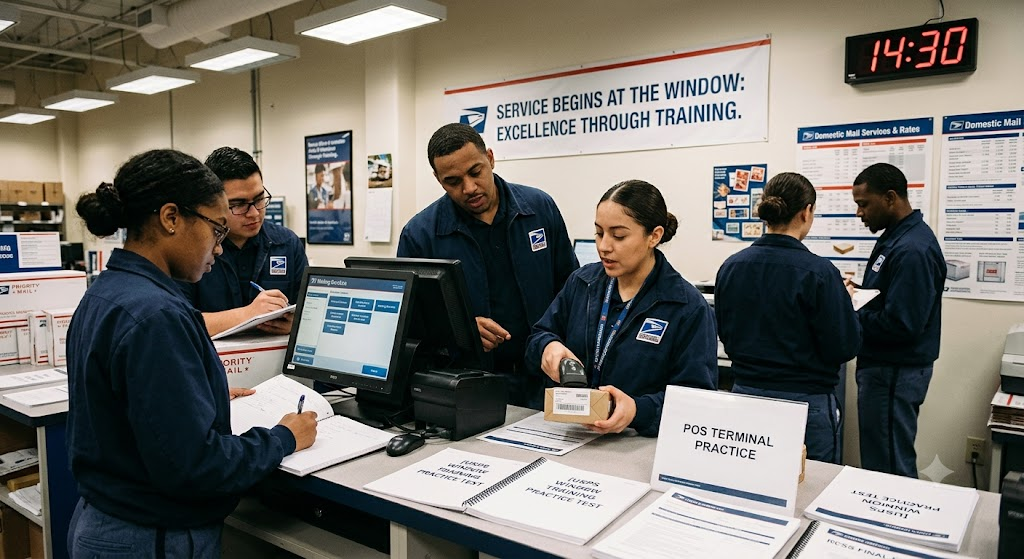
Additional Information
What the Course Entails and Exam Details
The RCSS window training is an intensive multi-week program, blending traditional classroom instruction with hands-on practice. The "Practice Test" aspect is built into the curriculum through repeated simulations and quizzes, preparing you for the two final, critical assessments:
Core Topics Covered
Postal Products and Services: Mastering the details of First-Class Mail, Priority Mail, Express Mail, international options, packaging requirements, and insurance.
Point-of-Service (POS) Terminal Operations: Intensive training on using the cash register and computer system for all transaction types.
Customer Service Excellence: Developing skills for handling difficult customers, navigating complex requests, and maintaining a professional demeanor.
Domestic and International Mail Regulations: Understanding the critical rules regarding acceptable mail matter, custom forms, and restrictions.
Financial Procedures: Learning to manage a cash drawer, process various payment methods (cash, checks, credit cards), issue money orders, and perform daily accounting.
Additional Services: Instruction on processing passport applications, selling retail items, and managing P.O. Boxes.
The Two Final Components You Must Pass
Your window training will culminate in two separate official evaluations, and you must pass both to be certified.
Written Knowledge Test (formerly Postal Exam 473): This is a closed-book, multiple-choice exam that covers all theoretical aspects of the RCSS curriculum. In some areas, this has been updated to the Newer Customer Service Test (Postal Exam 477), though the core concepts remain similar. Note: Most regions now require passing the Postal Exam 473 (or its replacement 477) as part of the initial application process before window training, but a subsequent knowledge test specifically on RCSS material is common at the end of training.
Practical Skills Demonstration (Hands-On Window Evaluation): This is a simulated operational assessment. An examiner will play the role of multiple customers, presenting various transaction scenarios. You will be evaluated on your ability to use the POS terminal, recommend products, process payments, and interact professionally, following all protocols learned.
What to Expect in the Final Exam
Trainees should approach the final evaluations expecting a true test of preparedness. You will not succeed without thorough study and deliberate practice during your program.
Format:
Written: Multiple-choice, matching, and true/false questions, typically administered via a computer portal or a paper-based exam.
Practical: A real-time simulation with an examiner.
Passing Score: The required passing score for both the written and practical components is generally high, reflecting the responsibility of the role. A score of 70% is often the minimum threshold, but higher scores are frequently targeted. In many cases, you are allowed only one or two retakes for a failed component before you might be separated from employment.
Time Limits:
Written: Standard, non-negotiable time limits apply, ensuring you can recall information efficiently.
Practical: You will be given a set amount of time to complete all scenarios. The examiner will observe both accuracy and efficiency.
Specific Rules: Both tests are strictly closed-book and proctored. You cannot use personal phones, notes, or training manuals during the evaluations. During the practical evaluation, you must operate the POS terminal independently, though you may use official reference guides provided to clerks (e.g., mail class charts). The evaluator will assess your adherence to exact procedures, safety protocols, and "Six Steps of Sales."
How to Study and Exam Centers
Preparation begins long before the final exam date. Think of every class day as part of your "practice test."
Study Strategies
Treat Training Like Your Full-Time Job: Pay close attention in every session, ask questions, and take detailed notes, especially on financial procedures.
Leverage Official Practice Scenarios: Your instructors will use practice exercises throughout the course. Participate actively. Request extra practice time on the POS terminals during breaks or before/after class. This hands-on repetition is critical for the practical evaluation.
Create Your Own Scenarios: Get together with fellow trainees and role-play. Create diverse "customer orders" (e.g., "I need to mail this breakable ceramic horse to Italy with insurance") and practice processing them from start to finish on a mock counter.
Practice POS Software Independently: Find opportunities to explore the POS training software (if available) to become fluent in its menus and shortcuts.
Use Third-Party Practice Tools: While official USPS practice tests are not widely publicized, there are online educational resources and study communities where you can find user-created quizzes and transaction simulations that mimic the structure of the RCSS materials and Postal Exam 473.
Exam Centers
The location for both your written and practical evaluations is specific to your USPS training cohort.
Practical Evaluation: This always takes place at the centralized USPS Training Center or a designated physical training branch where your RCSS classroom training is hosted. This allows examiners to evaluate you in a standardized, controlled, realistic retail window environment.
Written Knowledge Test: This component is typically administered in a dedicated computer lab at the same training center, or occasionally, at a separate authorized physical testing center in the region. You will be notified of the exact time and location during your training program.
Job Opportunities from the Course
Passing the official evaluations and completing your USPS Window Training certification unlocks stability, career progression, and competitive federal benefits. This certification is a prerequisite for several career paths:
Sales and Services Associate (Window Clerk, Career Position)
Lead Sales and Services Associate
Customer Service Supervisor
Postmaster Relief (PMR, a pathway to Postmaster roles)
Postmaster (Certification is required as you progress)
Administrative positions (especially in local Post Office operations)
Your certification demonstrates proficiency in handling complex public-facing transactions and financial accountability, making you a highly versatile candidate within the USPS organization.
Frequently Asked Questions
Reviews
5.0
Based on 0 reviews
Leave a Review
No reviews yet. Be the first to review!