
USPTO Patent Bar Practice Exam
$69.00
- Buy to unlock unlimited access to all Quiz questions and Answers in this Quiz.
- After purchase you can print a PDF of the whole quiz at any point. The PDF will contain the questions and the correct answers.
About this Exam
The USPTO Patent Bar Practice Exam is designed to provide candidates with a simulated experience of the actual "Examination for Registration to Practice in Patent Cases Before the United States Patent and Trademark Office." Often referred to simply as the "Patent Bar," this high-stakes exam is not for everyone. It is specifically created for individuals possessing a scientific or technical background, typically evidenced by a bachelor's degree in a recognized field of engineering or hard science. The practice exam serves as a crucial final step for aspiring patent practitioners—both future patent agents and patent attorneys—to validate their comprehension of the intricate rules, regulations, and procedural nuances of U.S. patent law and prosecution. This comprehensive simulation helps ensure you possess the technical, legal, and mental preparedness required to navigate the six-hour test day successfully.
Ready to test your knowledge?
Buy Now to Access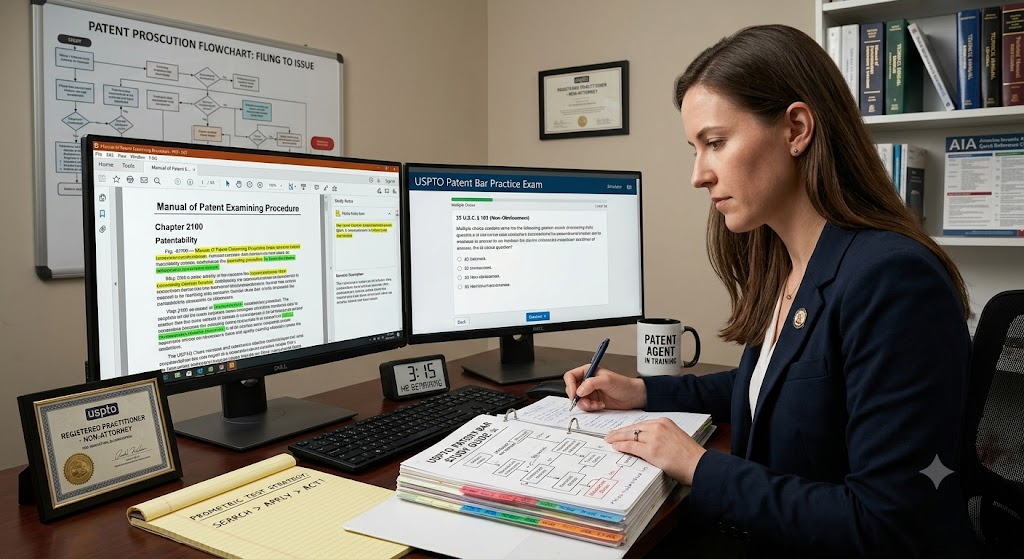
Additional Information
What the Course Entails and Exam Details
This examination does not test general legal knowledge but rather a very specific subset: the rules governing the examination of patent applications at the USPTO. It is entirely based on the contents of the Manual of Patent Examining Procedure (MPEP). While it is an "open-book" exam, the term is misleading; your familiarity with the MPEP's structure and contents is the real challenge. The primary "course" material for the Patent Bar is the MPEP itself. Key chapters of the MPEP that are extensively tested include: Chapter 700 (Examination of Applications), Chapter 2100 (Patentability), Chapter 100 (Secrecy, Access, National Security, and Foreign Filing), Chapter 200 (Types of Applications, Filing), and Chapter 600 (Parts, Form, and Content of Application). Additionally, you must master: PCT International Applications (Chapter 1800), Appeals (Chapter 1200), Inter Partes Review, and other post-grant proceedings. The exam evaluates your ability to locate relevant rules, apply legal standards to complex factual scenarios, and make procedural decisions with a precision required for patent prosecution.
What to Expect in the Final Exam
The actual USPTO Patent Bar Exam is a daunting computer-delivered, 100-question, multiple-choice assessment administered by Prometric. Out of these 100 questions, only 90 are "scored" questions, while 10 are "beta" questions used for future validation and are not included in your score. Because the beta questions are indistinguishable from the scored questions, you must treat every question as if it counts. The passing score is a minimum of 70%, which translates to correctly answering 63 of the 90 scored questions. You are given a total of six hours of testing time, split into two three-hour sessions (morning and afternoon) separated by a one-hour break. During the exam, you will have access to a searchable PDF version of the MPEP, but time is your greatest adversary. You must complete approximately one minute per question to ensure you have time to look up the answers to difficult or unfamiliar queries. Immediate results are provided on-screen upon completion of the PM session. All test-takers must sign a rigorous non-disclosure agreement.
How to Study and Exam Centers
Effective study requires a combination of rote memorization of core concepts and proficiency in efficiently "looking up" obscure details within the MPEP. The MPEP is a monstrous document, making it impossible to memorize. Focus your study on high-yield chapters (700, 2100). The most common advice, and statistically the most effective, is to enroll in a commercial Patent Bar prep course (e.g., PLI, Wysebridge, Patent Education Series). These courses streamline the MPEP into digestible sections, prioritize heavily tested topics, and, crucially, provide access to large banks of simulated practice questions and full-length, timed mock exams. A core strategy is to develop a robust "search" skill, learning to use precise keywords to navigate the searchable PDF MPEP quickly. Your ultimate preparation must include multiple, full-length (6-hour) timed simulation days to build stamina and test your strategy. The official examination is administered only through authorized Prometric test centers, which are located throughout the United States and some international locations. You must apply for eligibility with the USPTO's Office of Enrollment and Discipline (OED) before you can schedule your exam with Prometric.
Job Opportunities from the Course
Passing the USPTO Patent Bar and becoming a Registered Patent Practitioner unlocks a unique and niche career path at the intersection of technology and law. Here are specific job opportunities and career paths this achievement makes possible:
Patent Agent: Non-attorneys who are registered to represent inventors before the USPTO in patent application preparation and prosecution.
Patent Attorney: Individuals with both a Juris Doctor (J.D.) degree and a state bar membership who, upon passing the Patent Bar, can also practice patent litigation and provide broader IP legal advice.
Patent Examiner: Employed by the USPTO to review patent applications and determine whether a patent should be granted based on technical and legal criteria.
In-House Corporate Patent Counsel: Registered practitioners who manage a corporation’s patent portfolio, working closely with research and development teams to identify and protect new technologies.
Technology Transfer Specialist: Professionals, often in academic or research institutions, who assist in licensing and commercializing intellectual property, including patents.
Patent Litigator: (Usually requires being an attorney) Specializes in representing plaintiffs or defendants in patent infringement lawsuits.
Portfolio Manager / IP Strategist: Advises companies on a global strategy for managing and monetizing their patent assets.
Frequently Asked Questions
Reviews
5.0
Based on 0 reviews
Leave a Review
No reviews yet. Be the first to review!