
USPTO Registration Practice Exam
$69.00
- Buy to unlock unlimited access to all Quiz questions and Answers in this Quiz.
- After purchase you can print a PDF of the whole quiz at any point. The PDF will contain the questions and the correct answers.
About this Exam
The Examination for Registration to Practice in Patent Cases Before the United States Patent and Trademark Office, commonly referred to as the Patent Bar Exam, is a rigorous licensing test designed for individuals seeking to practice patent law. It is the sole examination that grants the title of "Registered Patent Attorney" or "Registered Patent Agent," allowing individuals to represent inventors and companies before the USPTO. This exam is specifically tailored for those who possess a scientific or technical degree, including engineers, scientists, and lawyers with a strong technical background.
Ready to test your knowledge?
Buy Now to Access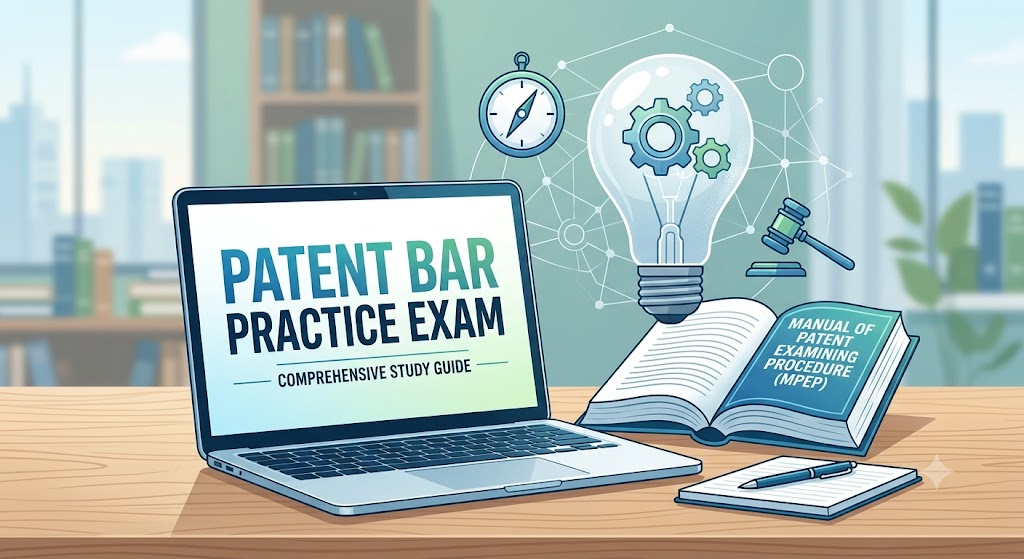
Additional Information
What the Course Entails and Exam Details
This examination is not a course, but a comprehensive test of an applicant's knowledge of the complex rules and procedures found within the United States patent system. The primary source material, and the core of what you must master, is the Manual of Patent Examining Procedure (MPEP). The MPEP is an extensive document that compiles all the statutes, rules, and procedures related to the examination of patent applications. A successful candidate must demonstrate a deep understanding of the MPEP to navigate factual scenarios and apply the laws to secure patent rights for clients.
Key topics covered within the MPEP and tested on the exam include:
Patent Application Filing and Prosecution: Mastering the steps to prepare, file, and move an application through the USPTO.
Prior Art Searches and Analysis: Understanding how to identify and apply prior inventions to determine patentability.
Interviews with Patent Examiners: Procedures for effective communication and negotiation with USPTO staff.
Post-Grant Procedures: Covering actions like re-examination and inter partes review after a patent has been issued.
Patent Cooperation Treaty (PCT) Basics: Knowledge of the international patent application system.
Ethics and Disciplinary Rules: Adhering to professional conduct requirements.
What to Expect in the Final Exam
The Patent Bar Exam is a challenging, computer-based test with a unique format designed to test both knowledge and time management. It consists of 100 multiple-choice questions administered over a single day. The exam is divided into two parts: a three-hour morning session (50 questions) and a three-hour afternoon session (50 questions), separated by a mandatory one-hour break.
To pass the examination, candidates must achieve a scaled score of 70%. This means correctly answering at least 63 of the 90 scored questions. It is important to note that 10 of the 100 questions are unscored "beta" questions, used by the USPTO to test new material for future exams. You will not know which questions are scored or unscored, so treating all questions with equal importance is vital. Candidates must sign a strict non-disclosure agreement before taking the exam. You are permitted to use an electronic version of the MPEP provided on the testing computer, but it is not a traditional "open book" test, as time limits prevent extensive reading.
How to Study and Exam Centers
Preparation for the Patent Bar Exam requires significant dedication, often involving months of focused study. Because the MPEP is so vast, most candidates find that taking a commercial Patent Bar review course is the most effective strategy. These courses streamline the MPEP, provide structured study plans, and focus on heavily tested areas.
Actionable study methods include:
Master the MPEP Navigation: Practice searching the electronic MPEP quickly and efficiently. Time is your greatest enemy in this exam.
Practice with Prior Exams: Use previous USPTO-released questions to understand the logic and complexity of the questions.
Simulate Exam Conditions: Take full-length, timed practice tests to build stamina and manage your time effectively.
Create Outlines and Flashcards: Simplify complex rules and focus on memorizing crucial definitions and deadlines.
The Patent Bar Exam is administered on a computer-based platform year-round at Prometric testing centers located across the United States and its territories. Candidates can submit their application to the USPTO Office of Enrollment and Discipline (OED) at any time. Once approved, you are granted a 90-day window to schedule your specific exam date directly with Prometric.
Job Opportunities from the Course
Passing the Patent Bar opens doors to exclusive and specialized career paths that blend technology and law.
Specific job titles and career paths this certification unlocks include:
Registered Patent Agent: For non-attorneys who are registered to represent clients before the USPTO.
Registered Patent Attorney: For attorneys who are registered to represent clients before the USPTO and practice broader patent law.
In-house Corporate Patent Counsel: Managing the intellectual property portfolio of a corporation.
USPTO Patent Examiner: Working for the USPTO to review and make determinations on patent applications.
Patent Litigator: Specializing in handling patent disputes and infringement cases in court.
Technology Transfer Specialist: Working with universities or research institutions to manage the licensing and commercialization of new inventions.
Good luck on your journey to becoming a registered patent practitioner! This certification is a significant achievement that can transform your professional future.
Frequently Asked Questions
Reviews
5.0
Based on 0 reviews
Leave a Review
No reviews yet. Be the first to review!