
Utah CNA Skills Practice Test
$69.00
- Buy to unlock unlimited access to all Quiz questions and Answers in this Quiz.
- After purchase you can print a PDF of the whole quiz at any point. The PDF will contain the questions and the correct answers.
About this Exam
The Utah CNA Skills Practice Test is an indispensable resource designed to prepare aspiring Certified Nursing Assistants for the clinical skills evaluation portion of the Utah NAAP (Nursing Assistant Assessment Program). This guide is specifically crafted for students who have completed a state-approved CNA training program and are gearing up to demonstrate their practical competency to a state-appointed evaluator. This examination is a critical hurdle; you must prove that you possess the hands-on skills necessary to provide safe, effective, and compassionate care to residents in various healthcare settings before you can be listed on the Utah Nurse Aide Registry. Our practice materials simulate the actual testing environment to build your confidence and ensure you are ready for exam day.
Ready to test your knowledge?
Buy Now to Access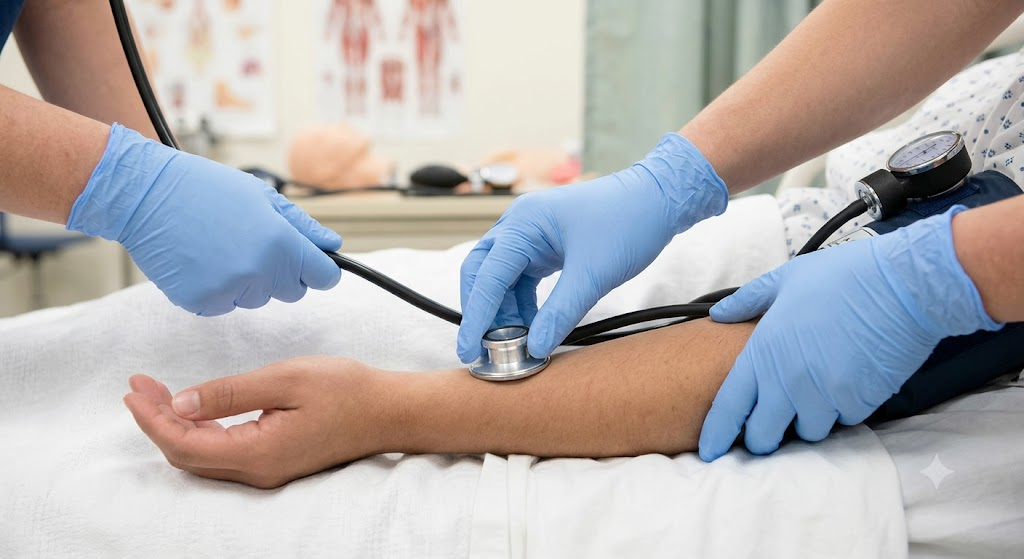
Additional Information
What the Course Entails and Exam Details
Your CNA training curriculum has equipped you with a broad range of skills, but the state exam focuses on a specific, standardized set of competencies. When preparing for the skills portion, you are mastering the physical application of nursing assistant theory.
The skills you must master, which are all potentially testable during your evaluation, generally fall into several core categories:
Foundational Skills: Hand hygiene (the most critical skill, which must be performed correctly and is often evaluated with every other skill), and proper use of Personal Protective Equipment (PPE).
Basic Nursing Skills: Measuring and recording vital signs (blood pressure, temperature, pulse, and respiration), measuring and recording weight, and measuring and recording intake and output.
Personal Care Skills: Assisting with personal hygiene (bathing, grooming, shaving, nail care), dressing and undressing, and providing oral care (to both conscious residents and those with dentures).
Restorative Skills: Assisting with ambulation (using a gait belt), transferring a resident (e.g., from bed to wheelchair), performing Range of Motion (ROM) exercises, and positioning residents to prevent pressure injuries.
Care of the Cognitively Impaired: Demonstrating appropriate communication and interaction techniques for residents with dementia or Alzheimer’s disease.
The exact checklist of potential skills is provided by the Utah testing vendor (e.g., D&S Diversified Technologies/Headmaster). Your practice should revolve around mastering every single step of every skill listed in that handbook.
What to Expect in the Final Exam
The final Utah CNA exam is a two-part assessment: a written/knowledge test and the clinical skills test. You must pass both components to receive your certification.
Here is what you can expect during the skills evaluation:
Format: You will perform your assigned skills in a one-on-one setting with a state-approved RN Evaluator.
Assigned Skills: You will be evaluated on a 'skill set' consisting of three to four specific skills randomly selected from the overall testable skills list. Crucially, one of your assigned skills will always be Handwashing. The additional skills will be a mix of measurement, personal care, and restorative tasks.
Scoring: You do not have to be perfect, but you must pass! You will receive a pass/fail grade for each skill. To pass a skill, you must successfully demonstrate competency in a vast majority of the steps, and you must perform all Critical Element Steps (often marked in bold or with an asterisk in your handbook) without error.
Time Limit: There is usually a maximum time allowed for the entire skills evaluation (e.g., 30-40 minutes), but you should focus on accuracy over speed. The evaluator will often remind you of the time remaining.
Testing Rules: You must maintain a professional demeanor, respect the resident’s dignity, and communicate effectively throughout the entire process. You may be asked to perform your skills on a volunteer 'actor' or on a realistic medical mannequin.
How to Study and Exam Centers
Effective study for the skills test requires a combination of rote memorization, practical repetition, and self-assessment.
Study Strategies and Practice Methods:
Master the Handbook: The testing vendor’s candidate handbook is your bible. Memorize the steps for every skill, paying extreme attention to the Critical Element Steps.
Practice, Practice, Practice: You cannot pass the skills test just by reading. Create a mock testing environment. Practice on friends, family, or even a pillow. Use household items as stand-ins for medical equipment (e.g., using a stopwatch to practice counting a pulse).
Focus on Communication: When you practice, speak out loud as if you are talking to a real resident. (e.g., "Hello, Mrs. Jones. I’m here to give you a bed bath.") Evaluators watch your interaction as closely as your technique.
Record Yourself: Video yourself performing a full skill set without stopping. Watch the playback while looking at the state checklist. You will be surprised by the small errors (like skipping a handwash or a safety step) that you catch.
Use the Practice Test: Utilize the Utah CNA Skills Practice Test to simulate the stress of a randomly generated skill set and to time yourself, ensuring you can complete the tasks within the constraints.
Utah Exam Centers and Location Information:
In Utah, CNA training programs and the final state examination are regulated by the Utah Nursing Assistant Registry (UNAR). Your CNA school is usually your best source of information about scheduling and testing locations.
Testing Vendors: UNAR currently contracts with D&S Diversified Technologies (Headmaster) for the administration of the exams. You will likely register and view test results through their portal.
Location: While the written exam may sometimes be taken online (proctored) or at specific Pearson VUE centers, the clinical skills exam must be taken at an authorized, approved testing facility. These are typically located at:
CNA training program schools.
Select community colleges and applied technology centers (e.g., Salt Lake Community College, Davis Technical College).
Some long-term care facilities that have approved testing labs.
Your CNA program coordinator will guide you on how to register and select a convenient testing center and date after you complete your course.
Job Opportunities from the Course
Passing your skills evaluation and written test unlocks immediate, stable, and rewarding career opportunities in the vibrant Utah healthcare sector. Becoming a Certified Nursing Assistant is also a powerful first step for those who wish to pursue careers as Licensed Practical Nurses (LPNs) or Registered Nurses (RNs).
Upon successfully adding your name to the Utah Nurse Aide Registry, you can pursue the following career paths and job titles:
Certified Nursing Assistant (CNA) in long-term care facilities, nursing homes, and assisted living centers (the largest employer of CNAs).
Acute Care CNA / Patient Care Technician (PCT) in hospitals, working on medical/surgical, emergency, or specialty units.
Home Health Aide providing personalized care to clients in their private residences.
Hospice Aide focusing on comfort and compassionate end-of-life care.
CNA in Rehabilitation Centers supporting patients recovering from surgery, injury, or stroke.
Correctional Health CNA working in jail or prison health systems.
Clinic CNA in outpatient medical clinics or urgent care centers.
Frequently Asked Questions
Reviews
5.0
Based on 0 reviews
Leave a Review
No reviews yet. Be the first to review!