
Utah County Emissions Practice Test
$69.00
- Buy to unlock unlimited access to all Quiz questions and Answers in this Quiz.
- After purchase you can print a PDF of the whole quiz at any point. The PDF will contain the questions and the correct answers.
About this Exam
The Utah County Emissions Certification is a mandatory qualification for individuals seeking employment as emissions inspectors within Utah County. This certification ensures that inspectors possess the necessary knowledge and skills to accurately perform vehicle emissions tests in compliance with state and county regulations. It is specifically designed for automotive professionals, mechanics, and anyone aspiring to work in authorized emissions testing centers. The certification plays a crucial role in maintaining air quality standards by ensuring vehicles meet established emissions requirements.
Ready to test your knowledge?
Buy Now to Access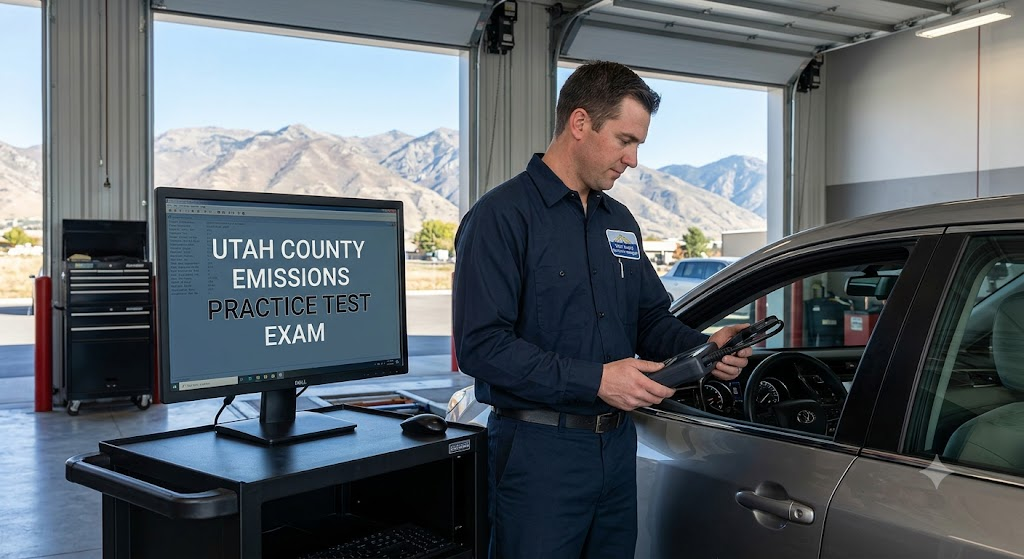
Additional Information
What the Course Entails and Exam Details
While this resource is a practice test designed for preparation, the actual Utah County Emissions Certification typically requires completion of a state-approved training course.
The comprehensive training and subsequent examination cover several core areas:
Regulations and Procedures: In-depth understanding of Utah County emissions testing laws, policies, and procedural requirements.
OBDII (On-Board Diagnostics) Testing: Detailed knowledge of OBDII systems, diagnostic procedures, and data interpretation for vehicles model year 1996 and newer.
Visual Inspection: Procedures for inspecting emission control devices, such as catalytic converters, gas caps, and positive crankcase ventilation (PCV) systems, to ensure they are present and functioning correctly.
Safety Procedures: Standard safety practices to be followed during the emissions testing process in a garage environment.
Tampering Detection: Identification of illegal modifications or tampering with vehicle emission control systems.
What to Expect in the Final Exam
The actual Utah County Emissions Certification exam is designed to verify the competency of future inspectors. While specific details may vary, applicants can generally expect the following format for the official certification:
Format: The examination typically consists of multiple-choice questions. A practical hands-on demonstration of emissions testing proficiency may also be required, depending on current county requirements.
Topics: Questions are evenly distributed across the key areas outlined in the section above, focusing heavily on regulations and OBDII diagnostics.
Passing Score: A minimum passing score (often around 80% or higher) is required to obtain certification.
Time Limit: The exam is typically timed, requiring candidates to manage their time effectively across all questions.
How to Study and Exam Centers
Preparing effectively for the Utah County Emissions Certification is essential for success. Here are actionable strategies for studying:
Review Official Manuals: Obtain and thoroughly study the official Utah County Emissions Inspection Manual and any relevant materials provided by the Utah Division of Motor Vehicles (DMV). These are the primary resources for understanding the current regulations and procedures.
Utilize Practice Tests: Engaging with resources like the Utah County Emissions Practice Test is highly recommended. Practice exams help familiarize you with the question format, identify knowledge gaps, and build testing stamina.
Understand OBDII: Focus significantly on understanding how OBDII systems operate, how to retrieve and interpret readiness monitors, and identifying diagnostic trouble codes (DTCs).
Regarding Exam Centers:
To obtain the actual certification, individuals must typically register for and complete an authorized training program. These courses are often offered through:
Utah County Health Department: They administer the emissions program and can provide information on approved training providers.
Local Community Colleges or Technical Schools: These institutions often provide state-approved automotive technology and emissions inspector training courses.
The final certification exam is usually administered directly after the completion of the required training course at the testing location or training facility.
Job Opportunities from the Course
Obtaining the Utah County Emissions Certification opens up specific career paths within the automotive service industry in the region. Key job opportunities include:
Certified Emissions Inspector: The primary role this certification qualifies you for, allowing you to perform mandatory emissions tests at licensed inspection stations.
Automotive Technician/Mechanic: Most repair shops in Utah County require their technicians to hold emissions certification, enhancing their employability and enabling them to perform comprehensive vehicle services.
Lube Technician: Many quick-lube facilities are also authorized inspection stations, making this certification a valuable asset for technicians employed there.
Service Advisor: While not always performing the tests, service advisors benefit from this knowledge to accurately explain inspection results and required repairs to customers.
Frequently Asked Questions
Reviews
5.0
Based on 0 reviews
Leave a Review
No reviews yet. Be the first to review!