
Utah Esthetician State Board Practice Exam
$69.00
- Buy to unlock unlimited access to all Quiz questions and Answers in this Quiz.
- After purchase you can print a PDF of the whole quiz at any point. The PDF will contain the questions and the correct answers.
About this Exam
The Utah Esthetician State Board Exam is the essential final milestone for aspiring skincare professionals in Utah. Developed to ensure that all licensed estheticians possess the critical knowledge and hands-on skills required to protect public health and safety, this comprehensive examination is a mandatory requirement set by the Utah Division of Professional Licensing (DOPL). Achieving passing scores on both the written theory and practical portions proves you are ready to launch your career as a licensed esthetician. The exam is designed for individuals who have successfully completed the state’s required training hours—typically 600 hours for a basic esthetician license—from an approved cosmetology or esthetics school. It validates your expertise to future employers and clients alike, marking your official entry into the thriving beauty and wellness industry.
Ready to test your knowledge?
Buy Now to Access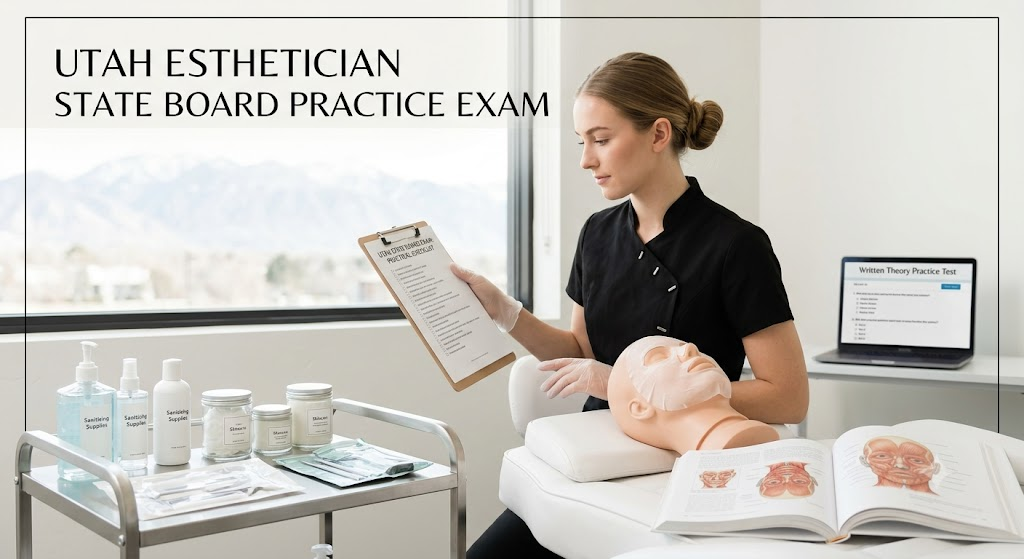
Additional Information
What the Course Entails and Exam Details
To prepare for the Utah State Board Exam, students complete a rigid curriculum at a licensed esthetics school. This training provides the foundational knowledge and technical prowess needed to tackle the two distinct parts of the exam: the Written (Theory) Exam and the Practical Exam. While your school curriculum covers a broad spectrum of beauty topics, the State Board Exam specifically targets your competency in core domains, with a profound emphasis on safety and sanitation.
The core domains covered in your training and tested on the exam include:
Scientific Concepts: Including microbiology, infection control procedures, standard precautions, anatomy and physiology (cells, tissues, organs, systems), basic chemistry (product composition), and advanced skin histology.
Skin Science: Skin disorder diagnosis, skin typing, contraindications, and hair structure/growth cycles.
Esthetics Services: Facial cleansing procedures, massage techniques (effleurage, petrissage, etc.), exfoliation, mask application, hair removal methods (waxing and tweezing), and makeup application principles.
Equipment and Safety: Proper use of electrical equipment, sanitization protocols for tools, and maintaining a sterile work environment.
Utah State Laws and Regulations: Essential knowledge of DOPL rules, licensing requirements, and scope of practice limitations.
What to Expect in the Final Exam
You must pass two separate examinations administered by the state's contracted testing administrator, Prov.
The Written (Theory) Exam
The Written Exam is a computer-based, multiple-choice assessment that tests your knowledge of esthetic theory, science, and Utah regulations. It is often provided in multiple languages including English, Spanish, Vietnamese, and Korean. Candidates generally have approximately 90 minutes to complete the exam. The questions are weighted across core areas like infection control (which typically holds significant importance) and specific skin treatment protocols.
The Practical Exam
The Practical Exam is a hands-on demonstration of your technical skills, proctored by evaluators in a controlled testing environment. Unlike school, creativity is not the focus; safety, sanitation, and correct procedural sequencing are paramount. Candidates must bring their own candidate kit with properly labeled, sanitized implements, as well as a mannequin head (verify current Candidate Information Bulletin for model rules, as they may vary by testing site).
You will be required to perform specific service "sections" under strict time limits, including:
Work Area Preparation: Setting up your station safely and sanitizing everything.
Client Preparation and Basic Facial: Draping, cleansing, steaming, and massage movements.
Exfoliation with Towel Steaming: Applying product and proper towel handling.
Hair Removal: Tweezing and simulated soft wax.
Facial Makeup Application: Demonstrating proper hygiene during makeup application.
Blood Exposure Procedure: A crucial section testing your immediate response to an accidental cut.
Passing Score
To obtain your Utah Esthetician license, you must achieve a passing score of 70% or higher on both the Written Exam and the Practical Exam.
How to Study and Exam Centers
Effective preparation is the difference between anxiety and confidence on exam day.
Actionable Study Strategies
Master the Candidate Information Bulletin (CIB): This is your ultimate guide. DOPL’s testing partner, Prov, provides a detailed CIB that outlines every topic covered in the written exam and exactly which procedures you must perform (and how they will be graded) in the practical exam. Read it front to back.
Take Practice Tests: Utilizing practice exams is non-negotiable for success. Taking standardized [Esthetician State Board Practice Tests] familiarizes you with the multiple-choice format, identifies your knowledge gaps, and helps you manage your time effectively. Repeated practice builds speed and accuracy.
Practice the Practical steps in Order: Evaluators grade you on following the correct sequence. Practice packing your kit, sanitizing your hands between every major action, and performing the facial steps verbally to ensure you don’t miss crucial steps.
Drill Anatomy and Infection Control: These sections usually carry heavy weight. Use flashcards for definitions of skin disorders, bone structures of the face, and sanitation/disinfection protocols.
Study Utah-Specific Rules: Do not forget to review the specific Utah Administrative Code regarding the scope of practice, facility sanitation, and license renewal requirements.
Exam Centers and Scheduling
You must register and schedule both portions of your exam through the authorized testing partner, Prov. Registration can be done online at the Prov website or via phone/text. Once registered, you can schedule your testing date and time. Written exams are often offered at certified testing centers like Pearson VUE, located in major areas such as Salt Lake City, Provo, and Ogden. Practical exams are scheduled for specific dates at authorized schools or dedicated testing sites throughout the state. Candidates must arrive at least 30 minutes early with valid, government-issued identification.
Job Opportunities from the Course
A Utah Esthetician License is a powerful credential that unlocks a wide range of career opportunities across the state's growing beauty and wellness landscape. Whether you dream of working in a luxurious resort spa or opening your own business, this license is your key.
Career paths unlocked by this certification include:
Spa Esthetician: Providing specialized facials, body treatments, and relaxation therapies in day spas, resort spas, or destination spas.
Medical Esthetician: Collaborating with dermatologists or plastic surgeons to perform advanced skincare treatments such as chemical peels, laser therapies, or pre/post-operative care (some advanced procedures may require a Master Esthetician license or additional training).
Wax Specialist: Focusing specifically on face and full-body hair removal services using both hard and soft wax techniques.
Lash and Brow Technician: Specializing in eyelash extensions, lash lifts, tints, and brow shaping or lamination.
Makeup Artist: Working for weddings, special events, film, television, or as a retail cosmetics consultant.
Salon or Spa Owner/Manager: Running the operational and business side of a wellness facility.
Beauty Educator or School Instructor: Teaching the next generation of estheticians at a licensed beauty school.
Manufacturer’s Representative or Brand Ambassador: Promoting specific skincare lines, training other professionals, or selling products to salons and spas.
Frequently Asked Questions
Reviews
5.0
Based on 0 reviews
Leave a Review
No reviews yet. Be the first to review!