
Utah Law School Practice Exam
$69.00
- Buy to unlock unlimited access to all Quiz questions and Answers in this Quiz.
- After purchase you can print a PDF of the whole quiz at any point. The PDF will contain the questions and the correct answers.
About this Exam
Embarking on a career in law within the state of Utah is a significant and rewarding challenge. This practice exam is specifically designed as a comprehensive study tool for law school graduates and students preparing for the rigors of the official Utah State Bar Examination.
Our practice exam offers a realistic simulation of the types of legal concepts, procedural rules, and analytical skills required to pass the bar and become a licensed attorney in Utah. It is an invaluable resource for assessing your readiness, identifying critical areas for improvement, and building the confidence needed for success on test day.
Ready to test your knowledge?
Buy Now to Access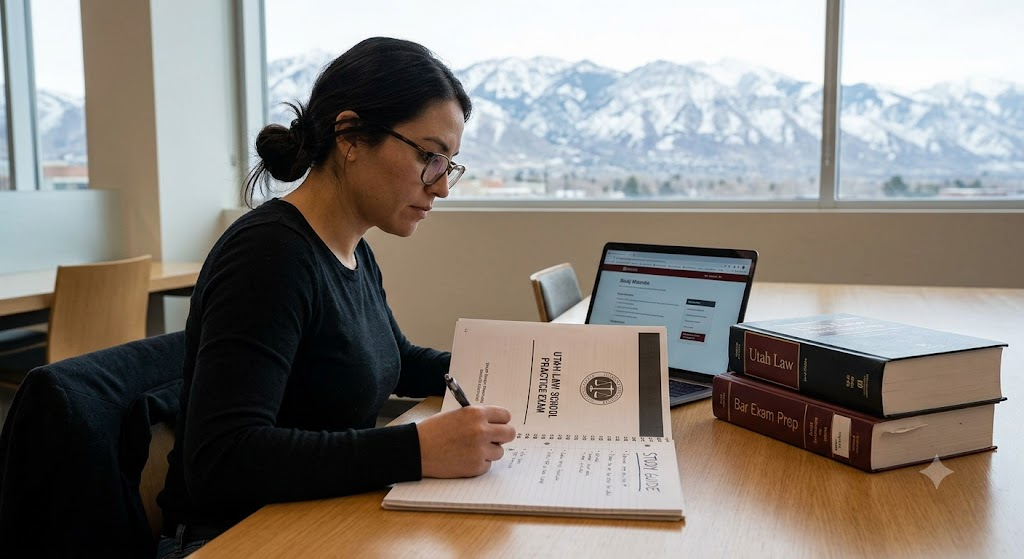
Additional Information
What the Course Entails and Exam Details
This practice exam content is structured to align with the core subjects and components of the official Utah Bar Exam, which typically utilizes the Uniform Bar Examination (UBE). The UBE consists of three main parts: the Multistate Bar Examination (MBE), the Multistate Essay Examination (MEE), and the Multistate Performance Test (MPT).
Your practice course or material should cover a wide range of substantive legal topics, including but not limited to:
Constitutional Law
Contracts and Sales
Criminal Law and Procedure
Evidence
Real Property
Torts
Civil Procedure
Family Law
Business Associations (Corporations, Partnerships, LLCs)
Secured Transactions
Trusts and Estates
Conflict of Laws
The purpose of a comprehensive practice exam is to mimic the structure and breadth of these topics, providing you with a representative set of multiple-choice questions, essay prompts, and performance tasks.
What to Expect in the Final Exam
While a practice exam is a study tool, the final hurdle is the Utah State Bar Examination. Here is what you can generally expect:
Exam Format: The Utah Bar Exam is a two-day event.
Day 1 (Morning): Two Multistate Performance Test (MPT) tasks.
Day 1 (Afternoon): Six Multistate Essay Examination (MEE) questions.
Day 2: The Multistate Bar Examination (MBE), consisting of 200 multiple-choice questions administered in two 3-hour sessions.
Time Limits: You will be under strict time constraints for each section, emphasizing the need for efficient time management and a solid understanding of the law.
Passing Score: The minimum scaled score required to pass the Utah Bar Exam is typically 270 (out of 400).
Specific Rules: The Utah State Bar has detailed rules regarding examinee conduct, permitted materials, and character and fitness requirements, which you must carefully review and adhere to.
How to Study and Exam Centers
Effective preparation for a law school or bar exam requires a dedicated and structured approach.
Actionable Study Strategies:
Establish a Study Schedule: Allocate specific time slots each day to cover different subjects, with a balanced focus on all UBE components.
Use Practice Exams: Take multiple practice exams under timed conditions. Review your answers thoroughly, understanding not just what you got wrong, but why. This is crucial for developing legal reasoning.
Utilize High-Quality Study Materials: Supplement your learning with reputable bar review courses, outlines, and textbooks from your law school or commercial providers.
Form Study Groups: Collaborating with peers can help clarify complex topics and provide motivation.
Exam Centers and Location: You can find practice resources online through various commercial providers.
The official Utah Bar Examination is administered by the Utah State Bar. The exam itself is generally held at specific physical locations in or around Salt Lake City. You must register directly with the Utah State Bar and follow their specific application deadlines and location assignments.
Job Opportunities from the Course
Successfully passing the Utah Bar Exam is the essential step to becoming a licensed attorney in Utah. This opens doors to a diverse and impactful range of career paths:
Associate Attorney (Private Practice): Working in a law firm of any size.
Solo Practitioner: Building and managing your own legal practice.
In-House Counsel: Providing legal services directly to a corporation or business.
Government Attorney: Working for local, state, or federal government agencies (e.g., as a prosecutor or public defender).
Judicial Clerk: Assistance to a judge, gaining valuable insight into the court system.
Public Interest Attorney: Working for non-profit organizations or legal aid societies.
Legal Consultant: Providing expert advice in a specific legal area.
Alternative Legal Careers: Roles in legal publishing, legal technology, or alternative dispute resolution.
This extensive career potential is unlocked by dedicating yourself to your studies and successfully navigating the official licensing exam, with this practice material as a foundational tool for your journey. Good luck!
Frequently Asked Questions
Reviews
5.0
Based on 0 reviews
Leave a Review
No reviews yet. Be the first to review!