
Utah Post Narcotics Dog Manual Practice Exam
$69.00
- Buy to unlock unlimited access to all Quiz questions and Answers in this Quiz.
- After purchase you can print a PDF of the whole quiz at any point. The PDF will contain the questions and the correct answers.
About this Exam
The Utah Peace Officer Standards and Training (POST) Narcotics Dog certification is a premier standard for law enforcement canine teams specializing in drug detection. This rigorous certification is designed exclusively for sworn peace officers and their appointed canine partners operating within the state of Utah or authorized agencies. The associated practice exam is a crucial tool, providing a realistic simulation to evaluate the team’s preparedness for the high-stakes final evaluation. Successfully navigating this manual and its practice components ensures that the canine team can effectively, safely, and legally locate controlled substances in real-world scenarios.
Ready to test your knowledge?
Buy Now to Access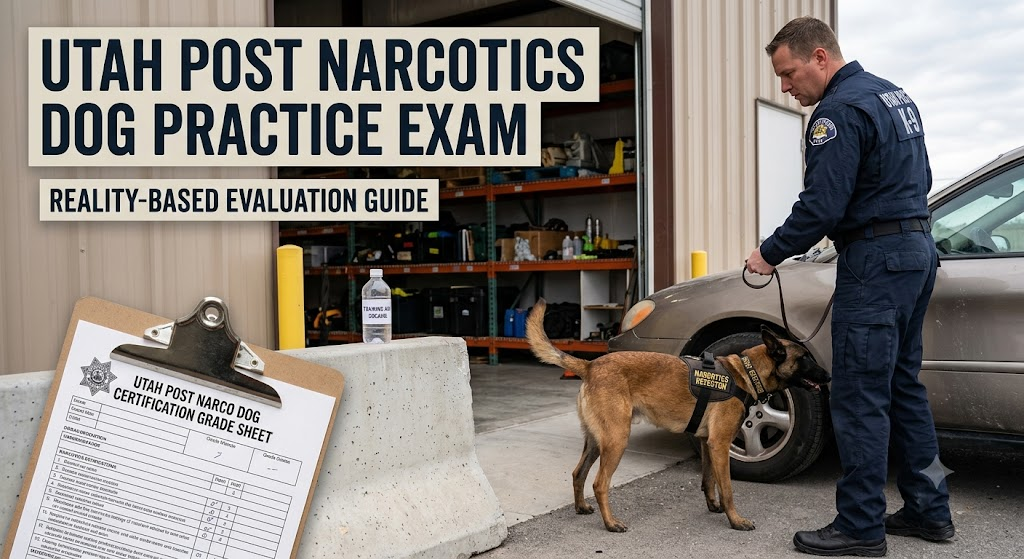
Additional Information
What the Course Entails and Exam Details
This specialized curriculum, defined by the Utah POST K-9 Program Narco Dog Training Manual, provides a standardized framework for training and evaluating a narcotics detection team. The manual outlines essential performance objectives that a K-9 must master under the guidance of its handler.
Core topics and skills covered in the coursework include:
Odor Recognition: Training the canine to reliably detect and differentiate the odors of specific controlled substances, including but not limited to Marijuana, Cocaine, Methamphetamine, and Heroin.
Searching Mechanics: Techniques for a systematic, methodical search of various environments to maximize coverage and efficiency.
K-9 Indication Behavior: Distinguishing between a canine's "alert" (natural behavior when perceiving target odor) and its "indication" (trained final response pointing to the source). The manual defines the requirements for a valid indication.
Handler Skills: Mastering leash handling, understanding and interpreting canine body language, and providing effective direction without influencing the dog’s natural search drive.
Safety and Obedience: Ensuring the canine possesses sufficient obedience skills to perform its function safely in public and operational environments.
Legal Guidelines: Foundational knowledge regarding search and seizure laws (Fourth Amendment) as they pertain to canine deployments.
Diversion and Distraction: Training the canine to ignore common "diversions" (odors placed to deceive, like coffee or food) and "distractions" (naturally occurring interesting odors, like other animals or toys).
What to Expect in the Final Exam
The Utah POST Narcotics Dog Final Certification is overwhelmingly a practical, reality-based field evaluation rather than a traditional written test. The canine team will be tested across multiple, diverse, and unpredictable scenarios that mirror operational deployments.
While the specific layout of a practice exam may vary, the final certification typically requires the K-9 team to:
Complete Multiple Search Scenarios: The team must perform searches in a minimum number of standardized settings, such as a residential sniff, automobile sniff (both interior and exterior), business/storage facility sniff, and sometimes specialized areas like livestock/stable sniffs or human clothing sniffs.
Locate Multiple Hidden Stashes: Within each scenario, the team must find two or three separate stashes of narcotics hidden in varying quantities.
Maintain 100?curacy: The standard is exceptionally high. A passing grade requires the team to locate and accurately indicate all hidden narcotic stashes within the allotted time. Crucially, no false indications (calling a "find" where no target odor is present) are permitted.
Score on Handing and Searching Skill: The judges evaluate not only if the drugs were found but how the team performed. Both "Searching Skill" (canine’s intensity, focus, and methodology) and "Handler Skill" (leash control, interpretation, and directional clarity) contribute to the overall rating.
Follow Standardized Grade Sheets: The final evaluation is scored using standard POST administrative tools that document searching skill, handler skill, and the team’s overall ability to identify target odor while ignoring blanks and diversions.
How to Study and Exam Centers
Preparation for the Utah POST Narcotics Dog Exam must be hands-on, consistent, and reflective of the POST manual’s guidelines.
How to Study:
Master the POST Manual: The official Utah POST K-9 Program Narco Dog Training Manual is your primary study guide. Understand every definition, standard, and grade sheet requirement.
Practice in Realistic Settings: Do not limit your training to a single location. Conduct practice searches in warehouses, residential rooms, varied vehicles, and open area "ranging" scenarios.
Train with Diversions and Blanks: Regularly incorporate common diversion odors (food, coffee, engine fluid) into your training problems. Include "blank" scenarios where no target odor is present to ensure your dog reliably confirms an "all clear."
Video Your Sessions: Reviewing footage of your training can reveal unconscious handler cues or subtle changes in your dog's alert behavior that you might miss in the moment.
Utilize Mock Scenarios: Use the grade sheets provided in the POST manual to conduct mock exams with a peer or supervisor acting as the judge.
Exam Centers and How to Register:
In Utah, K-9 certification is managed internally by POST.
Authorized School: Certification training and testing are provided through the Utah Peace Officer Standards and Training (POST) In-Service Training K-9 Program. This is typically held at the main POST facility.
Course Dates: Specific 8-week courses for Detector Dogs (including Narcotics) are offered periodically throughout the year (e.g., April-June, October-December). You must monitor the official POST website or contact the K-9 Program Sergeant directly for current registration dates.
Fees: Tuition is free for Utah officers, while a fee applies to out-of-state officers.
Job Opportunities from the Course
A Utah POST Narcotics Dog Certification is a specialized asset that dramatically enhances an officer’s career trajectory and unlocks specific, demanding roles within law enforcement.
Career paths this certification unlocks include:
K-9 Handler / Canine Officer
Narcotics Investigator / Detective
Special Operations Group (SWAT/Tactical) Support
Drug Task Force Member (Inter-agency)
Highway Patrol / Interdiction Officer
Correctional Facility K-9 Handler
K-9 Instructor / Trainer (requires subsequent instructor certification)
Disclaimer: This study guide is designed as an educational and preparation tool. For official guidelines, current schedules, and regulatory requirements, always consult the Utah Peace Officer Standards and Training (POST) K-9 Program directly.
Frequently Asked Questions
Reviews
5.0
Based on 0 reviews
Leave a Review
No reviews yet. Be the first to review!