
Utah Structural and Health Related Pest Practice
$69.00
- Buy to unlock unlimited access to all Quiz questions and Answers in this Quiz.
- After purchase you can print a PDF of the whole quiz at any point. The PDF will contain the questions and the correct answers.
About this Exam
In the state of Utah, protecting the health and property of residents from harmful pests is a critical responsibility.
The Utah Structural and Health Related Pest Practice exam is the mandatory certification hurdle for professionals dedicated to managing pests in, on, or around human dwellings, schools, hospitals, industrial establishments, and other structures. Managed and administered by the Utah Department of Agriculture and Food (UDAF), this license—often referred to as Category 7—validates that an applicator possesses the necessary knowledge to handle pesticides safely, identify common structural pests, and implement effective management plans that protect public health while minimizing environmental impact. It is designed for individuals seeking employment in the commercial pest control industry or for those performing pest control as part of their non-commercial duties (e.g., in-house maintenance).
Ready to test your knowledge?
Buy Now to Access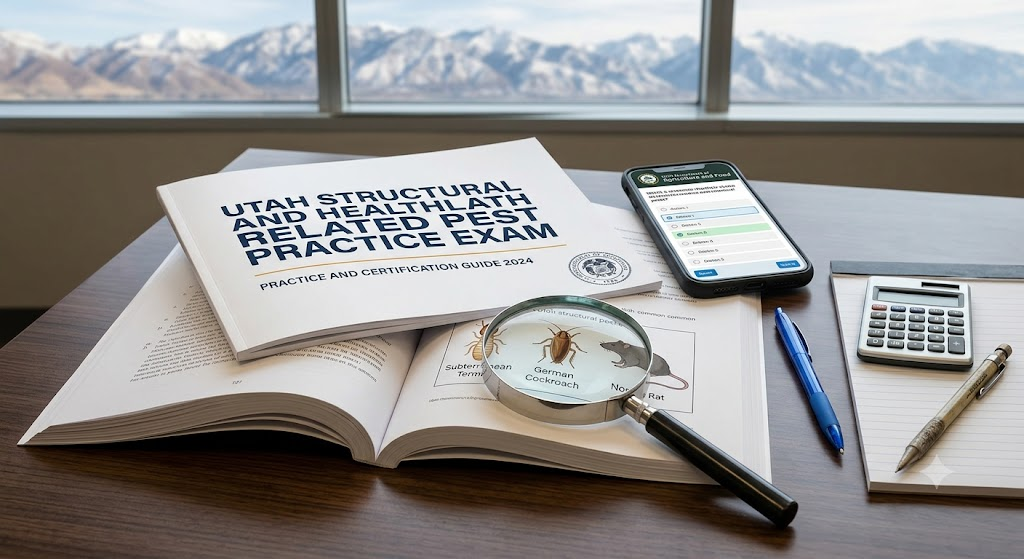
Additional Information
What the Course Entails and Exam Details
Preparing for this exam requires studying material that covers both general pesticide knowledge (Core) and specialized knowledge specific to the structural category. The comprehensive syllabus for the Category 7 exam includes the following core components:
1. General Pesticide Knowledge (Core):
Pesticide Laws and Regulations: Understanding federal (FIFRA) and specific Utah state laws governing the sale, use, and disposal of pesticides.
Pesticide Safety: Mastering the reading and interpretation of pesticide labels (the law), selecting proper Personal Protective Equipment (PPE), and first aid protocols.
Environmental Protection: Knowledge of how pesticides behave in the environment, preventing groundwater contamination, and protecting non-target organisms.
Application Equipment and Calibration: Principles of selecting, maintaining, and calibrating sprayers, dusters, and other application tools to ensure accurate dosages.
2. Structural Category Specifics (Category 7):
Integrated Pest Management (IPM) Principles: Emphasizing non-chemical control methods (sanitation, exclusion) and inspection before chemical application.
Pest Identification and Biology: Positive identification and life cycle knowledge of major structural pests:
Household Insects: Cockroaches, ants, fleas, flies, fabric pests (carpet beetles), and stored food pests.
Wood-Destroying Organisms: Termites (especially subterranean) and carpenter ants.
Vertebrate Pests: Domestic rodents (mice, rats) and biting/stinging pests (spiders, wasps).
Pest Control Strategies: Choosing appropriate chemical and non-chemical methods specifically for structures, including baits, dusts, and crack and crevice treatments.
What to Expect in the Final Exam
The Utah Structural and Health Related Pest Practice exam is a closed-book, multiple-choice assessment designed to test practical knowledge and problem-solving skills. You must be prepared for the specific rules and format established by UDAF:
Prerequisites: You must apply with UDAF and pay all applicable fees before you are permitted to schedule your examination. You will typically take two separate tests: the Pesticide Core Exam and the Category 7 Structural Exam.
Exam Format: The exams are administered digitally (computer-based) at official testing centers. All questions are multiple-choice.
Question Count: While official numbers can shift slightly, the Category 7 exam usually consists of approximately 50 to 100 questions.
Time Limit: You are usually given a strict time limit (e.g., 90 to 120 minutes per test) to complete your answers. You should allocate at least three hours if you plan to take both the Core and Category tests in one session.
Passing Score: A minimum score of 70% is required on both the Core and the Category 7 exams to obtain your license.
Testing Rules: You are not permitted to use any study materials, phones, or programmable calculators. Scratch paper and a simple calculator will be provided by the testing center. If you fail, there are waiting periods (e.g., 3 to 14 days, depending on the number of attempts) before you can retest.
How to Study and Exam Centers
Gaining your Utah pest control license requires a dedicated and structured approach to studying. Follow these actionable strategies to ensure success on test day:
1. Obtain Official Study Materials:
The essential study resources are the Utah Pesticide Applicator Core Manual and the Utah Category 7: Structural and Health-Related Pest Control Manual.
You can access and print these free PDF manuals directly from the Utah Department of Agriculture and Food (UDAF) website. It is recommended that you study these materials thoroughly as they are the direct source of all exam questions.
2. Study Methods:
Read the Label: Spend extensive time practicing how to read and interpret pesticide labels. Label interpretation is always a significant part of the exam.
Use Practice Tests: Utilize practice exams or quiz questions found online or in study guides. While they won't have the exact exam questions, they are invaluable for testing your knowledge of terms, math formulas for calibration, and pest biology.
Active Recall: Rather than just highlighting, write out summaries of each chapter. Focus on differentiating between similar pests and their unique biology and habits.
3. Exam Centers:
UDAF does not use third-party centers like Pearson VUE for initial licensing exams.
Exams must be scheduled and taken at designated UDAF field offices located throughout Utah (including Salt Lake City, Logan, Ogden, Provo, Richfield, and St. George). Appointments are mandatory, and walk-ins are only tested if space is available.
Visit the UDAF pesticide licensing page to find contact information for your nearest field office and schedule your examination.
Job Opportunities from the Course
Earning your Category 7 Structural Pest Control License is a significant career milestone, opening the door to a specialized and stable industry. This certification is in high demand by employers in both the private and public sectors across Utah.
Successfully passing this exam unlocks the following career paths and job titles:
Pest Control Technician: The fundamental role in the industry, performing inspections, diagnosing pest problems, and applying treatments for residential and commercial customers.
Commercial Pest Applicator: A licensed technician authorized to apply pesticides for hire (Commercial) or as an employee (Non-Commercial) of a business, institution, or government agency.
Structural Pest Inspector: Specializing in detailed inspections, particularly for real estate transactions, identifying signs of infestation or structural damage caused by wood-destroying organisms.
Service Manager: A leadership role within a pest control company, supervising technicians, managing routing and scheduling, and ensuring regulatory compliance.
Public Health Vector Control Specialist: Employment with local health departments or mosquito abatement districts, focusing on managing pests that carry human diseases (like rodents or biting insects).
Franchise Owner or Entrepreneur: With significant experience and business acumen, your license allows you to start and operate your own licensed pest control business in Utah.
Frequently Asked Questions
Reviews
5.0
Based on 0 reviews
Leave a Review
No reviews yet. Be the first to review!