
Utah Web Development 1 Practice Test
$69.00
- Buy to unlock unlimited access to all Quiz questions and Answers in this Quiz.
- After purchase you can print a PDF of the whole quiz at any point. The PDF will contain the questions and the correct answers.
About this Exam
The Utah Web Development 1 certification is a foundational credential designed for students and aspiring IT professionals looking to launch a career in web creation. This exam validates proficiency in the core building blocks of the modern internet. It is specifically tailored for those in Utah’s Career and Technical Education (CTE) pathways, high school students, or adult learners seeking to demonstrate their readiness for entry-level development roles. Earning this certification proves to employers that you possess the essential technical skills needed to build and maintain professional websites.
Ready to test your knowledge?
Buy Now to Access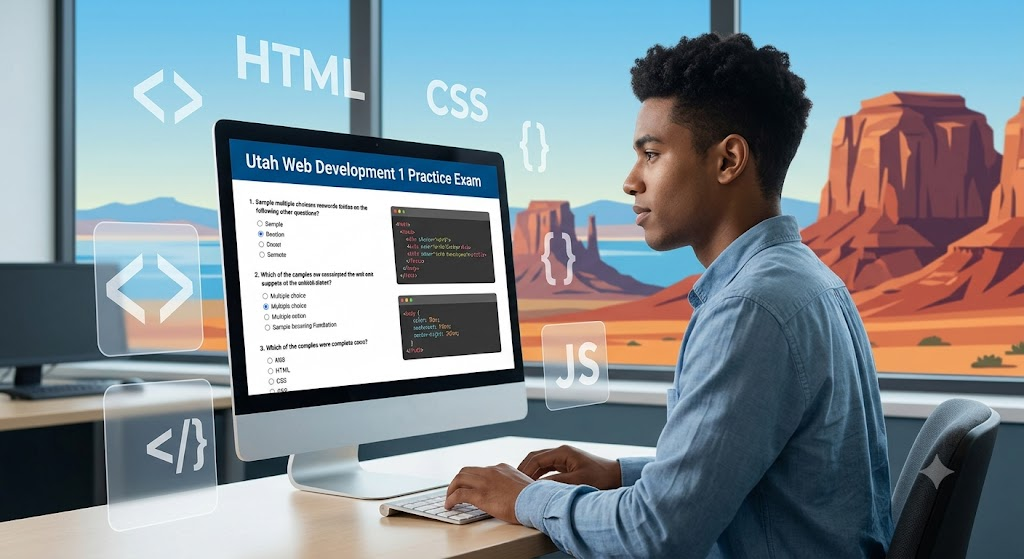
Additional Information
What the Course Entails and Exam Details
This course provides a robust introduction to front-end web technologies and best practices. Candidates must master computational thinking along with the syntax and implementation of programming languages. The primary domains covered within the syllabus include:
Web Literacy and Fundamentals: Understanding how the internet functions, including the roles of servers, clients, and protocols. Students also learn about internet ethics, copyright laws, and project planning methodologies.
HTML5 (HyperText Markup Language): Master structural semantic tagging. This includes creating document structures, forms, tables, lists, and embedding media according to modern W3C standards.
CSS3 (Cascading Style Sheets): Learn how to style and lay out web pages effectively. Key topics include the Box Model, color theory, typography, selectors, specificity, and foundational responsive design techniques using Flexbox or Grid.
Basic [removed] Introduction to client-side scripting to add interactivity. Candidates are tested on variables, data types, basic operators, and conditional statements.
Tools and Deployment: Familiarity with code editors, debugging tools within browsers, and the process of publishing a website to a live server.
What to Expect in the Final Exam
Knowing the structure of the exam is key to reducing test anxiety. The Utah Web Development 1 Final Exam is typically administered through an approved testing platform within the Utah education system, such as YouScience Brightpath (formerly Precision Exams).
Format: The exam consists entirely of multiple-choice questions. These questions test both theoretical knowledge and practical application, such as predicting the output of a snippet of HTML or CSS code.
Time Limit: Candidates are usually given approximately 60 to 90 minutes to complete the assessment, depending on the specific testing environment.
Passing Score: A passing score generally falls within the range of 70% to 80%, though you should verify the exact threshold with your instructor or proctor before the test begins.
Rules: The exam is strictly closed-book. No external resources, notebooks, websites, or code repositories are permitted during the testing session.
How to Study and Exam Centers
Effective preparation requires a combination of rote learning and hands-on practice.
Study Strategies:
Begin by actively coding. Do not just read about HTML and CSS; build small projects, restructure pages, and intentionally break code to learn how to fix it. Utilize flashcards to memorize specific semantic tags, CSS properties, and JavaScript syntax rules. Focus heavily on the "Utah Web Development 1 Practice Test" mentioned in your preparation materials to identify knowledge gaps. Finally, ensure you understand the "why" behind the code, such as why semantic HTML is better for accessibility than generic tags.
Exam Centers:
Because this is primarily a state-administered CTE certification, the official exam is not typically taken at public centers like Pearson VUE. Instead, the exam is proctored directly at authorized locations.
High Schools: If you are a high school student, your teacher will schedule the exam to be taken in your school’s computer lab.
Technical Colleges: Adult learners or students not currently in high school may take the exam at authorized Utah System of Higher Education (USHE) facilities, such as Davis Technical College, Ogden-Weber Technical College, or Salt Lake Community College.
Consult the Utah State Board of Education (USBE) CTE website for a full list of authorized testing partners if you are not currently enrolled in a preparatory course.
Job Opportunities from the Course
While this Level 1 certification is foundational, it is a significant asset that proves technical competency to employers. It serves as a strong stepping stone to Level 2 advanced development courses or immediate entry-level tech roles. The following career paths are unlocked or enhanced by holding this credential:
Junior Web Designer: Focusing on the layout, visual appearance, and usability of websites using HTML and CSS.
Web Content Specialist: Responsible for updating, managing, and structuring content within Content Management Systems (CMS) using standard markup.
Junior Front-End Developer: A starting role focused on translating design mockups into functional code.
QA Tester (Web): Testing websites for bugs, compatibility issues, and adherence to structural standards.
Technical Support Specialist (Web Services): Assisting clients with basic website hosting or coding issues.
Frequently Asked Questions
Reviews
5.0
Based on 0 reviews
Leave a Review
No reviews yet. Be the first to review!