
Vancouver International Airport (YVR) Class D Airside Vehicle Operator’s Permit (D-AVOP) Practice Test
$69.00
- Buy to unlock unlimited access to all Quiz questions and Answers in this Quiz.
- After purchase you can print a PDF of the whole quiz at any point. The PDF will contain the questions and the correct answers.
About this Exam
The Vancouver International Airport (YVR) Class D Airside Vehicle Operator’s Permit (D-AVOP) is a specialized certification mandatory for personnel required to drive vehicles on the "controlled" surfaces of the airport, specifically taxiways and runways. While the Class DA permit limits operators to aprons and vehicle corridors, the D-AVOP authorizes access to areas where movement is directly controlled by Air Traffic Control (ATC). This permit is designed for highly skilled operators, including airfield maintenance staff, aircraft towing specialists, rescue and firefighting personnel, and operations officers. It ensures that those navigating the critical maneuver areas of YVR possess the advanced knowledge of airport geometry, safety protocols, and radio communication necessary to prevent runway incursions and maintain seamless operations at Canada's second-busiest airport.
Ready to test your knowledge?
Buy Now to Access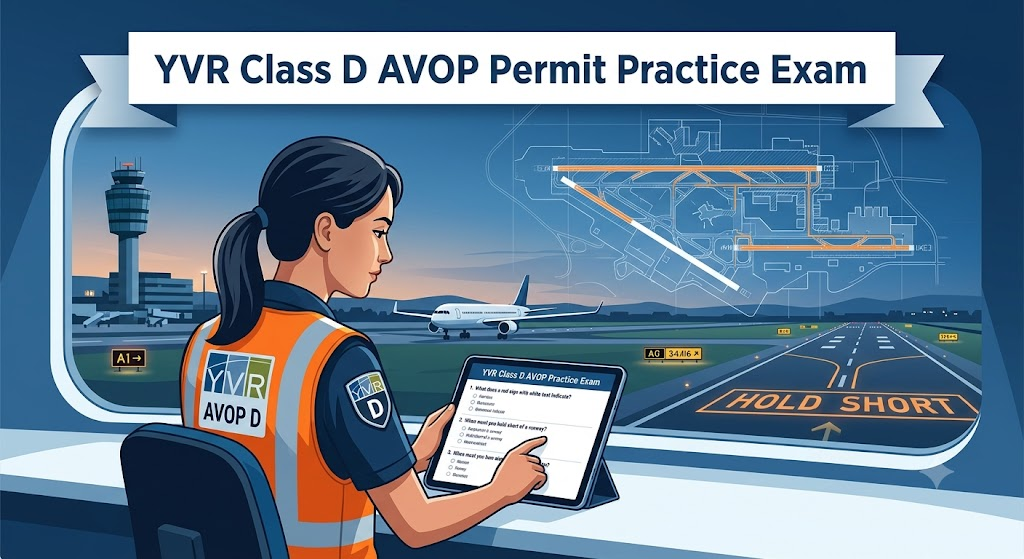
Additional Information
What the Course Entails and Exam Details
To obtain a Class D-AVOP, candidates must master a comprehensive curriculum focused on high-stakes airfield safety and procedural knowledge. The course details and final exam preparation deep-dive into the following core areas:
YVR Airside Traffic Directives (ATDs): Absolute familiarity with the specific rules governing vehicle movement on taxiways and runways at Vancouver International.
Airport Geography and Naming Conventions: A granular understanding of YVR's complex layout, including the precise location and identification of all runways, taxiways, intersection markings, and holding positions.
Advanced Radio Telephony Procedures: Mastery of the standard phraseology, phonetic alphabet, and communication protocols required for clear, concise, and professional interaction with Nav Canada Air Traffic Control (ATC).
Signage, Markings, and Lighting: The ability to instantly recognize and interpret all maneuvering area signs (mandatory instruction, location, direction), pavement markings (enhanced taxiway centerlines, hold short lines), and airfield lighting systems.
Runway Incursion Prevention: Critical protocols and situational awareness strategies designed to eliminate unauthorized entry onto an active runway.
What to Expect in the Final Exam
The D-AVOP examination process is a rigorous, multi-part evaluation that ensures candidates are fully prepared for the responsibilities of operating on controlled surfaces.
The Written Knowledge Test:
The final assessment begins with a comprehensive written exam, typically conducted in a multiple-choice format. This test rigorously evaluates your theoretical knowledge of the YVR ATDs, radio procedures, and airport geography. The examination is designed to be challenging, often requiring a passing score of 80% or higher, reflecting the low tolerance for error in airside operations. It is a timed exam, necessitating quick and accurate recall of safety protocols.
The Practical Driving Assessment:
Upon successful completion of the written test, candidates must pass a practical driving exam on the actual maneuvering area of YVR. During this component, an examiner will assess your ability to apply theoretical knowledge in a real-world environment. You will be expected to demonstrate flawless communication with ATC, navigate specified routes across taxiways and runways without error, adhere strictly to all signage and markings, and maintain constant situational awareness. A critical error, such as a runway incursion or failure to follow ATC instructions during the practical, results in immediate failure.
How to Study and Exam Centers
Effective preparation is essential for success in the D-AVOP exam. Candidates should adopt a multifaceted study strategy:
Primary Study Materials: Your single most important resource is the current edition of the YVR Airside Traffic Directives (ATDs) manual. This is the source material for the written exam. Study it thoroughly and repeatedly.
Map Study: Spend significant time memorizing the YVR airport diagram. Be able to visualize taxiway routes, runway intersections, and hot spots without looking at the map.
Practice Exams: Utilizing high-quality YVR Class D AVOP practice tests is one of the most effective ways to prepare. These tests simulate the exam environment, familiarize you with the questioning style, and help identify areas where you need further study.
Radio Communication Practice: Listen to live ATC audio (if available online) to understand the cadence and phraseology of real transmissions. Practice reading back instructions clearly and concisely.
Exam Centers: The final D-AVOP examination (both written and practical) is administered directly by the Vancouver Airport Authority. Specifically, it is coordinated through the YVR AVOP Licensing and Training office, located on-site at the airport. Candidates must usually be registered for the exam through their employer, who must verify the operation need for the D-class permit.
Job Opportunities from the Course
Earning a Class D-AVOP is a significant achievement that opens the door to advanced, specialized, and often higher-paying career paths within the aviation industry at YVR.
This certification is typically a mandatory requirement for the following roles:
Airfield Maintenance Specialist (operating heavy snow removal or runway sweepers)
Aircraft Towing Specialist (moving large commercial aircraft between gates and hangars)
YVR Operations Officer (Airside Security and Safety)
Airport Rescue and Firefighting (ARFF) Personnel
Contractors supervising major airside construction projects
Wildlife Control Officers
By obtaining your D-AVOP, you demonstrate a high level of professional competence and a commitment to maintaining the highest safety standards in one of the most dynamic operating environments in the world.
Frequently Asked Questions
Reviews
5.0
Based on 0 reviews
Leave a Review
No reviews yet. Be the first to review!