
Vascular Targeted Photodynamic (VTP) Diagnostic Imaging Practice Test
$69.00
- Buy to unlock unlimited access to all Quiz questions and Answers in this Quiz.
- After purchase you can print a PDF of the whole quiz at any point. The PDF will contain the questions and the correct answers.
About this Exam
Vascular Targeted Photodynamic (VTP) therapy is a cutting-edge, minimally invasive medical procedure that uses a photosensitizing drug and targeted laser light to destroy cancer cells by cutting off their blood supply. Due to its precise nature, success hinges entirely on advanced and accurate diagnostic imaging for patient selection, treatment planning, and real-time guidance. The VTP Diagnostic Imaging Practice Test is a comprehensive tool designed for medical professionals, such as radiologists, interventional specialists, and advanced imaging technologists. It validates their specialized knowledge and competency in the crucial imaging protocols that underwrite this revolutionary oncology treatment. Mastering this diagnostic specialization ensures you are at the forefront of personalized, minimally invasive cancer care.
Ready to test your knowledge?
Buy Now to Access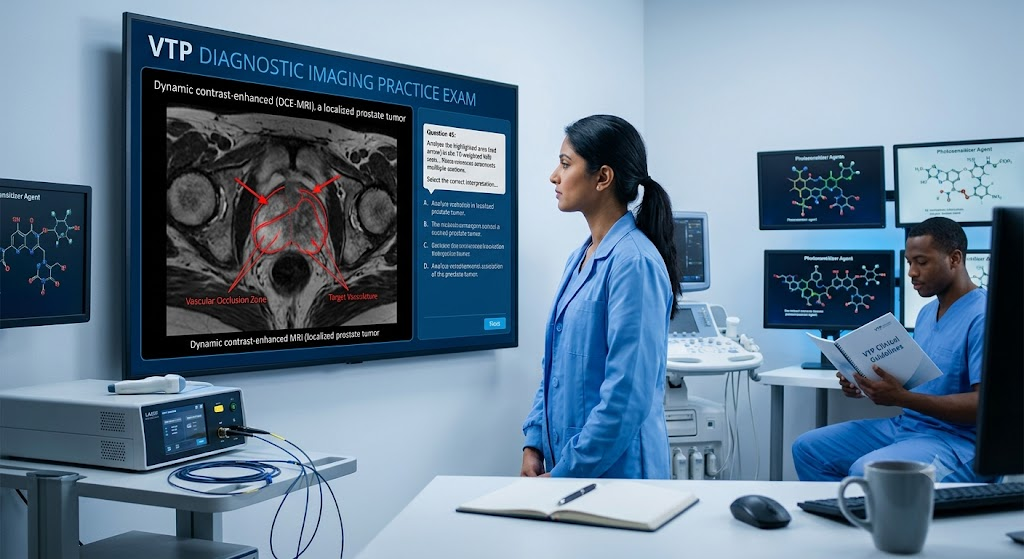
Additional Information
What the Course Entails and Exam Details
This practice exam tests a multidisciplinary syllabus that bridges oncology, pharmacology, and sophisticated imaging physics. It is structured around the core competencies required to support a successful VTP program. Students must demonstrate a deep understanding of the whole VTP workflow. Key areas covered include:
VTP Mechanisms and Pharmacology: You will be tested on the pharmacokinetics of the specific photosensitizers used, understanding how they accumulate in the tumor vasculature and the timing required for optimal light activation.
Imaging Modalities for VTP: The exam focuses heavily on your proficiency with key modalities. This includes interpreting Multi-Parametric MRI (mpMRI) for precise tumor localization and the use of Transrectal Ultrasound (TRUS) for real-time laser fiber placement.
Treatment Planning and Contour Mapping: Candidates must know how to accurately delineate the target treatment zone and the surrounding 'organs-at-risk' on specialized planning software.
Intraoperative Guidance: You will cover the skills needed to provide dynamic, live imaging support to the interventionalist during the light-delivery phase of the VTP procedure.
Patient Safety and Protocol: This section covers standard operating procedures, including light safety measures for both the patient and the medical team.
What to Expect in the Final Exam
While actual exam parameters are set by the specific credentialing body, most specialized medical imaging exams follow a standardized format to ensure rigorous assessment. The VTP Diagnostic Imaging Final Exam is typically a proctored, closed-book assessment. You should expect a format consisting primarily of Multiple Choice Questions (MCQs), which may include scenario-based case studies requiring the interpretation of dynamic imaging clips.
Exam Duration: Candidates are generally allotted 2 to 3 hours to complete the test.
Number of Questions: Expect between 100 and 150 questions.
Passing Score: The passing threshold is usually set between 70% and 75%.
Specific Rules: You will need valid government-issued identification. Standard rules regarding the prohibition of electronic devices and study materials apply. Due to the technical nature of the exam, it may be delivered via a secure, high-resolution testing platform capable of displaying complex medical imagery.
How to Study and Exam Centers
Preparation for a specialized exam like the VTP Diagnostic Imaging Practice Test requires a dedicated, structured approach. You cannot rely on general imaging knowledge alone.
Actionable Study Strategies:
Utilize Practice Tests: Make this practice exam the cornerstone of your study plan. It is the best way to familiarize yourself with the question style, difficulty level, and time constraints. Analyze every incorrect answer to understand the rationales.
Review the Official Curriculum: Study the specific syllabus or recommended reading list provided by the credentialing or awarding organization. Focus heavily on clinical trial data and manufacturer-specific protocols for VTP technologies like TOOKAD®.
Analyze Real-World Case Studies: Reviewing anonymized pre-operative, intra-operative, and post-operative scans from actual VTP cases is invaluable. This builds practical skill in tumor demarcation and treatment effect assessment.
Join Professional Forums: Engage with online communities or professional societies dedicated to interventional oncology or photodynamic therapy to discuss complex topics and emerging imaging techniques.
Exam Centers:
Authorized exams are typically administered through secure, global testing network providers such as Pearson VUE or Prometric, which have dedicated physical testing centers globally. Alternatively, some organizations offer the exam through secure online proctoring portals, allowing you to take the test from your own location under strict supervision. Always check the official awarding body’s website for the most current list of authorized test delivery methods and locations.
Job Opportunities from the Course
A certification or validated expertise in VTP Diagnostic Imaging distinguishes you in the competitive fields of radiology and oncology. It signifies a specialist competency in a high-growth area of cancer care.
Interventional Radiologist specializing in Oncology Guidance
Lead Medical Imaging Technologist for Focal Therapy Programs
MRI Specialist in Prostate Cancer Localization and Delineation
Urology-Oncology Imaging Coordinator
Clinical Application Specialist for VTP Technology Manufacturers
Research Coordinator in Minimally Invasive Oncology Clinical Trials
Frequently Asked Questions
Reviews
5.0
Based on 0 reviews
Leave a Review
No reviews yet. Be the first to review!