
VATI Predictor Practice Test
$69.00
- Buy to unlock unlimited access to all Quiz questions and Answers in this Quiz.
- After purchase you can print a PDF of the whole quiz at any point. The PDF will contain the questions and the correct answers.
About this Exam
The VATI Predictor, specifically known as the Virtual ATI Comprehensive Predictor Assessment, is one of the final and most significant milestones in a nursing student's academic journey. This powerful evaluative tool serves as a comprehensive "exit exam" for students nearing the completion of their Registered Nurse (RN) or Practical Nurse (PN) program. The primary purpose of the assessment is not merely to provide a grade, but to calculate a statistical "Predicted Probability of Passing" the ultimate hurdle: the NCLEX licensure exam. By simulating the rigors, content mix, and pressure of the official NCLEX, the VATI Predictor gives students and their educational institutions a precise measurement of readiness, allowing them to pinpoint critical knowledge gaps before the real licensure attempt.
Ready to test your knowledge?
Buy Now to Access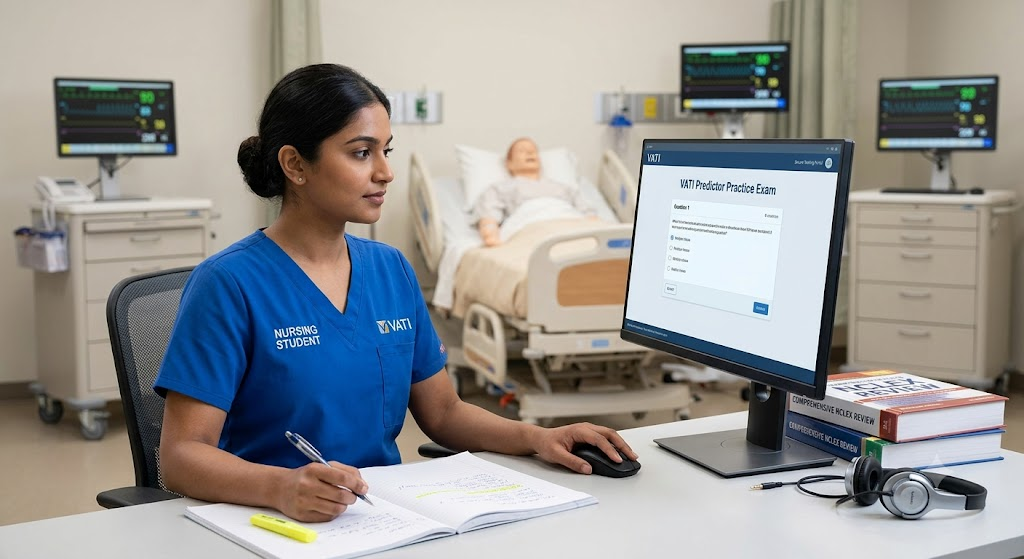
Additional Information
What the Course Entails and Exam Details
While the VATI Predictor is the assessment itself, it is typically administered as the culmination of the Virtual ATI NCLEX Review "course." This course is an intensive, self-paced, online review program often integrated into a nursing student’s final semester (the Capstone course). It pairs students with a dedicated Virtual ATI Educator who provides personalized guidance, assigns modules based on previous performance, and helps them progress through content review. The course material is derived directly from the major NCLEX Client Needs categories. Students will review core principles within Physiological Integrity, which includes Medical-Surgical nursing, Pharmacology, and advanced physiological adaptation. The curriculum also thoroughly covers Health Promotion and Maintenance, including pediatric and maternal-newborn care; Psychosocial Integrity, focusing on mental health nursing; and Safe and Effective Care Environment, which assesses skills in management of care, safety, and infection control.
What to Expect in the Final Exam
You should expect the final, proctored VATI Predictor to be a rigorous and accurate simulation of the licensure experience. The assessment is usually a three-hour, computer-based exam consisting of 180 items. Of these items, approximately 150 are typically scored, with the remaining items serving as pretest questions for future assessments. The vast majority of the questions are standard multiple-choice. However, contemporary versions of the exam are designed to mirror the Next Generation NCLEX (NGN), meaning you must prepare for interactive item types such as case studies, drag-and-drop sequencing, and extended multiple-response questions. There is no static "passing" raw score; rather, your percentage correct is converted into a specific "Probability of Passing NCLEX" percentage. While many nursing programs set a threshold of 90% or higher probability for a student to receive the "Green Light" to register for the NCLEX, you must check your specific program’s syllabus for its unique graduation requirements.
How to Study and Exam Centers
Effective study for the VATI Predictor requires a tactical combination of content mastery and test-taking strategy. Your best asset is the Virtual ATI Review course itself; engage fully with your educator and don’t just complete modules—analyze your rationales. Actionable study methods include dedicating fixed hours each day to high-yield content review and taking timed, standardized practice quizzes to build stamina. When you receive results from any practice tests, utilize the "Focused Review" feature immediately. This generates a personalized study plan detailing the exact "Topics to Review" where you missed questions. The VATI Predictor is a secure, proctored examination. You will typically not take this exam at a public testing vendor. Instead, it is administered either on-campus at your authorized school under faculty supervision or through an authorized online proctoring service (such as Proctorio) within the ATI portal, adhering to strict security protocols.
Job Opportunities from the Course
Passing your nursing program and the VATI Predictor clears the path for the most crucial career step: taking and passing the NCLEX to gain your nursing license. Once licensed, an incredible array of career paths opens to you. Specific job opportunities and roles you may unlock include:
Clinical Roles:
Registered Nurse (RN) - Staff Nurse (Medical-Surgical, Intensive Care Unit, Emergency Department)
Licensed Practical Nurse (LPN/LVN) - Skilled Nursing Facility Nurse
Pediatric Nurse
Maternal-Newborn/Labor and Delivery Nurse
Operating Room/Perioperative Nurse
Mental Health/Psychiatric Nurse
Home Health Nurse
Hospice Nurse
Specialized and Non-Bedside Roles:
Telehealth/Telephone Triage Nurse
Informatics Nurse Specialist
Nurse Case Manager
Public Health/Community Health Nurse
School Nurse
Occupational Health Nurse
Legal Nurse Consultant
Nurse Educator (clinical or academic)
Frequently Asked Questions
Reviews
5.0
Based on 0 reviews
Leave a Review
No reviews yet. Be the first to review!