
VCE Legal Studies Practice Exam
$69.00
- Buy to unlock unlimited access to all Quiz questions and Answers in this Quiz.
- After purchase you can print a PDF of the whole quiz at any point. The PDF will contain the questions and the correct answers.
About this Exam
VCE Legal Studies is a vibrant and dynamic course designed for Victorian senior high school students fascinated by the machinery of justice, law, and government.
This subject is designed for students who want to understand how laws are made, how the court hierarchy functions, and how the legal system resolves disputes to maintain social cohesion.
If you are interested in rights, responsibilities, and the balance of power between individuals and the state, this course provides the analytical tools to critique the Victorian and Australian legal systems.
Mastering a VCE Legal Studies Practice Exam is the most effective diagnostic step a student can take, identifying knowledge gaps and refining essential exam techniques before the final assessment.
Ready to test your knowledge?
Buy Now to Access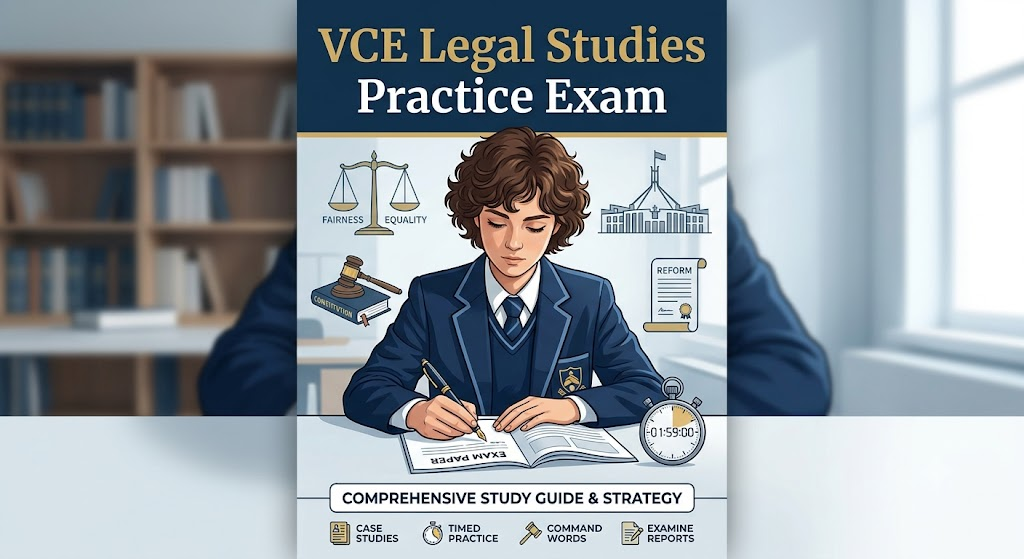
Additional Information
What the Course Entails and Exam Details
The VCE Legal Studies curriculum, specifically Units 3 and 4 which are externally examinable, investigates the mechanisms of the Australian legal system and their effectiveness.
Core topics focus on the overarching principles of justice: fairness, equality, and access, assessing how well these principles are upheld in practice.
The course entails a deep dive into the Victorian criminal justice system, including the roles of the police, courts, and institutions available to assist an accused person and victims of crime.
Students also master the complexities of the civil justice system, examining dispute resolution bodies like VCAT and judicial powers such as case management and remedies.
Furthermore, the syllabus covers law-making processes, detailing the relationship between Parliament and the courts, the impact of the Australian Constitution, and how the people can influence law reform.
What to Expect in the Final Exam
The final VCE Legal Studies exam is a written paper that demands not only recall of legal principles but also the ability to apply, analyze, and evaluate legal scenarios.
The exam is historically 2 hours in duration, plus 15 minutes of crucial reading time where you should plan your extended responses.
The total mark allocation is typically 80 marks, and the score you receive contributes 50% to your final VCE study score, making it a pivotal assessment.
The paper is split into two sections: Section A consists of short-answer and extended-response questions ranging from 2 to 10 marks each.
Section B requires students to use stimulus material, such as media clips, case studies, or legal scenarios, to answer integrated questions that test their ability to synthesis knowledge.
A central element of success is understanding the ‘command words’; you must know exactly how to tailor your response when asked to ‘describe,’ ‘discuss,’ ‘evaluate,’ or ‘compare.’
How to Study and Exam Centers
Active recall and timed repetition are the keys to acing VCE Legal Studies, rather than just passively re-reading your textbook.
Your most valuable study tools are past VCAA exam papers and, crucially, the associated Examiner Reports, which provide model answers and reveal common student mistakes.
Create flowcharts for complex processes like the passage of a bill through parliament or the stages of a criminal trial, as visualization strengthens memory.
Develop flashcards for essential legal terminology, definitions, and recent case studies, ensuring you can use precise language under pressure.
Practice writing 10-mark extended responses under strict timed conditions, focusing on structuring a logical, balanced argument that uses evidence effectively.
Regarding exam logistics, VCE exams are standardized and administer by the Victorian Curriculum and Assessment Authority (VCAA).
You will not take this exam at generic centers like Pearson VUE; instead, the final written exams are almost exclusively held at your own authorized school or a nearby central facility arranged by your school’s VCE coordinator.
Job Opportunities from the Course
A strong foundation in VCE Legal Studies is the essential first step on a pathway toward diverse and rewarding careers in the legal and public sectors.
While you will need further tertiary study to fully qualify, the critical thinking, analytical, and communication skills unlocked by this course are highly valued in the following job titles:
Solicitor or Barrister
Paralegal or Legal Assistant
Judge’s Associate
Court Registrar
Police Officer (State or Federal)
Criminologist or Criminal Justice Analyst
Policy Adviser for Government Departments
Human Rights Advocate or Mediator
Journalist (specializing in legal or political reporting)
Conveyancer
Legal Compliance Officer
Frequently Asked Questions
Reviews
5.0
Based on 0 reviews
Leave a Review
No reviews yet. Be the first to review!