
VCE Revolutions Practice Exam
$69.00
- Buy to unlock unlimited access to all Quiz questions and Answers in this Quiz.
- After purchase you can print a PDF of the whole quiz at any point. The PDF will contain the questions and the correct answers.
About this Exam
The Victorian Certificate of Education (VCE) History: Revolutions is one of the most intellectually stimulating and challenging subjects available to senior secondary students in Victoria, Australia. This course is specifically designed for Year 12 students (or high-achieving Year 11 students) who are curious about the past and eager to understand the seismic shifts that have shaped the modern political landscape. This practice exam serves as a crucial diagnostic tool, allowing students to measure their readiness for the final external examination administered by the Victorian Curriculum and Assessment Authority (VCAA). It provides a realistic simulation of the high-stakes testing environment, testing both narrative recall and deep analytical skills regarding key historical upheavals.
Ready to test your knowledge?
Buy Now to Access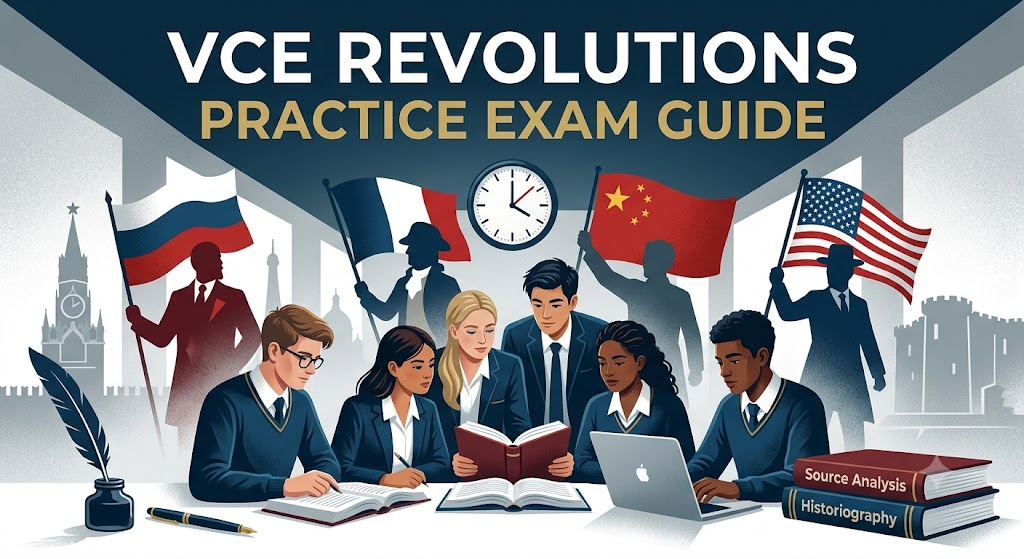
Additional Information
What the Course Entails and Exam Details
VCE History Revolutions focuses on the intense periods of political and social change that dismantled old regimes and forged new societies. The core topics, or syllabus, are structured around four significant historical events, from which schools select two to study in detail for the entire year: the Russian Revolution, the French Revolution, the Chinese Revolution, and the American Revolution. The course entails a comprehensive exploration of two key Areas of Study (AoS) for each chosen revolution.
First, students investigate "Causes of Revolution," examining the role of revolutionary ideas, prominent leaders, popular movements, and pivotal events that generated the pressure to overthrow the existing order.
Second, the course covers "Consequences of Revolution," analyzing the dramatic challenges faced by new regimes as they sought to consolidate power. This entails examining the new society's response to crises like counter-revolution or war, and evaluating the degree of social, political, and economic change achieved. The detailed knowledge required demands rigorous reading and a sophisticated grasp of historical context.
Furthermore, students must master critical historical skills, such as interpreting primary and secondary sources, analyzing conflicting historical interpretations (historiography), and constructing logical, evidence-based historical arguments.
What to Expect in the Final Exam
The final VCE History: Revolutions exam is a standard, paper-based written assessment that takes place toward the end of the academic year. It contributes 50 percent to your overall study score. Students are permitted 15 minutes of reading time, followed by exactly 2 hours of writing time. The examination paper structure is divided into two main sections: Section A and Section B.
Section A focuses on the first revolution you studied and consists of source analysis and short-answer questions. You will be provided with a separate Sources Book containing three or four different sources (visual or written) relevant to that revolution. You must answer several questions that require you to extract information, identify perspectives, compare different sources, and write an extended response of around 8-10 marks drawing on the provided evidence. Section A is worth a total of 25 marks.
Section B requires you to select one revolution (the other one you studied) and write a formal essay. You will typically be given four different essay prompts—one for each of the four possible revolutions—and you must respond to the one matching your specific focus. This essay is worth a total of 20 marks and is assessed against criteria that prioritize a coherent argument, accurate historical knowledge, application of thinking concepts (like cause and consequence), and the use of primary sources, perspectives, and historical interpretations. The final VCAA rules set strict guidelines on permissible materials, which are typically restricted to blue or black pens, pencils, highlighters, and no unauthorized notes or electronics. There is no simple "passing score," but your performance determines your study score out of 50, which is then used to calculate your ATAR.
How to Study and Exam Centers
Preparation for this rigorous exam requires dedication, strategy, and consistent effort. We highly recommend that you incorporate the following actionable study strategies into your revision plan.
First and foremost, do not just memorize facts; you must understand the narrative arc and the historiographical debates. Practice writing a high volume of responses, both short-answers under the pressure of timed conditions and full, structured essays. This process refines your time management and helps you identify which quotes are most versatile for different arguments.
Develop a thorough grasp of conflicting historical interpretations. You must know the differing arguments of key historians who specialize in your chosen revolutions. Be prepared to quote them and evaluate why they hold that view.
Create organized study resources. This entails making extensive timelines that visualize the chronology of events, as well as detailed profiles of key revolutionary leaders and groups. Many students find success by organizing their notes with color-coded highlighting, for example, using one color for primary source quotes and another for secondary historical interpretations.
In addition to your school textbook, engage with diverse, reliable digital resources. Websites like Alpha History offer accessible overviews, while the VCAA official website provides essential past examination papers, examiner reports, and the complete study design document.
When the time comes for the actual exam, you will not need to locate commercial testing centers like Pearson VUE. Instead, the external VCE exams are held strictly at authorized schools across Victoria. The VCAA organizes these assessments, and they are typically hosted by your own secondary school or a neighboring host school, with strict supervision rules and standardized conditions enforced across the state.
Job Opportunities from the Course
Mastering the complex analysis required by VCE History: Revolutions unlocks crucial thinking and communication skills that are vital in several highly respected career paths. These skills do not lead to a specific "certification" job, but rather lay the groundwork for university-level study or professional development in diverse sectors.
Secondary School History Teacher
Archivist or Museum Curator
Academic Researcher or Historian
Lawyer or Legal Advocate
Political Analyst or Journalist
Diplomat or International Relations Officer
Public Service Policy Officer
Historical Consultant for Film and Television
Heritage Management Specialist
Frequently Asked Questions
Reviews
5.0
Based on 0 reviews
Leave a Review
No reviews yet. Be the first to review!