
VCFD Fire Control Worker Practice Test
$69.00
- Buy to unlock unlimited access to all Quiz questions and Answers in this Quiz.
- After purchase you can print a PDF of the whole quiz at any point. The PDF will contain the questions and the correct answers.
About this Exam
The VCFD Fire Control Worker certification represents a critical entry point for individuals dedicated to a career in public safety and fire services. This exam is meticulously designed for aspiring fire service professionals seeking employment or advancement within the department.
It serves as a comprehensive assessment tool to ensure that candidates possess the necessary foundational knowledge, aptitude, and reasoning skills required to excel in the demanding role of a Fire Control Worker.
By validating these core competencies, the certification maintains the high standards of operational readiness and safety expected by the department and the community it serves.
Ready to test your knowledge?
Buy Now to Access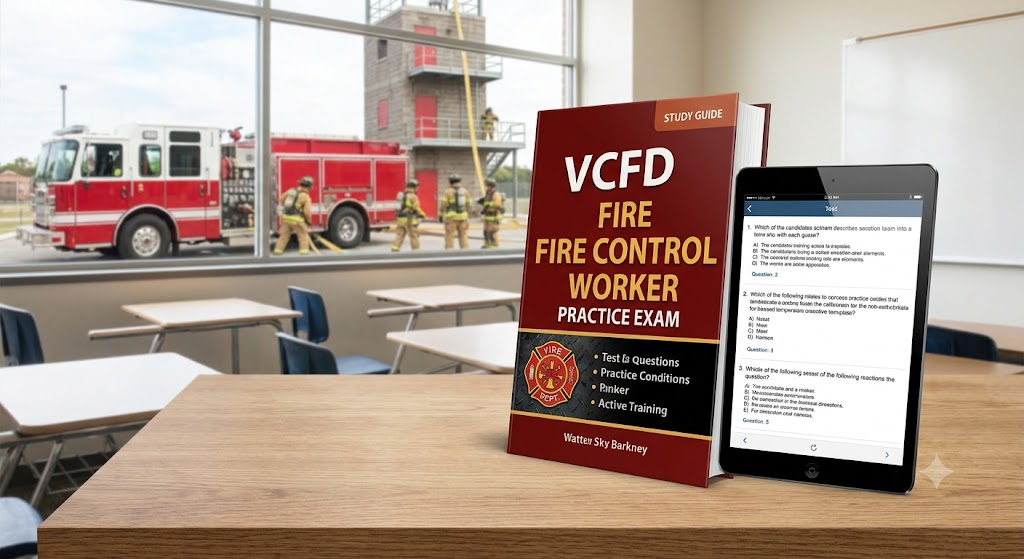
Additional Information
What the Course Entails and Exam Details
While the specific curriculum may vary depending on prerequisite training, the exam primarily evaluates cognitive abilities essential for firefighting and emergency response scenarios. Candidates are not usually tested on advanced firefighting tactics at this stage but rather on the intellectual foundations needed to learn those tactics.
The core areas assessed typically include:
Mechanical Aptitude: Understanding basic mechanical principles, tool usage, and how devices operate, which is crucial for handling firefighting equipment.
Reading Comprehension and Verbal Reasoning: The ability to read, understand, and interpret complex written materials, directives, and safety protocols accurately and quickly.
Mathematical Reasoning: Practical application of mathematics, including addition, subtraction, multiplication, division, fractions, and basic algebra, often applied to scenarios like calculating hose pressure or resource allocation.
Spatial Orientation and Situational Awareness: The ability to visualize objects in three dimensions and maintain navigation and orientation within unfamiliar or complex environments.
Logic and Problem-Solving: Applying inductive and deductive reasoning to analyze situations, identify critical information, and make sound decisions under pressure.
What to Expect in the Final Exam
The final VCFD Fire Control Worker exam is a comprehensive written test administered in a controlled environment. The exact logistics can differ by testing cycle, but candidates should generally prepare for the following format:
Exam Format: The test is usually composed entirely of multiple-choice questions. This standardized format ensures objective and efficient grading of a large volume of candidates.
Time Limit: The exam is strictly timed. Candidates must manage their time effectively to complete all sections within the allotted period, which often ranges from two to four hours depending on the specific test version.
Passing Score: The department establishes a competitive passing threshold, often 70% or higher. However, since hiring processes are highly competitive, achieving the minimum passing score does not guarantee advancement; higher scores significantly improve a candidate's standing in the recruitment pool.
Specific Rules: Standard testing protocols apply. No outside study materials, electronics (like smartwatches or cell phones), or calculators are permitted during the examination. Candidates must present valid photo identification to be admitted.
How to Study and Exam Centers
Effective preparation is key to success on the VCFD Fire Control Worker Exam. Candidates should adopt a multifaceted study strategy:
Utilize Practice Tests: Engaging with specific VCFD Fire Control Worker Practice Tests is highly recommended. These resources help candidates familiarize themselves with the question formats, timing constraints, and difficulty levels they will encounter on the actual exam.
Review Core Subject Matter: Brush up on fundamental concepts in math (fractions, decimals, percentages, word problems) and mechanical principles (pulleys, levers, gears).
Develop Test-Taking Strategies: Practice active reading for comprehension sections and time management techniques to ensure all questions are addressed without rushing.
Testing Locations: The examination process is typically managed directly by the department's human resources or recruitment division during an active hiring cycle. Candidates will receive specific instructions regarding the date, time, and location upon successful application.
Testing may take place at a dedicated municipal testing center, a local community college partnered with the department, or a designated departmental training facility. It is crucial to monitor official department communications for precise testing center details and schedule updates.
Job Opportunities from the Course
Successfully navigating the recruitment process, which begins with passing this exam, opens the door to a challenging and rewarding career path in the fire service.
The primary role this process leads to is:
Fire Control Worker (Trainee/Recruit)
Following successful completion of the probationary period and required academy training, candidates are typically promoted to:
Firefighter
This foundational role serves as the launchpad for numerous specialized career paths and advancement opportunities within the department, including:
Fire Engineer (Apparatus Operator)
Fire Captain
Battalion Chief
Fire Inspector or Investigator
Hazardous Materials Specialist
Paramedic Firefighter (requiring additional medical licensure)
Frequently Asked Questions
Reviews
5.0
Based on 0 reviews
Leave a Review
No reviews yet. Be the first to review!