
Vehicle Operations Practice Test
$69.00
- Buy to unlock unlimited access to all Quiz questions and Answers in this Quiz.
- After purchase you can print a PDF of the whole quiz at any point. The PDF will contain the questions and the correct answers.
About this Exam
The [Vehicle Operations Practice Test] is a standardized assessment tool designed to evaluate an individual's readiness for a professional career in operating various classes of vehicles. This certification is crucial for proving to employers that you possess the mandatory theoretical knowledge regarding vehicle safety, regulatory compliance, pre-trip mechanics, and operational best practices.
It is specifically designed for aspiring professional drivers, fleet operators, delivery personnel, and warehouse staff who need to operate vehicles as part of their daily duties. For employers, this test serves as a reliable benchmark to ensure all operating personnel meet a minimum standard of competence, reducing workplace incidents and improving efficiency.
Ready to test your knowledge?
Buy Now to Access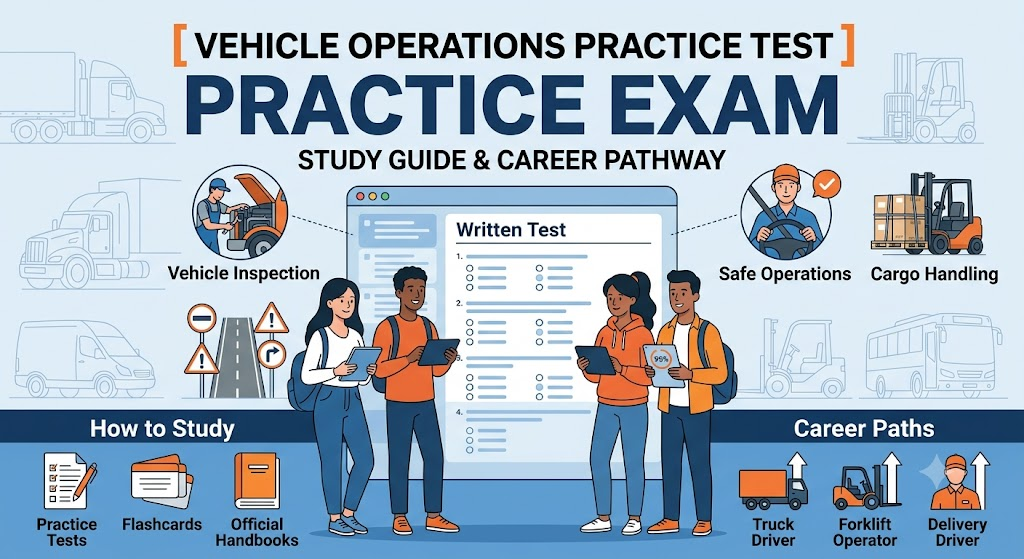
Additional Information
What the Course Entails and Exam Details
This comprehensive practice exam is structured around the core competencies required for safe and efficient vehicle operation across multiple industries. It does not replace a mandated state or federal practical license course (such as a CDL program), but rather acts as the essential theoretical prerequisite and final review.
The syllabus covered typically includes the following critical areas:
Core Syllabus Areas:
Vehicle Inspection: Mastering the pre-trip, en-route, and post-trip inspection processes to identify potential mechanical failures.
Basic Control: Understanding the principles of accelerating, steering, shifting gears, and braking smoothly.
Safe Operating Procedures: Visual searching techniques, managing speed and space, and communicating with other road users.
Hazard Management: Identifying and responding to extreme driving conditions such as skid control, night operations, and adverse weather.
Regulatory Compliance: Knowledge of relevant transportation laws, hours-of-service regulations, and documentation requirements.
Cargo Management (Class Dependant): Principles of securing cargo and understanding weight distribution.
What to Expect in the Final Exam
Knowing what to expect on exam day is vital for reducing anxiety and managing your time effectively. The actual final exam, which this practice test simulates, usually consists of two distinct parts: a written knowledge assessment and a practical skills test.
The Written Exam Format:
Type of Questions: The majority of questions are multiple-choice, designed to test your recall of facts, understanding of regulations, and application of safety principles. Some matching or "drag and drop" identification scenarios may be included.
Number of Questions: Standard exams generally feature between 50 and 100 questions.
Time Limit: You are typically allocated between 60 and 90 minutes to complete the written portion.
Passing Score: The required passing score is high, often requiring an 80% or better to ensure safety compliance.
The Practical Skills Test (If Applicable):
Pre-Trip Inspection: A hands-on demonstration where you must verbally and physically inspect the vehicle, identifying various components and explaining their safety checks.
Basic Control Skills: Performing maneuvers within a controlled yard, such as straight-line backing, offset backing, and parallel parking.
On-Road Driving: A supervised drive in real-world traffic to assess your application of safety rules in diverse situations.
How to Study and Exam Centers
Effective preparation is the difference between success and a retake. Your study plan should utilize this practice test as the cornerstone of your strategy.
Actionable Study Strategies:
Utilize This Practice Test Repetitively: Do not just take the practice test once; take it multiple times until you can achieve a score of 95% or higher consistently. Focus on the explanation provided for any question you miss.
Master the Official Handbook: Obtain the most recent official operating manual or handbook for the specific class of vehicle you intend to operate. This is the primary source of all exam questions.
Create Visual Aids for Inspections: Use flowcharts or checklists to memorize the exact order of a pre-trip inspection. Visualize the components under the hood, around the cab, and at the rear.
Form Study Groups: Explaining complex concepts like air brake systems or hours-of-service rules to others is a proven way to solidify your own understanding.
Simulate Exam Conditions: When taking the practice test, eliminate distractions, set a timer, and do not use study materials. This builds stamina and familiarity with the pressured environment.
Exam Centers and Testing Portals:
The official final exam is usually administered by a combination of government agencies and authorized private entities. The exact location depends on your jurisdiction and the specific certification type.
Online Portals: The written component is frequently taken through proctored online testing portals or authorized computer-based testing networks such as Pearson VUE centers.
Government Licensing Agencies: Practical skills tests for vehicle classes requiring a state or national license (like commercial truck driving) are often conducted at official Departments of Motor Vehicles (DMV), Ministries of Transportation, or National Transport and Safety Authority (NTSA) examination yards.
Authorized Training Schools: Many accredited driving and technical schools are authorized to conduct the practical exam for their graduates.
Job Opportunities from the Course
Passing the [Vehicle Operations Practice Test] and the subsequent official certification unlocks dynamic career paths across logistics, transportation, and construction. Employers prioritize candidates who can demonstrate a validated commitment to safety and operational competence.
Below are some of the career paths and job titles this certification can unlock:
Delivery and Logistics:
Last-Mile Delivery Driver
Courier/Express Parcel Driver
Fleet Operational Supervisor
Route Delivery Driver
Commercial and Specialized Transport:
Heavy Commercial Vehicle (HCV) Operator
Regional Freight Truck Driver
Public Service Vehicle (PSV) Operator (Bus/Shuttle)
Long-Haul Transport Driver
Industrial and Construction Operations:
Warehouse Material Handler (Forklift Operator)
Construction Equipment Operator
Fleet Maintenance Operations Assistant
Plant Mechanic/Operator
Good luck with your studies! By using this guide and dedicatedly practicing, you are ensuring you are prepared not just for the exam, but for a safe and successful professional future.
Frequently Asked Questions
Reviews
5.0
Based on 0 reviews
Leave a Review
No reviews yet. Be the first to review!