
Vermont Barbers Practice Exam
$69.00
- Buy to unlock unlimited access to all Quiz questions and Answers in this Quiz.
- After purchase you can print a PDF of the whole quiz at any point. The PDF will contain the questions and the correct answers.
About this Exam
The Vermont barber license is the official credential required to legally practice barbering within the state. It is administered by the Vermont Board of Barbers and Cosmetologists to ensure that all practicing professionals meet the state’s high standards for safety, sanitation, and technical skill. This exam is designed for individuals who have completed the required education, either through a 1,000-hour barber school program or a 24-month registered apprenticeship. Becoming a licensed barber in Vermont validates your expertise in men's grooming and opens the door to a rewarding, stable career in a growing industry.
Ready to test your knowledge?
Buy Now to Access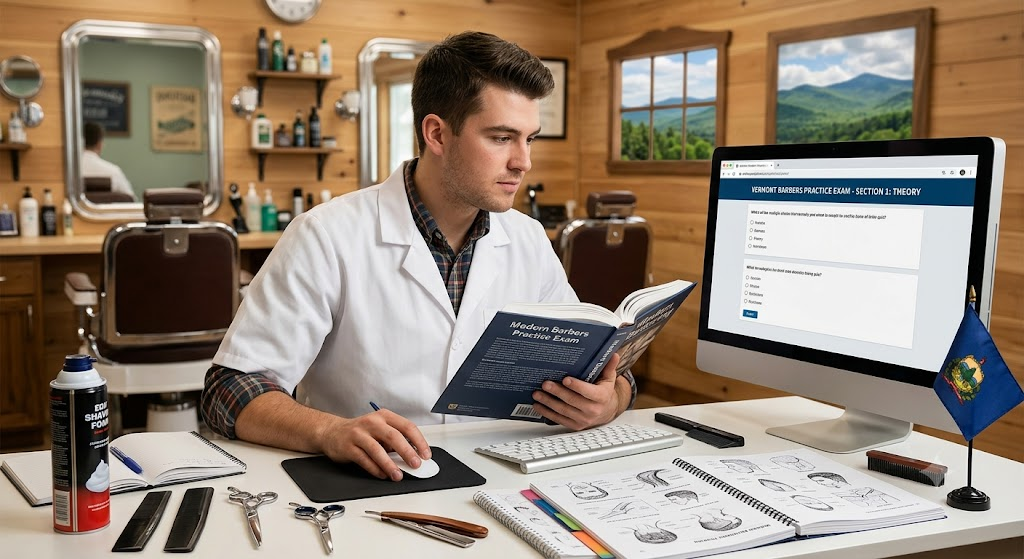
Additional Information
What the Course Entails and Exam Details
The barbering curriculum, which you must complete before testing, covers a broad spectrum of scientific concepts and artistic skills. You must be well-versed in theoretical knowledge and practical application.
Your course training included hours dedicated to safe practices such as sanitation, sterilization, and infection control, alongside essential scientific knowledge like the anatomy and physiology of the hair, skin, and nails. You also learned the chemistry of products, the fundamentals of electricity, and the history of barbering.
On the artistic side, you mastered the core technical skills: straight razor shaving, haircutting and shaping, hairstyling, mustache and beard design, chemical waving, hair coloring and lightening, chemical relaxing, and facial treatments. The exam will rigorously test your competency in all these areas to prove you are ready to serve the public safely.
What to Expect in the Final Exam
The Vermont barber licensure process consists of two mandatory components: a Theory Examination and a Practical Examination. You must achieve a passing score of at least 75% on both sections to receive your license.
1. The Theory Examination
This is a computerized, multiple-choice exam that focuses on your knowledge of concepts and state regulations. It is often divided into a national barbering section and a specific Vermont State Law section. Topics covered include:
Infection Control & Safety Practices: Sanitation, sterilization, and safety data sheets (SDS).
Implements & Equipment: Care and use of shears, clippers, razors, and combs.
Anatomy & Physiology: Structure of the hair and skin, and scalp diseases.
Hair & Scalp Care: Shampooing, conditioning, and draping.
Facial & Shaving Services: Straight razor shaving, facials, and massage.
Haircutting & Styling: Techniques and hair additions.
Chemical Services: Chemistry of products, coloring, waving, and relaxing.
Vermont State Laws: Regulations governing barbering practices in VT.
2. The Practical Examination
The practical component is a hands-on examination where you must perform core barbering services in front of proctors. You are expected to bring your own supplies and a mannequin (often two heads) as specified in your candidate handbook. Services you will likely be asked to perform include:
Setup and Client Protection: Demonstrating proper sanitation and draping.
Straight Razor Shaving: Performing a full shave safely.
Haircutting: Completing a defined haircut style.
Chemical Services: Demonstrating the application process for chemical waving, hair lightening, or coloring.
How to Study and Exam Centers
Preparation is key to conquering exam anxiety and ensuring a passing grade. Here is how to approach your study plan effectively.
How to Study Successfully
Master the Candidate Handbook: Your first stop must be the official Candidate Information Bulletin provided by the state’s testing administrator. It contains the exact breakdown of the exam content, required supplies for the practical, and the scoring rubrics proctors use.
Use the Vermont Barbers Practice Exam: Utilizing a dedicated Vermont Barbers Practice Exam is the most efficient way to study for the theory portion. Consistent practice will help you identify weak areas, understand the phrasing of multiple-choice questions, and improve your time management. Many online platforms offer mock tests that simulate the official exam environment.
Simulate the Practical: Treat your study sessions like the real exam. Set up your station exactly as required, time yourself strictly for each service, and practice your techniques on your mannequins until the movements are fluid and secondary nature.
Study VT State Laws: Do not ignore the state laws section. Dedicate time to studying the specific regulations of the Vermont Board of Barbers and Cosmetologists, focusing on licensing requirements, shop ownership rules, and penalties for violations.
Exam Centers
The Vermont barber licensure exams are administered by a designated professional testing service, currently Professional Credential Services (PCS). You must register with PCS after the Vermont Board approves your eligibility.
Theory exams are typically offered via computer at authorized testing centers, often located in or near larger cities. Practical exams are held on specific dates at physical locations in Vermont, frequently at authorized barber schools or dedicated testing facilities. Always refer to your PCS authorization-to-test email for the precise time and location of your examination.
Job Opportunities from the Course
Earning your Vermont barber license grants you the legal authority to work in numerous settings throughout the state. Here are some of the professional job titles and career paths this certification unlocks:
Professional Barber
Master Barber
Men's Grooming Specialist
Hair Stylist (Specializing in short hair and texture)
Barbershop Manager
Barbershop Owner/Entrepreneur
Barbering Product Representative
Barbering Instructor (Requires additional training and certification)
By focusing on your training and utilizing a Vermont Barbers Practice Exam, you are setting yourself up for a confident testing day and a successful, creative career.
Frequently Asked Questions
Reviews
5.0
Based on 0 reviews
Leave a Review
No reviews yet. Be the first to review!