
Vermont CDL Permit Practice Test
$69.00
- Buy to unlock unlimited access to all Quiz questions and Answers in this Quiz.
- After purchase you can print a PDF of the whole quiz at any point. The PDF will contain the questions and the correct answers.
About this Exam
The Vermont CDL Permit Practice Test is the essential first step for anyone aspiring to become a commercial driver in the Green Mountain State. This written examination, administered by the Vermont Department of Motor Vehicles (DMV), assesses a candidate's understanding of traffic laws, commercial vehicle operations, safety procedures, and special equipment operation required to operate a Commercial Motor Vehicle (CMV). Successfully passing this permit test grants a Commercial Learner’s Permit (CLP), allowing a driver to begin behind-the-wheel training, which is the necessary prerequisite to taking the skills test and earning a full Vermont CDL. This test is designed for individuals seeking to launch a career in professional driving, whether operating large trucks, buses, or other commercial vehicles that require a Commercial Driver’s License. It ensures that all aspiring commercial operators have the fundamental knowledge to safely navigate Vermont’s roadways.
Ready to test your knowledge?
Buy Now to Access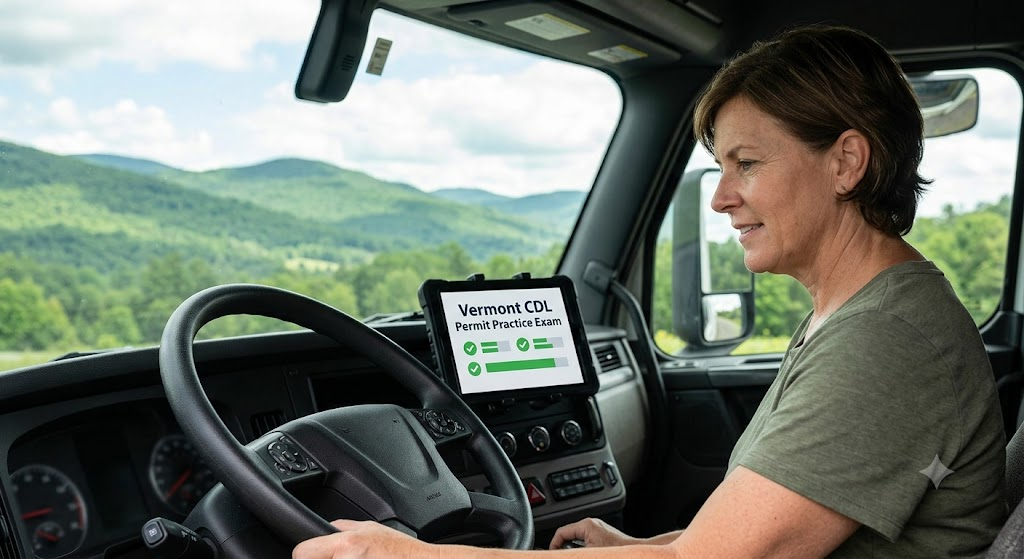
Additional Information
What the Course Entails and Exam Details
While this practice test isn't a "course" itself, it simulates the mandatory knowledge requirements set by the Vermont DMV based on the Vermont Commercial Driver License Manual. The actual permit exam covers three main areas depending on the type of vehicle and any endorsements the applicant is seeking. All CDL applicants, regardless of the vehicle class (Class A, B, or C), must pass the General Knowledge portion. This section includes critical topics such as:
Basic vehicle control and inspection.
Shifting gears and managing speed.
Driving safely in diverse weather conditions and night driving.
Recognizing and avoiding distracted or fatigued driving.
Emergency procedures and accident reporting.
General traffic regulations and rules of the road for CMVs.
Vehicle security and hazardous materials awareness.
Beyond General Knowledge, specific applicants must also pass:
Air Brakes: Required if the vehicle has air brakes.
Combination Vehicles: Required for all Class A CDL applicants.
Endorsements: There are additional knowledge tests for endorsements such as Double/Triple Trailers, Hazardous Materials (HazMat), Passenger Transport, School Bus, and Tank Vehicles. Each test has a specific number of multiple-choice questions focused solely on that area of operation.
What to Expect in the Final Exam
The final Vermont CDL permit test is a computerized examination. You must prepare for multiple tests depending on your CDL goals. For the core requirements, expect the following:
General Knowledge Test: This is the primary requirement for all CDL classes and features approximately 50 multiple-choice questions. You must achieve a passing score of at least 80%, meaning you must correctly answer 40 or more questions.
Air Brakes Test: If you will operate vehicles with air brakes, you must pass this separate knowledge test, typically consisting of around 25 multiple-choice questions.
Combination Vehicles Test: All applicants for a Class A license must pass this test, which usually features approximately 20 questions.
Endorsement Tests: Each endorsement (such as HazMat or Passenger) is its own separate multiple-choice exam with varying lengths. For instance, the Hazardous Materials endorsement test is usually around 30 questions.
The questions are designed to be clear but test detailed knowledge of the Vermont CDL Manual. There is generally no specific time limit for the tests, allowing applicants to take the time needed to carefully consider each question, but you should expect the testing process for a full set of tests (e.g., General Knowledge, Combination, and Air Brakes) to take several hours. Electronic devices, phones, or study materials are strictly prohibited during the examination.
How to Study and Exam Centers
The key to passing the Vermont CDL permit test is thorough preparation and utilization of official resources. Start by obtaining a physical or digital copy of the official Vermont Commercial Driver License Manual from the Vermont DMV. This is your definitive study guide, as every question on the real exam is drawn directly from its pages. Effective strategies include:
Read the entire manual carefully, highlighting key sections.
Focus on one topic at a time (e.g., study for General Knowledge first, then Air Brakes).
Take numerous free, high-quality online practice tests that simulate the official exam format. Repetitive practice helps you build confidence and identify weak areas.
Create your own flashcards or study sheets for important rules, regulations, and terminology.
When you are confident in your knowledge and consistent in passing practice tests, you can schedule your permit exam. The CDL permit knowledge tests are not taken online. You must visit an official Vermont DMV location in person. Many DMV locations offer walk-in services for knowledge testing, but scheduling an appointment online is highly recommended to minimize wait times. Ensure you have all required identification and documentation ready before your visit. A learner’s permit is valid for 180 days from the date of issue.
Job Opportunities from the Course
Earning your Vermont Commercial Learner's Permit (CLP) is the gateway to a wide range of essential and profitable careers in transportation. By successfully completing your CLP and subsequent full CDL, you can pursue jobs including:
Local and regional delivery truck driver.
Over-the-road (OTR) long-haul truck driver.
City bus or transit operator.
Commercial passenger tour driver.
Fuel delivery driver.
Construction vehicle operator.
School bus driver.
Heavy equipment transport operator.
Hazardous materials transport driver (with HazMat endorsement).
LTL (Less-Than-Truckload) freight driver.
Drayage driver in logistics and warehousing.
Frequently Asked Questions
Reviews
5.0
Based on 0 reviews
Leave a Review
No reviews yet. Be the first to review!