
Vertebrate Pest Control (Category P) Practice Test
$69.00
- Buy to unlock unlimited access to all Quiz questions and Answers in this Quiz.
- After purchase you can print a PDF of the whole quiz at any point. The PDF will contain the questions and the correct answers.
About this Exam
Are you ready to advance your career in pest management?
The Vertebrate Pest Control (Category P) certification is a specialized credential designed for current and aspiring Pest Management Professionals (PMPs) who focus on the control of non-insect animal pests. This exam is essential for individuals who need to legally and safely apply pesticides—specifically rodenticides, avicides, and other vertebrate-control chemicals—in a variety of settings, such as commercial, residential, and agricultural properties.
Earning this certification demonstrates your expertise in managing complex vertebrate pest issues while upholding high standards of environmental safety and public health. This study guide and our associated practice test are tailored to help you pass this rigorous exam on your first attempt.
Ready to test your knowledge?
Buy Now to Access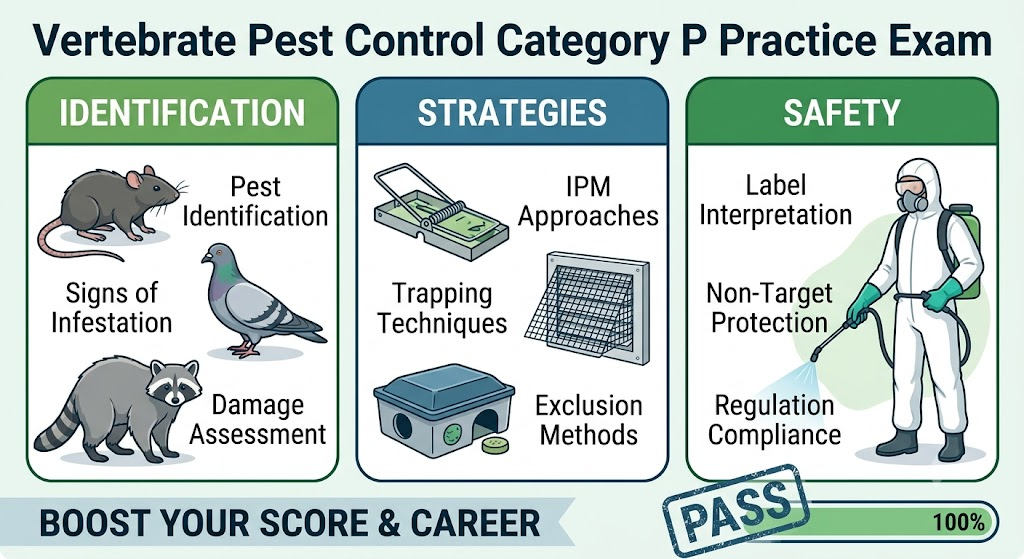
Additional Information
What the Course Entails and Exam Details
This specialized certification covers a broad range of knowledge beyond general pesticide application. The core curriculum focuses on the biology, behavior, and control methods for specific vertebrate species that are considered pests.
By engaging with the Category P material, you will master skills and knowledge in the following areas:
Pest Identification and Biology: Accurately identifying common vertebrate pests, such as various species of commensal rodents (Norway rats, roof rats, house mice), pest birds (pigeons, starlings, sparrows), and nuisance wildlife (skunks, raccoons, bats, and squirrels), and understanding their lifecycles, feeding habits, and reproduction.
Damage Assessment: Learning to recognize signs of infestation and assess the economic, health, and structural damage caused by different vertebrate pests.
Integrated Pest Management (IPM) for Vertebrates: Developing comprehensive strategies that combine sanitation, exclusion, habitat modification, trapping, and the responsible use of chemical controls.
Pesticide Safety and Application: Understanding the specific formulations, application techniques, and equipment used for vertebrate pesticides, including bait stations, tracking powders, and fumigants. A strong focus is placed on minimizing non-target animal exposure and environmental impact.
Regulations and Laws: Familiarizing yourself with federal, state, and local laws governing the control of vertebrate species, especially those that are protected or endangered.
What to Expect in the Final Exam
While specific exam formats can vary by jurisdiction, most Category P certification exams share a consistent structure. You should prepare for a comprehensive test that assesses both your theoretical knowledge and practical understanding.
Here is what you can typically expect from the final exam:
Exam Format: The test is almost universally comprised of multiple-choice questions. It may also include true/false sections or scenario-based questions where you must choose the best course of action.
Number of Questions: You can generally expect between 50 and 100 questions, depending on the specific state or licensing agency.
Passing Score: The typical passing score is 70% to 75%. You must achieve this score or higher on the entire exam to receive your certification.
Time Limit: Most exams have a set time limit, often ranging from 90 to 120 minutes. It is vital to manage your time effectively during the test.
Specific Rules: This is a proctored, closed-book exam. No reference materials, including study guides, are permitted in the testing area. You will likely need to bring valid government-issued photo identification.
How to Study and Exam Centers
Preparation is the single most important factor for success on the Category P exam. You cannot rely on general knowledge alone.
Actionable Study Strategies:
Obtain Official Study Materials: Your first step should be to acquire the official study guide or manual provided by your state's department of agriculture or lead pesticide regulatory agency. This is the definitive source for the information that will be on the test.
Use Our Practice Test: Our optimized [Vertebrate Pest Control Category P Practice Test] is specifically designed to simulate the real exam experience. It helps you identify knowledge gaps, practice time management, and become familiar with the types of questions you will encounter.
Focus on Identification: Create flashcards for pest identification, including images of the pests, their tracks, droppings, and the damage they cause. This is a common area for test questions.
Understand Labeling: Practice reading and interpreting pesticide labels. A significant portion of the exam may require you to answer questions based on a sample pesticide label.
Form Study Groups: If possible, study with colleagues or peers who are also preparing for the exam. Discussing concepts and quizzing each other can reinforce learning.
Where to Take the Exam:
The process for registering and taking the exam is managed at the state or local level. You should check the website of your state’s regulatory agency (often the Department of Agriculture) for specific instructions.
Most exams are administered through:
State Regulatory Offices: Some states conduct testing at their central or regional offices.
Third-Party Testing Centers: Many states partner with professional testing services, such as Pearson VUE, which offer convenient locations throughout the state.
Authorized Training Schools: Some licensed pest control training schools are authorized to proctor the exam.
Online Portals: In some cases, states are offering proctored online exams, which allow you to test from home or your office, provided you meet certain technical requirements.
Job Opportunities from the Course
A Category P certification is a significant asset in the pest management industry. It qualifies you for higher-level positions and allows you to offer a broader range of services to clients.
This certification unlocks numerous career paths and job titles, including:
Vertebrate Pest Control Specialist
Rodent Control Technician
Nuisance Wildlife Control Operator (NWCO)
Integrated Pest Management (IPM) Coordinator
Pest Control Supervisor or Manager
Agricultural Pest Control Advisor
Commercial Pest Control Service Technician (with a vertebrate focus)
Public Health Vector Control Officer
Pesticide Application Quality Control Inspector
Owner-Operator of a Specialized Pest Control Business
By obtaining your Category P certification, you establish yourself as a trained professional capable of addressing complex, high-stakes pest issues, making you a vital asset to any pest management team.
Frequently Asked Questions
Reviews
5.0
Based on 0 reviews
Leave a Review
No reviews yet. Be the first to review!