
Vertical Navigation (VNAV) Practice Exam
$69.00
- Buy to unlock unlimited access to all Quiz questions and Answers in this Quiz.
- After purchase you can print a PDF of the whole quiz at any point. The PDF will contain the questions and the correct answers.
About this Exam
The Vertical Navigation (VNAV) Practice Exam is designed for pilots and aviation professionals seeking to master advanced automated flight. While often not a standalone certification, understanding VNAV logic, procedures, and systems is a critical component within broader aircraft type ratings, instrument ratings, and recurrent airline training checks.
This comprehensive guide and practice exam will help you solidify your knowledge of automated vertical flight path control, from optimal climbs and cruise performance to precision descents and meeting complex altitude constraints. It is an indispensable tool for anyone preparing for assessments on modern Flight Management Systems (FMS).
Ready to test your knowledge?
Buy Now to Access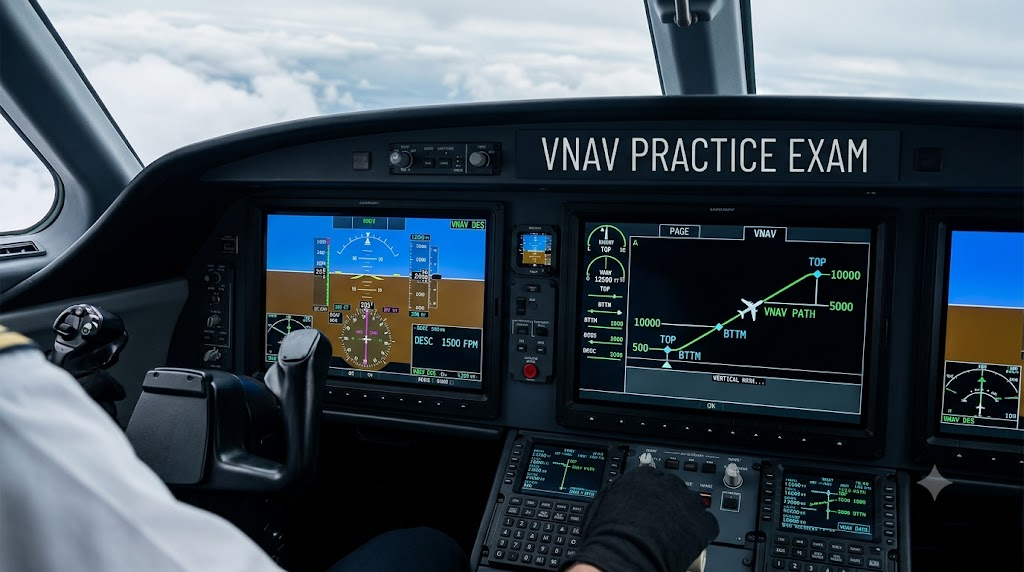
Additional Information
What the Course Entails and Exam Details
A VNAV focused course, which this exam prepares you for, delves into the technical and operational aspects of Vertical Navigation. Key areas often covered include:
FMS Integration: How VNAV interacts with the Flight Management System, performance databases, and lateral navigation (LNAV).
VNAV Modes: Deep understanding of VNAV Climb (VNAV CLB), Cruise (VNAV CRZ), and Descent (VNAV DES) modes.
Speed and Altitude Constraints: Programming and managing waypoints with specific crossing altitudes and speed restrictions.
Vertical Profile Interpretation: Reading and verifying the aircraft's intended vertical path on navigation displays and primary flight displays.
Performance Factor Management: Understanding how aircraft weight, cost index, wind, and temperature affect VNAV calculations and efficiency.
Contingency Procedures: Procedures for VNAV failures, manual intervention, and reverting to other flight levels or modes.
System Limitations: Knowing the operational envelope and situations where VNAV may not be suitable or available.
Exam Details (specifics depend on the broader overarching certification or type rating organization and should be verified with your training provider):
Format: Typically includes a theoretical segment (multiple-choice or scenario-based questions) and a practical evaluation, often conducted within a full-flight simulator (FFS) or other advanced Flight Simulation Training Device (FSTD).
Content: Expect a mix of system knowledge questions and dynamic operational scenarios.
Passing Score: Set by the regulatory authority or training organization (e.g., FAA, EASA, or a specific airline's standards).
Time Limit: Also defined by the specific assessment, covering both the knowledge test and the dynamic simulator session.
What to Expect in the Final Exam
When you take a final assessment involving VNAV, you are not just being tested on theory. You must demonstrate proficiency in real-time application and decision-making. You should expect:
System Logic and Knowledge: Questions will verify your understanding of how VNAV calculates paths, manages transitions between flight phases, and interprets different database inputs.
Operational Scenarios: In a simulator, you will be given complex clearances with multiple altitude and speed constraints. Examiners will evaluate your ability to correctly program the FMS, verify the VNAV profile, monitor execution, and make necessary adjustments for weather or ATC changes.
Abnormal and Emergency Situations: You may face VNAV-related system failures or be required to manually override the automation in response to a simulated ATC instruction or traffic conflict. Demonstrating safe and correct reversion techniques is crucial.
CRM (Crew Resource Management): If applicable, examiners will assess how you communicate VNAV intentions and verify actions with your flight crew.
How to Study and Exam Centers
Preparation is key to success. Utilize these strategies to master VNAV:
Review Official FMS Manuals: Your aircraft's specific Flight Management System pilot’s guide is the primary source of technical truth. Study it thoroughly.
Consult Regulatory Materials: Review relevant sections of your country’s aviation regulations (e.g., FAA's Pilot’s Handbook of Aeronautical Knowledge, Instrument Flying Handbook, and Advisory Circulars related to advanced navigation).
Use Simulation Software: Practice extensively with desktop flight simulators that feature realistic FMS with VNAV capabilities, or access an authorized training simulator for structured practice.
Take Specialized VNAV Courses: Many flight schools and training centers offer standalone or integrated courses on advanced automation and FMS operations.
Take Practice Exams: Utilize high-quality practice exams, like this one, to identify knowledge gaps and get accustomed to the types of questions and operational scenarios you will encounter.
Exam Centers:
Final assessments for VNAV proficiency (whether for a type rating, instrument check, or airline checking) are conducted at:
Authorized Flight Simulation Training Devices (FSTDs): These must be approved for the specific aircraft and level of training required.
Approved Training Organizations (ATOs) or Flight Schools: Organizations authorized to conduct advanced pilot training.
Airline Training Facilities: For pilots employed by commercial airlines.
Specific Testing Centers: Theoretical exams associated with broader certifications may be taken at computer-based testing centers authorized by the regulatory body (e.g., FAA knowledge test centers).
Job Opportunities from the Course
A strong command of VNAV and related advanced automated systems, certified through appropriate pilot ratings, significantly enhances job prospects in many areas of aviation. Key roles include:
Airline Pilot (First Officer and Captain)
Corporate and Charter Pilot
Military Pilot (various roles)
FMS or Flight Operations Engineer
Flight Instructor (specializing in advanced avionics/instrument training)
Check Airman or Simulator Instructor
Aviation Safety Inspector/Investigator
Air Traffic Controller (where system knowledge improves procedural understanding)
Disclaimer: This study guide provides a representative overview of typical Vertical Navigation assessments and knowledge areas based on industry standards. Specific exam details, syllabus, and passing requirements are determined by individual aviation regulatory authorities, aircraft type rating organizations, and training providers, and should always be verified directly with them.
Frequently Asked Questions
Reviews
5.0
Based on 0 reviews
Leave a Review
No reviews yet. Be the first to review!