
Veterans Affairs (VA) Accreditation Practice Exam
$69.00
- Buy to unlock unlimited access to all Quiz questions and Answers in this Quiz.
- After purchase you can print a PDF of the whole quiz at any point. The PDF will contain the questions and the correct answers.
About this Exam
The Veterans Affairs (VA) Accreditation program is designed to ensure that veterans, their dependents, and survivors have access to competent, qualified, and ethical representation when filing for VA benefits. The VA accredits three distinct types of individuals: attorneys, recognized Veterans Service Organization (VSO) representatives, and Claims Agents. The Veterans Affairs (VA) Accreditation Practice Exam is primarily targeting aspiring Claims Agents. Unlike attorneys who are usually presumed qualified by state bar membership, or VSO representatives who are certified by their respective organizations, independent individuals who wish to represent veterans must pass this rigorous written exam administered by the VA Office of General Counsel (OGC). Passing this exam proves you possess the requisite knowledge of veterans' benefits law and procedures necessary to guide clients through complex claim processes, from initial application to final appeal.
Ready to test your knowledge?
Buy Now to Access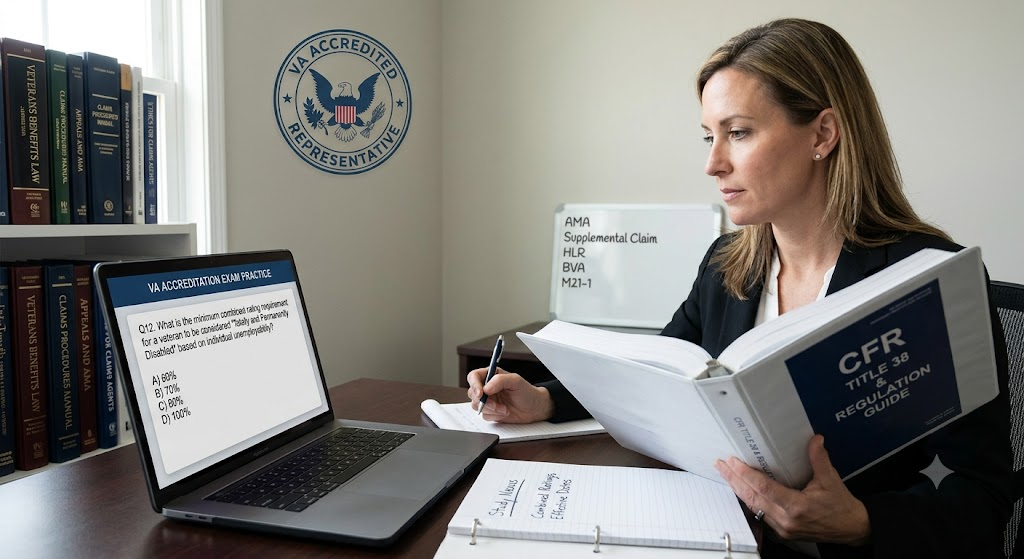
Additional Information
What the Course Entails and Exam Details
While the VA does not provide a single formal study "course," the core syllabus for this examination is derived strictly from federal law and regulations. To prepare effectively, you must become intimately familiar with Title 38 of the United States Code (U.S.C.) and Title 38 of the Code of Federal Regulations (C.F.R.). Your study plan must focus on several critical domains:
Veterans Benefits and Adjudication: You will be tested heavily on understanding the types of benefits available, including Service-Connected Disability Compensation (Part 3), non-service-connected Pension (Part 3), Dependency and Indemnity Compensation (DIC), education benefits, and burial benefits. You must know the criteria for eligibility and effective dates.
Adjudication and Claims Procedures: A significant portion of the test covers the operational side of filing a claim. You need to know the steps for submitting a "fully developed claim" vs. a standard claim, the duty to assist, and the responsibilities of the Veterans Benefits Administration (VBA).
The Schedule for Rating Disabilities: A deep understanding of how disabilities are evaluated, rated (from 0% to 100%), and combined using the "VA Math" found in Part 4 of the C.F.R. is crucial.
The Appeals Process: Following the Veterans Appeals Improvement and Modernization Act of 2017 (AMA), you must understand the "three lanes" of modern appeals: Supplemental Claim, Higher-Level Review, and Appeal to the Board of Veterans’ Appeals (BVA). You must know the deadlines, evidence rules, and jurisdictional limits of each.
Accreditation, Representation, and Fees: Crucially, you will be tested on the ethics of representation (Part 14), what you can and cannot charge a client (fees are generally prohibited for initial claims but allowed for appeals), and the process for getting appointed as a veteran's Power of Attorney (Form 21-22a).
What to Expect in the Final Exam
The official VA Accreditation Exam for Claims Agents is a written test that is designed to be challenging, as it guarantees the standard of aid being provided to veterans. The format is generally multiple-choice questions, requiring you to pick the best legal or procedural answer from several options.
The passing score requirement is strict, generally requiring candidates to score 75% or higher to receive their accreditation. The time limit is typically 60 minutes (1 hour), though some specific sessions might vary slightly. You should be prepared for one-way navigation; in most modern testing environments, once you select an answer and move to the next question, you cannot go back to review or change your answers. The exam is administered under strict proctoring conditions. Because it is a legal and regulatory test, it is highly recommended that you practice analyzing scenario-based questions that require applying regulation to specific veteran cases.
How to Study and Exam Centers
Preparation for this exam requires a legal study mindset. Do not simply memorize terms; you must learn how to apply federal regulations to hypothetical cases. Actionable study strategies include:
Read the C.F.R.: Start directly at the source. Dedicate weeks to reading 38 C.F.R. Parts 3 (Adjudication), 4 (Rating Schedule), 14 (Legal Authorities and Ethics), and 19-20 (Appeals).
Use The Manual (M21-1): Utilize the VBA’s own procedural manual (M21-1 Adjudication Procedures Manual) which is publicly accessible and provides practical guidance on how VA employees interpret the regulations you are studying.
Comprehensive Practice Exams: The best way to build exam stamina is through comprehensive practice tests. Seek reputable third-party study material providers that offer hundreds of scenario-based questions with annotated answers that cite the specific regulation. Practice time management to ensure you can complete the questions within the hour.
Regarding Exam Centers, the VA Office of General Counsel currently administers the exam several times per year. When your initial application for accreditation (VA Form 21a) is approved, the OGC will send you specific details and invitation instructions. While historical tests were taken physically at VA Regional Offices, the majority of current exams are administered through an online portal with live proctoring (monitoring your webcam and microphone). You will receive clear technical requirements upon approval to sit for the exam.
Job Opportunities from the Course
Earning VA accreditation through passing this exam is a major career achievement. The federal license unlocks numerous professional paths within the extensive ecosystem supporting veterans. While a "Veterans Affairs (VA) Accreditation Practice Exam" is not a "course" itself, the knowledge acquired from studying for it will unlock specific career opportunities including:
VA Accredited Claims Agent (Independent Practitioner): You can start your own private practice, representing veterans directly in preparing, presenting, and prosecuting claims for benefits.
Veterans Service Representative (VSR) or Decision Review Officer (DRO): Employment within the Department of Veterans Affairs itself, utilizing your knowledge to adjudicate claims or review appealed decisions.
Paralegal or Legal Assistant: Specialized in veterans’ law at dedicated legal firms that represent veterans, assisting accredited attorneys.
Benefits Case Manager at non-profit organizations or County Veteran Service Offices (CVSO), providing specialized advocacy.
Private Veterans Advocacy Case Manager: Working for companies that provide consultative support to veterans navigating the healthcare and compensation process (non-legal support roles).
Frequently Asked Questions
Reviews
5.0
Based on 0 reviews
Leave a Review
No reviews yet. Be the first to review!