
VI – Vapor Recovery Installation and Repair Practice Exam
$69.00
- Buy to unlock unlimited access to all Quiz questions and Answers in this Quiz.
- After purchase you can print a PDF of the whole quiz at any point. The PDF will contain the questions and the correct answers.
About this Exam
The [Exam Name] is a specialized certification designed for professionals within the petroleum storage and dispensing industry.
This credential validates an individual's knowledge regarding the installation, maintenance, and repair of both Phase I and Phase II vapor recovery systems.
These systems are critical for reducing the amount of volatile organic compounds (VOCs) that escape into the atmosphere during gasoline transfer and vehicle fueling.
The certification is primarily intended for underground storage tank (UST) installers, service technicians, petroleum equipment mechanics, and facility compliance managers.
Achieving this certification demonstrates a professional commitment to regulatory compliance, public safety, and environmental stewardship.
Ready to test your knowledge?
Buy Now to Access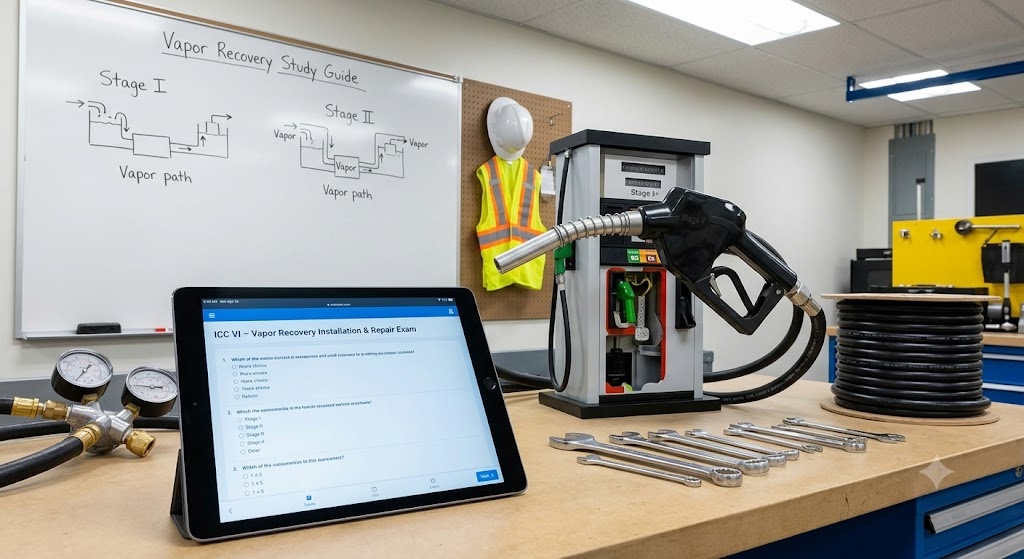
Additional Information
What the Course Entails and Exam Details
The certification process does not typically require a formal preparatory "course" from one specific provider, but candidates must master a comprehensive syllabus.
Students are expected to be familiar with technical manuals, industrial standards, and relevant regulatory codes, such as those from PEI (Petroleum Equipment Institute) and CARB (California Air Resources Board).
The core syllabus covers the full lifecycle of vapor recovery systems, including dynamic backpressure testing methods and troubleshooting common component defects.
Specifically, the material outlines procedures for installing Phase I systems (delivery tanker to tank) and Phase II systems (dispenser to vehicle).
You must study hanging hardware configurations, including coaxial hoses, nozzles, swivels, and breakaway couplings.
Furthermore, the details encompass critical safety procedures, leak detection methods, overfill prevention device installation, the proper slope of piping runs, and the "fire triangle" components essential for risk management on a fueling site.
What to Expect in the Final Exam
The final examination is a formal, closed-book, computer-based test that specifically challenges your theoretical understanding and practical problem-solving abilities.
Candidates are prohibited from bringing any personal reference materials, codebooks, or specialized manuals into the testing environment.
You should prepare to answer approximately 60 multiple-choice questions within a rigorous time limit of 1 hour and 30 minutes (90 minutes).
The questions will often present practical, real-world scenarios requiring you to identify proper installation techniques, correct defects, or apply regulatory standards to specific site conditions.
A passing score is typically determined through scaled scoring; always check the most current ICC Candidate Information Bulletin for the exact passing threshold required.
Calculators are generally provided on-screen within the testing interface for any necessary technical calculations.
How to Study and Exam Centers
Developing a focused study plan is essential for passing this demanding exam on your first attempt.
Begin by downloading the official exam outline from the certifying body to understand the weighting of each topic area.
Your primary study strategy must involve a deep dive into the mandatory reference materials, focusing heavily on PEI RP300 (Installation and Testing of Vapor-Recovery Systems) and relevant CARB Executive Orders.
Utilize the [Exam Name] Practice Exam to familiarize yourself with the phrasing and formatting of multiple-choice questions you are likely to encounter.
Focus on creating flashcards for identifying components (e.g., vapor pots, shear valves, p/v valves) and memorizing testing requirements, such as minimum dynamic backpressure standards.
To take the actual exam, you must first register and purchase a testing voucher through the International Code Council (ICC) myICC online portal.
The exam itself is administered globally through authorized Pearson VUE physical testing centers, which provide a secure and proctored testing environment.
In some cases, proctored online testing may be available, but this requires strict adherence to computer compatibility and environmental requirements.
Job Opportunities from the Course
Obtaining a [Exam Name] certification immediately positions you as a compliant specialist in a specialized field, enhancing your career trajectory in the fueling infrastructure industry.
The expertise verified by this credential is in high demand as state and federal air quality regulations become stricter.
Below are key job titles and career paths this certification unlocks:
Underground Storage Tank (UST) Installer
Petroleum Service Technician
Vapor Recovery Technician
Vapor Recovery Compliance Inspector
Pump and Dispenser Mechanic
Environmental Field Technician
Petroleum Equipment Maintenance Manager
Fueling System Compliance Specialist
Frequently Asked Questions
Reviews
5.0
Based on 0 reviews
Leave a Review
No reviews yet. Be the first to review!