
Video Production 1 Precision Exam Practice
$69.00
- Buy to unlock unlimited access to all Quiz questions and Answers in this Quiz.
- After purchase you can print a PDF of the whole quiz at any point. The PDF will contain the questions and the correct answers.
About this Exam
The Video Production 1 Precision Exam is a comprehensive certification test designed for high school and early college students looking to establish a solid foundation in audiovisual storytelling.
This exam validates a candidate's entry-level technical skills and theoretical knowledge, from understanding pre-production planning to executing editing procedures. It is the perfect benchmark for aspiring filmmakers, video journalists, and content creators to demonstrate their readiness for advanced study or entry-level positions in the production industry.
Ready to test your knowledge?
Buy Now to Access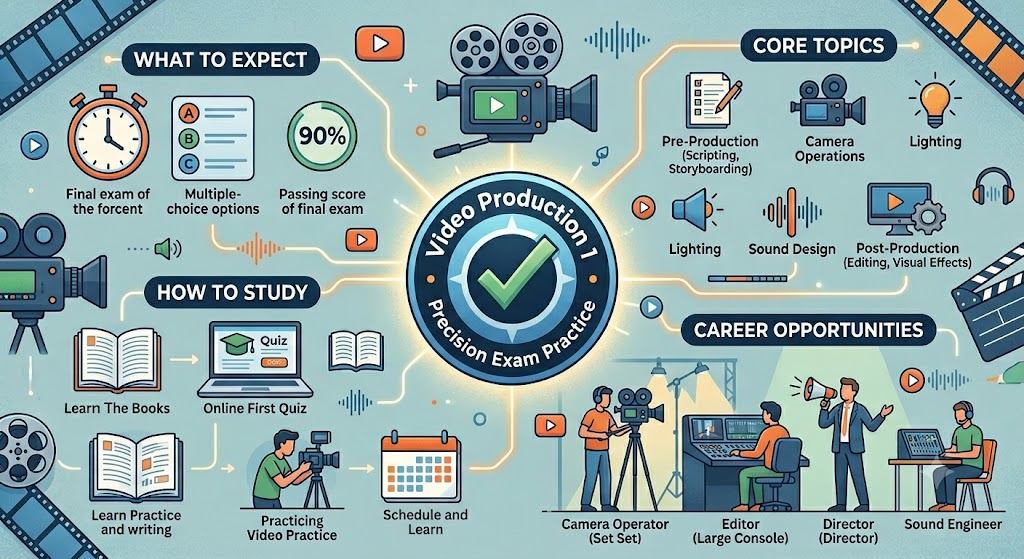
Additional Information
What the Course Entails and Exam Details
The corresponding course of study covers all phases of the creation workflow, requiring students to blend technical know-how with artistic composition.
The core domains of the syllabus typically include:
Pre-production: Scripting, creating detailed storyboards, and identifying necessary resources.
Production: Operating camera equipment, mastering basic lighting setups (e.g., three-point lighting), and capturing clean field audio.
Post-production: Using non-linear editing software, integrating audio, and applying basic graphics or transitions.
Visual Composition: Implementing the rule of thirds, utilizing appropriate lens types, and understanding varying camera angles for dramatic effect.
What to Expect in the Final Exam
Candidates should expect a rigorous assessment that measures both cognitive understanding and practical application scenarios.
The final exam usually follows a timed, standard multiple-choice format. It consists of multiple items that must be completed within a strict time limit (often approximately 60–90 minutes). The assessment requires a passing score of 70% or higher, and the test is typically proctored to ensure academic integrity.
How to Study and Exam Centers
To succeed on the test, students must dedicate equal time to reviewing terminology and practicing hand-on techniques.
Actionable Study Strategies:
Review Key Terms: Flashcards are highly effective for learning industry jargon, such as "b-roll," "depth of field," and "codecs."
Analyze Professional Content: Watch television and film with a critical eye, specifically looking for the composition and lighting techniques mentioned in the course curriculum.
Hands-on Practice: Spend as much time as possible in the editing suite or behind the camera; there is no substitute for experiencing how lighting and sound behave in different environments.
Exam Centers:
Because Precision Exams (now known as YouScience Industry Certifications) are usually offered as part of CTE (Career and Technical Education) programs, this exam is typically administered in authorized high schools, vocational centers, or community colleges. Students generally register and take the test during the scheduled window directly at their educational institution.
Job Opportunities from the Course
Earning this certification provides a strong competitive edge for entry-level media roles and creates a clear pathway to several exciting careers.
Camera Operator: Setting up and operating cameras to capture footage for broadcasts, films, or digital media.
Video Editor: Reviewing raw footage and cutting it together into a final, cohesive product.
Production Assistant (PA): The common "foot-in-the-door" role, assisting with a wide variety of tasks on a film set or in a television studio.
Content Creator / Social Media Manager: Crafting high-quality visual content for brands or organizations.
Grip / Lighting Technician: Planning and executing the lighting requirements for a shoot.
Frequently Asked Questions
Reviews
5.0
Based on 0 reviews
Leave a Review
No reviews yet. Be the first to review!