
Virginia CDL General Knowledge Practice Test
$69.00
- Buy to unlock unlimited access to all Quiz questions and Answers in this Quiz.
- After purchase you can print a PDF of the whole quiz at any point. The PDF will contain the questions and the correct answers.
About this Exam
The Virginia CDL General Knowledge exam is the cornerstone for anyone aspiring to operate commercial motor vehicles (CMVs) in the Commonwealth of Virginia. This comprehensive test evaluates an applicant's understanding of the fundamental safety rules, regulations, and operational procedures required to navigate a commercial vehicle safely.
It is designed for new applicants seeking their Commercial Driver's License (CDL) for the first time, as well as current CDL holders looking to upgrade their license class or add certain endorsements. Mastering the material in this exam is not just a regulatory requirement; it is essential for ensuring your safety, the safety of your passengers, and the safety of everyone sharing the road with you. Whether you aim to drive a massive semi-truck, a passenger bus, or a specialized delivery vehicle, your journey begins with passing the General Knowledge test.
Ready to test your knowledge?
Buy Now to Access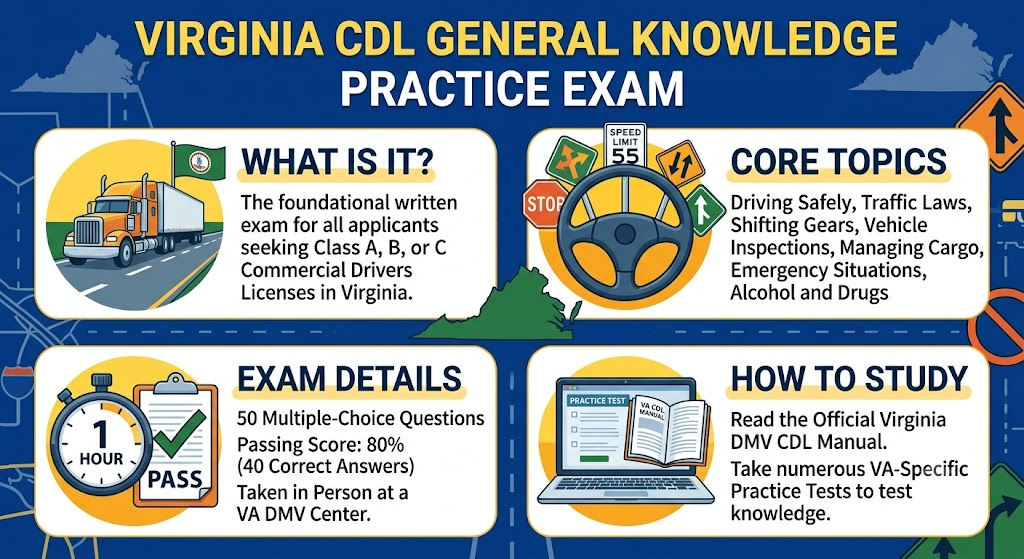
Additional Information
What the Course Entails and Exam Details
This exam covers a broad spectrum of critical topics that form the foundation of safe and professional commercial driving. While not a "course" in the traditional academic sense, preparation requires a deep dive into the official Virginia Commercial Driver's License Manual. The core areas you must master include:
Vehicle Inspection: Learning how to perform thorough pre-trip, en-route, and post-trip inspections to ensure the vehicle is in safe operating condition. This covers everything from tires and brakes to lights and emergency equipment.
Basic Control of Your Vehicle: Understanding the mechanics and techniques for shifting gears, braking, backing up safely, and managing space around your vehicle.
Shifting Gears: Mastering the proper techniques for shifting both manual and automatic transmissions, including double-clutching and choosing the right gear for the terrain.
Seeing and Communicating: Developing situational awareness by properly using mirrors, managing blind spots, and communicating your intentions to other drivers using signals and horns.
Managing Speed and Space: Learning how to adjust your speed based on road conditions, visibility, and traffic, as well as maintaining a safe following distance.
Driving in Hazardous Conditions: Techniques for navigating challenging environments like night driving, fog, heavy rain, snow, ice, and extremely hot weather.
Railroad-Highway Crossings: Understanding the specific safety procedures and regulations for approaching and crossing railroad tracks.
Mountain Driving: Special techniques for safely navigating steep upgrades and downgrades, including proper braking and gear selection.
Deep Awareness of Distracted and Fatigued Driving: Recognizing the dangers of cell phone use, texting, and driving while tired, and learning strategies to stay alert.
Stay Alert and Fit to Drive: Understanding the impact of alcohol, drugs, and health conditions on driving ability.
Air Brakes: If your vehicle is equipped with air brakes (most CMVs are), you must pass a separate air brakes test. However, the general knowledge section will cover the basic components and operation of air brake systems.
The exam itself is a computer-based test administered at DMV customer service centers throughout Virginia. It consists of multiple-choice questions drawn directly from the CDL manual.
What to Expect in the Final Exam
The Virginia CDL General Knowledge Test is designed to be challenging but fair. Knowing exactly what to expect on test day can help reduce anxiety and improve your performance.
Exam Format: The test is composed of 50 multiple-choice questions. Each question typically provides three or four possible answers, and you must select the best one.
Passing Score: To pass, you must answer at least 40 of the 50 questions correctly. This equates to an 80% passing score.
Time Limits: There is generally no strict time limit for completing the General Knowledge test in Virginia. You are encouraged to take your time, read each question carefully, and consider all options before making a selection.
Specific Rules:
You must take the test in person at a DMV customer service center.
No study materials, cell phones, or outside assistance are permitted during the exam.
The test is typically available in English and Spanish. If you need the test in another language, you should check with your local DMV in advance.
The test is often taken as the first part of a longer testing session that may include other endorsement tests (like air brakes, combination vehicles, or hazardous materials).
How to Study and Exam Centers
Preparation is key to success on the General Knowledge test. Relying solely on common sense will not be sufficient. Here are actionable study strategies:
Study Strategies and Practice Methods:
Obtain and Master the Virginia CDL Manual: This is your primary study resource. It's available for free online on the Virginia DMV website or as a physical hard copy at any DMV office. Read it cover-to-cover, focusing intently on the sections relevant to the general knowledge test (Sections 1, 2, and 3).
Take Multiple Practice Tests: This is one of the most effective ways to prepare. Utilize reputable online CDL practice test platforms. These tests mirror the format and content of the actual DMV exam, allowing you to identify your weak areas and track your progress. Ensure the practice tests you choose are specific to Virginia's regulations.
Use Flashcards: Create flashcards for critical information such as vehicle inspection steps, braking distances, speed limits for different conditions, and hazardous material classifications.
Create a Study Schedule: Don't cram. Dedicate consistent study time each day or week to cover different sections of the manual thoroughly.
Focus on Your Weaknesses: After taking practice tests, review the questions you missed. Go back to the manual and restudy those specific topics until you understand them completely.
Where to Take the Exam:
In Virginia, you cannot take the official CDL General Knowledge test online or at a third-party testing center like Pearson VUE for initial licensure. You must take it in person at an authorized Virginia DMV Customer Service Center (CSC).
DMV Customer Service Centers: Most full-service DMV offices across the Commonwealth administer the CDL knowledge tests. You can find a list of DMV locations and their services on the official Virginia DMV website.
Appointments Recommended: While some DMV offices accept walk-ins for knowledge tests, it is highly recommended to schedule an appointment online in advance to minimize your wait time.
Authorized Schools: While you take the knowledge test at the DMV, many CDL training schools are authorized to administer the skills (road) test. However, the initial step of the knowledge test always happens at the DMV.
Job Opportunities from the Course
Passing the Virginia CDL General Knowledge test is the vital first step toward a fulfilling and lucrative career in the transportation industry. Once you have your Commercial Learner's Permit (CLP)—which you get after passing this test—and eventually your full CDL, you'll be qualified for a variety of roles. Here are some of the career paths and job titles this certification unlocks:
Heavy and Tractor-Trailer Truck Driver: Operating large semi-trucks for long-haul (OTR), regional, or local delivery.
Delivery Truck Driver (Class B): Driving smaller commercial vehicles for local delivery of goods, food, or packages.
Bus Driver (School, Transit, Intercity): Transporting passengers safely on designated routes. (Requires Passenger endorsement)
Concrete Mixer Driver: Operating specialized trucks for construction projects.
Dump Truck Driver: Transporting materials like sand, gravel, or asphalt to and from construction sites.
Tanker Driver: Hauling liquid or gaseous loads. (Requires Tanker endorsement)
Hazardous Materials (HazMat) Driver: Transporting potentially dangerous materials. (Requires HazMat endorsement)
Furniture Mover: Driving moving vans and assisting with residential or commercial moves.
Expedited Freight Driver: Operating smaller, faster trucks for time-sensitive deliveries.
Mechanic Helper/Lube Technician: Many fleet maintenance roles prefer or require employees to hold a CDL General Knowledge certification to move vehicles around the yard.
By successfully navigating this exam, you aren't just passing a test; you are opening the door to a world of opportunity in an essential industry that keeps America moving. Good luck with your studies
Frequently Asked Questions
Reviews
5.0
Based on 0 reviews
Leave a Review
No reviews yet. Be the first to review!