
Virginia Concealed Handgun Permit (CHP) Practice Exam
$69.00
- Buy to unlock unlimited access to all Quiz questions and Answers in this Quiz.
- After purchase you can print a PDF of the whole quiz at any point. The PDF will contain the questions and the correct answers.
About this Exam
The Virginia Concealed Handgun Permit (CHP) certification is the essential legal credential required for residents and qualified non-residents to legally carry a concealed handgun within the Commonwealth of Virginia. This permit is designed for law-abiding citizens who wish to exercise their Second Amendment rights responsibly for personal protection. It ensures that individuals carrying concealed firearms have demonstrated a baseline level of competency and understanding regarding handgun safety and relevant state laws.
Ready to test your knowledge?
Buy Now to Access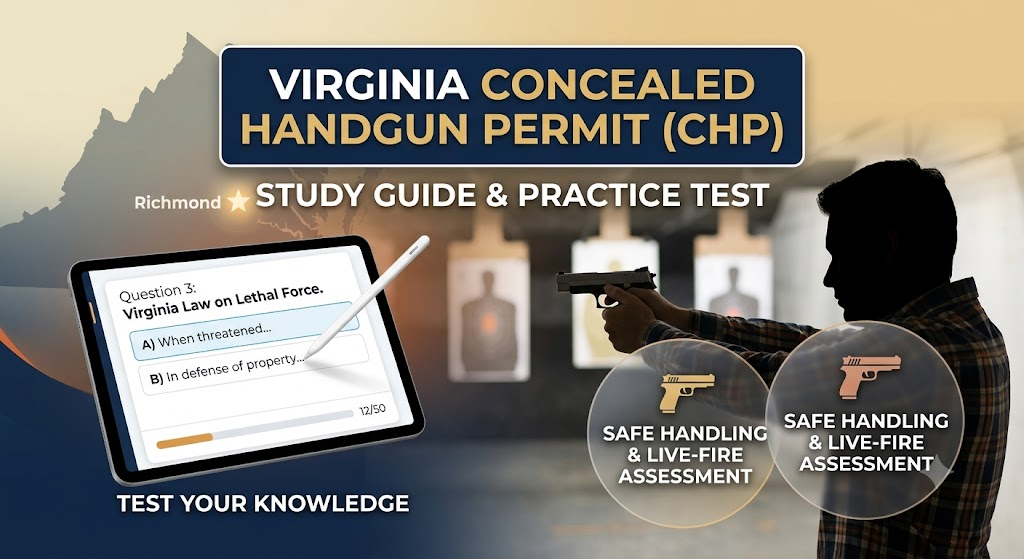
Additional Information
What the Course Entails and Exam Details
A Virginia CHP course is focused on two main pillars: safety and legality. The course content is strictly guided by the requirements set forth by the Virginia State Police and local jurisdictions.
Key topics covered include:
Comprehensive rules for safe handgun handling and storage.
Basic principles of marksmanship and handgun operation (nomenclature, loading/unloading).
Detailed review of Virginia-specific laws concerning the use of deadly force and self-defense doctrine.
Legal restrictions on where a permit holder cannot legally carry a concealed weapon within the state.
Understanding permit reciprocity with other states.
What to Expect in the Final Exam
The "final exam" for a Virginia Concealed Handgun Permit is not a standardized state-administered test in the traditional academic sense. Instead, the "exam" consists of two components. First, students must pass a written knowledge test administered by their certified instructor at the conclusion of the required safety course. This test typically consists of 20 to 50 multiple-choice or true/false questions focused directly on the safety and legal topics covered during the lecture.
The second, and arguably more critical, part of the exam is the "demonstration of competence" or practical assessment. Virginia law requires applicants to demonstrate "competence with a handgun." This means that after the classroom portion, students must successfully handle and fire a handgun on a firing range under the direct supervision of the certified instructor. There is no rigid point system for this shoot, but the instructor must be satisfied that the applicant can operate the firearm safely and hit a target at close range. Only upon successful completion of both the written safety test and the practical live-fire assessment will the instructor issue the signed certificate required to apply for the actual permit at the circuit court.
How to Study and Exam Centers
The best way to study for the written portion of the exam is to pay close attention during the mandatory safety course. Review any provided handbooks or materials specifically detailing Virginia’s firearms laws (Virginia Code § 18.2-308 et seq.). Taking a online Virginia Concealed Handgun Permit Practice Exam can be extremely helpful in reinforcing the legal and safety protocols, simulating the types of multiple-choice questions instructors commonly ask.
You cannot take this exam at standardized testing centers like Pearson VUE. To complete the required training, you must locate a certified firearms instructor or an authorized shooting school within Virginia. Many local gun ranges, rod and gun clubs, and dedicated tactical training centers host these courses regularly. These authorized private entities are where you will take the class, the written test, and perform the live-fire assessment.
Job Opportunities from the Course
While a Virginia Concealed Handgun Permit (CHP) is primarily for personal protection, obtaining the underlying safety certification and demonstrating handgun proficiency can complement and support several career paths, especially those in private security and specialized transportation.
Job opportunities influenced by this certification:
Armed Security Officer
Personal Protection Specialist (Bodyguard)
Armed Courier (e.g., armored car driver)
Executive Protection Detail Member
Bail Bondsman / Fugitive Recovery Agent
Range Safety Officer (with additional instructor certifications)
Firearms Sales/Retail Specialist
Frequently Asked Questions
Reviews
5.0
Based on 0 reviews
Leave a Review
No reviews yet. Be the first to review!