
Virginia DCJS Security Officer Practice Exam
$69.00
- Buy to unlock unlimited access to all Quiz questions and Answers in this Quiz.
- After purchase you can print a PDF of the whole quiz at any point. The PDF will contain the questions and the correct answers.
About this Exam
The Virginia Department of Criminal Justice Services (DCJS) mandates rigid training standards for private security professionals throughout the Commonwealth. This certification is the official license required for any individual wishing to work as a registered unarmed or armed security officer within Virginia. This exam is designed for individuals starting a career in the security industry, career-changers, or those seeking to renew their current registration. Completing this process demonstrates to employers and the public that you have mastered the essential legal, ethical, and practical skills necessary to perform your duties safely and professionally. Mastering the content through dedicated study and practice exams is the crucial first step toward achieving DCJS registration.
Ready to test your knowledge?
Buy Now to Access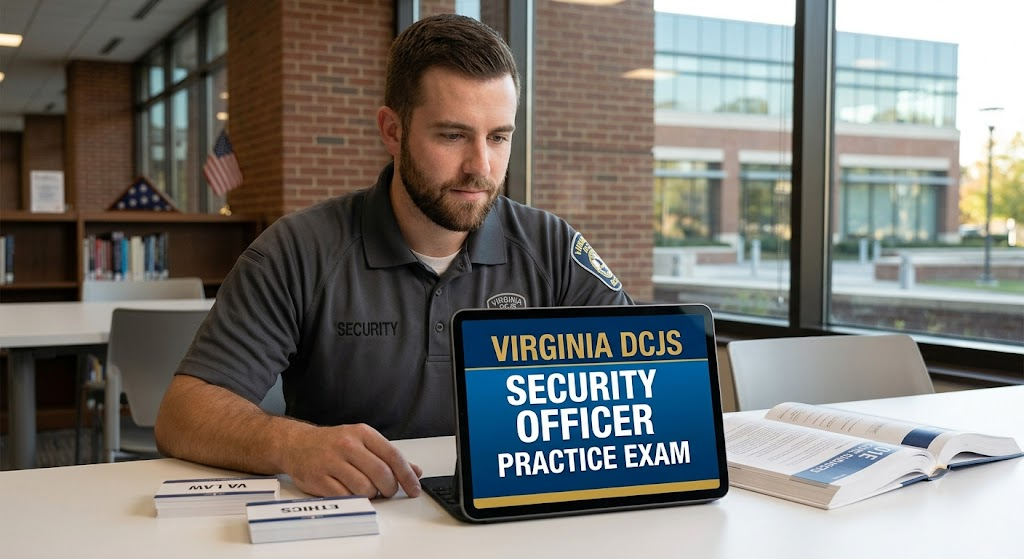
Additional Information
What the Course Entails and Exam Details
The foundation for this exam is a comprehensive training course, often referred to as the "01E" or Core Subjects curriculum. The material covers a wide array of competencies that every security officer must know to operate legally within Virginia.
Core topics typically included in the syllabus and covered on the exam are:
Virginia Law and Regulations: Understanding the specific statutes governing private security, arrest authority restrictions, and legal liability.
Ethics and Professional Conduct: Maintaining high standards of integrity, discretion, and public interaction.
Patrol Procedures: Techniques for effective foot and mobile patrol to observe, detect, and report.
Access Control: Managing entry and exit points to protect private property and personnel.
Report Writing: Mastering the art of writing clear, concise, and accurate official incident reports.
Communications: Proper use of radios, telephones, and interpersonal communication skills during conflicts.
Emergency Procedures: Recognizing and responding to fires, medical emergencies, and bomb threats.
Confrontation Management: De-escalation techniques and the legally appropriate "use of force" continuum.
What to Expect in the Final Exam
You must complete the required classroom or authorized online training before being eligible to take the final examination.
The exam format generally includes the following structure:
Format: The final exam is typically multiple-choice.
Content Scope: The questions are designed to test your retention of the Core Subjects detailed above.
Passing Score: Students are generally required to achieve a minimum passing score of 70% on the regulatory final test.
Time Limits: While time limits vary slightly by training academy, students are usually allotted sufficient time—often between 60 to 90 minutes—to complete the test without undue pressure.
Closed-Book: This is a closed-book examination; you cannot use your notes or course materials during the test.
Retakes: If you do not pass on your first attempt, the DCJS has specific regulations regarding waiting periods and potential retraining requirements before a retake is permitted.
How to Study and Exam Centers
Effective preparation requires a mixture of reviewing course materials and applying that knowledge practically. Using comprehensive study guides and practice exams is highly recommended to identify weak areas and build testing stamina.
Actionable Study Strategies:
Review Your Course Workbook: Pay specific attention to terms, legal definitions, and steps in official procedures.
Create Flashcards: Flashcards are excellent for memorizing Virginia-specific security laws and ethical codes.
Practice with Real Scenarios: Try to apply the "use of force" continuum to hypothetical situations you might encounter on patrol.
Take Mock Practice Exams: Practice tests that mimic the structure of the real 01E exam are invaluable. They teach you how to handle trick questions and manage your time effectively.
Exam Centers and How to Take the Exam: The Virginia DCJS Security Officer Exam is not taken at generalized testing centers like Pearson VUE. Instead, the final exam is administered directly by DCJS-authorized private security training schools or academies. These academies may offer the final test in a physical classroom setting upon completion of the 18-hour 01E course, or through secure, proctored online portals if the academy is approved for distance learning. You must contact an authorized Virginia DCJS training school to register for both the required course and the resulting final examination.
Job Opportunities from the Course
Obtaining your DCJS Security Officer registration unlocks immediate career opportunities across Virginia in diverse environments.
Specific job titles and career paths available include:
Unarmed Security Officer
Armed Security Officer (requires additional 05E/75E firearms endorsements)
Corporate Security Professional
Retail Loss Prevention Officer
Residential/Gated Community Security
Hospital and Healthcare Security Officer
Hotel and Hospitality Security
Event Security and Crowd Management Specialist
Mobile Patrol Officer
Contract Security Officer (working for private agencies)
Frequently Asked Questions
Reviews
5.0
Based on 0 reviews
Leave a Review
No reviews yet. Be the first to review!