
Virginia DMV Permit Practice Test
$69.00
- Buy to unlock unlimited access to all Quiz questions and Answers in this Quiz.
- After purchase you can print a PDF of the whole quiz at any point. The PDF will contain the questions and the correct answers.
About this Exam
The Virginia DMV Permit Practice Test is the essential preparatory step for aspiring drivers in the Commonwealth of Virginia looking to obtain their learner's permit. This initial milestone is required for all new drivers, regardless of age, who have never held a driver’s license issued by Virginia, another state, or a U.S. territory. It is specifically designed to evaluate a candidate's understanding of foundational road safety before they begin behind-the-wheel training. For teenagers under the age of 18, this test is often taken concurrently with, or shortly after, completing the classroom component of a state-approved driver education program.
Ready to test your knowledge?
Buy Now to Access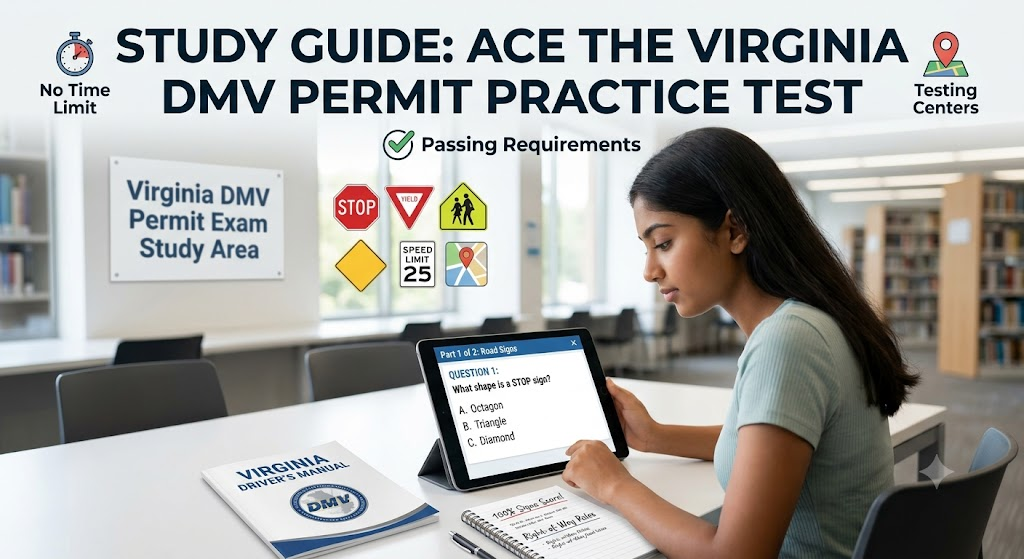
Additional Information
What the Course Entails and Exam Details
The knowledge required to pass the permit test is drawn entirely from the most recent version of the Virginia Driver's Manual. This comprehensive resource covers everything a novice driver needs to know to operate a vehicle responsibly. Students are expected to master a wide range of topics, ensuring they can interpret road language and react safely to various driving scenarios.
The core areas covered include:
Virginia Traffic Laws: Understanding rules regarding speed limits, right-of-way at intersections and roundabouts, signaling, and turning.
Road Signs and Signals: Recognizing and interpreting regulatory signs (stop, yield), warning signs (construction, school zones), guide signs, and traffic light sequences by shape, color, and symbol.
Safe Driving Practices: Defensive driving techniques, maintaining safe following distances, handling emergencies, and sharing the road with motorcycles, bicycles, and pedestrians.
Impaired Driving: Familiarity with Virginia's strictly enforced laws regarding alcohol, drugs, and driving, including Blood Alcohol Concentration (BAC) limits.
Special Driving Conditions: Adjusting driving behavior for night driving, severe weather like rain, fog, snow, or ice, and driving on highways versus residential streets.
What to Expect in the Final Exam
The final Virginia DMV knowledge exam is a computer-based, two-part test available in multiple languages. It is known to be challenging, with many first-time test-takers failing due to insufficient preparation, particularly on the signs section.
Here is the detailed breakdown of what to expect:
Exam Format: Multiple-choice questions answered on a touchscreen monitor at a testing facility.
Structure:
Part One (Road Signs): You will be given 10 questions focusing on traffic signs and signals.
Part Two (General Knowledge): Once you pass part one, you proceed to 25 questions on general rules of the road, traffic laws, and safety.
Passing Score Requirements: The scoring is strict.
Part One (Signs): You must answer all 10 questions correctly (100% score). If you miss one sign question, the test ends immediately.
Part Two (Knowledge): You must answer at least 20 out of 25 questions correctly (80% score).
Time Limits: There is generally no strict time limit for the knowledge test, allowing you to read each question carefully, though standard Customer Service Center operating hours apply.
Specific Rules: The test is closed-book. Handheld cell phones or other electronic devices are strictly prohibited during the exam. If you fail the test, there is a mandatory waiting period before you can retake it (15 days for those under 18; a standard fee applies for retakes). If you fail three times, you must complete the classroom portion of a Virginia-approved driver education course before taking it a fourth time.
How to Study and Exam Centers
Effective preparation is the key to passing on your first attempt. Because the passing requirement for the signs section is 100%, you must prioritize memorizing every sign in the manual by shape, color, and meaning.
Actionable Study Strategies:
Read the Official Manual: Begin by thoroughly reading the Virginia Driver's Manual. Do not skim; the test can ask about specific details regarding feet, seconds, or BAC percentages.
Take Mock Practice Tests: This is the most critical strategy. Utilize authorized and reputable Virginia DMV Permit Practice Tests online. These tests replicate the format and phrasing of actual DMV questions, helping you build confidence and identify weak areas.
Focus on the Signs: Create flashcards for every road sign shown in the manual. Practice until you can instantly identify them without reading the description.
Simulate Exam Conditions: When taking practice exams, turn off your phone and do not look at the manual. This helps you get used to the pressure of the real closed-book environment.
Exam Centers and How to Take the Exam:
In Virginia, the official knowledge exam must be taken in person at an authorized location. It is not currently offered as a remote, online option from home.
You can take the exam at:
Virginia DMV Customer Service Centers (CSCs): Most people take their test at their local DMV office. While walk-ins are sometimes accepted, it is highly recommended to make an appointment through the DMV’s online portal to avoid long wait times.
Participating Public High Schools: Many public high schools in Virginia are authorized to administer the permit knowledge test to their students within the classroom setting, often as part of the Health and Physical Education curriculum.
Remote Off-site Testing Locations: Occasionally, DMV-authorized mobile units or specific remote sites provide testing services. Check the official Virginia DMV website for the most current list of authorized off-site testing locations near you.
Job Opportunities from the Course
Passing the Virginia DMV Permit Practice Test and obtaining your learner's permit is the prerequisite for learning to drive. While a learner's permit itself does not qualify you for vocational driving jobs, it is the mandatory first step toward unlocking a vast array of career paths that require a full driver's license.
After holding your permit for the required period (typically 9 months for minors or 60 days for adults over 18) and passing the road skills test to obtain your full driver's license, the following job opportunities become accessible:
Delivery Driver (Food, Courier, Auto Parts)
Rideshare Driver (Uber, Lyft)
Sales Representative (Requiring regional travel)
Field Service Technician
Home Health Aide (Requiring travel to client homes)
Construction Worker (Often requires commuting to various sites)
Emergency Medical Technician (EMT) or Paramedic (Requires further certification)
Non-Emergency Medical Transportation Driver
Security Guard (Patrol services)
Prerequisite for obtaining a Commercial Driver’s License (CDL) for Truck or Bus Driving paths
Frequently Asked Questions
Reviews
5.0
Based on 0 reviews
Leave a Review
No reviews yet. Be the first to review!