
Virginia HazMat Ops Practice Exam
$69.00
- Buy to unlock unlimited access to all Quiz questions and Answers in this Quiz.
- After purchase you can print a PDF of the whole quiz at any point. The PDF will contain the questions and the correct answers.
About this Exam
The Virginia Hazardous Materials Operations (HazMat Ops) certification is a crucial credential for public safety personnel, primarily designed for firefighters, law enforcement officers, emergency medical services (EMS) providers, and other first responders who are likely to respond to the scene of a hazardous materials release.
This level of certification trains individuals to go beyond simple recognition and avoidance (covered in the Awareness level) and instead teaches them to take defensive actions to protect people, property, and the environment from a distance.
Earning this certification demonstrates your competency to analyze an incident, plan a response, implement defensive actions, and evaluate progress, adhering to the standard set by the Virginia Department of Fire Programs (VDFP) and NFPA regulations.
Ready to test your knowledge?
Buy Now to Access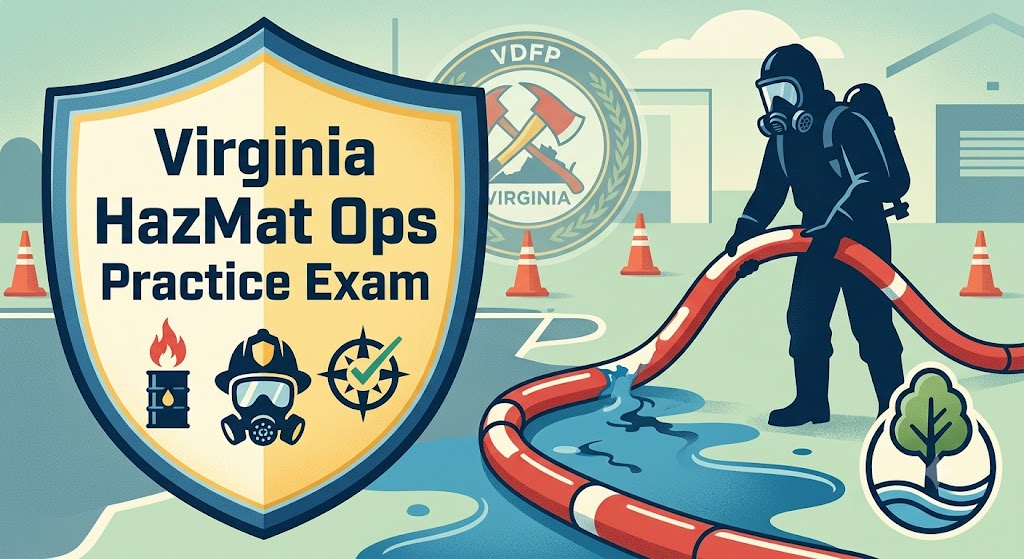
Additional Information
What the Course Entails and Exam Details
The training required for the HazMat Ops certification involves both classroom instruction and hands-on practical skill development. The syllabus is designed to build upon the knowledge gained at the Awareness level and focuses on safely conducting a defensive response to a hazardous materials incident.
The core competencies covered typically include:
Understanding Hazardous Materials and Processes: Deepening knowledge of physical and chemical properties of materials.
Container and Transportation Analysis: Identifying different types of storage containers and identifying packaging for hazardous substances.
Hazard Assessment and Scene Size-Up: Formulating initial strategies, assessing risks, and identifying materials involved from a distance.
Respiratory Protection and Personal Protective Equipment (PPE): Demonstrating proper selection, inspection, use, and doffing of appropriate PPE and self-contained breathing apparatus (SCBA).
Defensive Control Measures: Learning how to implement absorption, adsorption, damming, diking, diversion, retention, and emergency shutoff procedures.
Product Control Scenarios: Mastering methods to confine the spill from a safe distance and perform product transfers.
Decontamination: Understanding the principles and procedures of emergency and technical decontamination for personnel and equipment.
Incident Management System (IMS): Integrating HazMat operations into a larger unified command structure.
What to Expect in the Final Exam
The certification process in Virginia generally consists of two distinct components that a candidate must successfully pass.
First, you will need to complete a written multiple-choice examination. This test is designed to measure your cognitive knowledge of the subjects covered in the training manual and course curriculum.
Second, candidates must successfully complete a practical skills evaluation. This "hands-on" portion of the exam requires you to perform specific defensive actions under the supervision of authorized instructors. Skills tested may include setting up a dam to control run-off, properly donning and doffing various types of PPE, or establishing a decontamination corridor.
While official details regarding the specific number of questions, time limits, and the exact passing score can vary, a minimum of 70% to 80% is common for state-administered written fire service exams in Virginia.
How to Study and Exam Centers
Preparation is key to succeeding on the Virginia HazMat Ops exam. Your study strategy should integrate comprehensive review with practical application.
The most effective study methods include:
Utilize Practice Exams: Take advantage of practice questions specific to the Virginia or NFPA 1072 standards. This will familiarize you with the wording of potential exam questions and help you identify areas where your knowledge is weak.
Study the Authorized Manual: Focus your review on the mandated VDFP training curriculum and associated textbooks, such as Jones & Bartlett's Hazardous Materials Awareness and Operations or IFSTA's Hazardous Materials for First Responders.
Review the Skill Sheets: For the practical portion, obtain the official JPR (Job Performance Requirement) evaluation sheets and review each step meticulously. Practice these skills with your colleagues or during training sessions.
Locating Exam Centers:
In Virginia, HazMat Ops testing is primarily coordinated through authorized schools, fire departments, and the Virginia Department of Fire Programs (VDFP). To register for an exam, you should generally contact your local training officer, fire academy, or visit the VDFP website to search for upcoming test dates and locations within your region. Some testing might occur at specific, authorized physical testing sites or specialized training facilities across the Commonwealth.
Job Opportunities from the Course
Earning your Virginia HazMat Ops certification opens doors to specialized roles within both the public and private sectors focused on emergency management, environmental safety, and public security.
Potential job titles and career paths include:
Firefighter (many departments require HazMat Ops as a condition of employment)
Hazardous Materials Technician (often requires Ops as a prerequisite for advanced training)
Industrial Safety Specialist
Chemical Safety Coordinator
Environmental Health and Safety (EHS) Officer
Emergency Management Specialist
Law Enforcement specialized team member (e.g., SWAT, bomb squad, or regional task forces)
Private Sector Hazardous Materials Response Team Member
This guide provides a comprehensive overview of the path to HazMat Ops certification in Virginia. By combining dedicated study with structured practice, you can approach your exam with confidence and take a significant step in your public safety career.
Frequently Asked Questions
Reviews
5.0
Based on 0 reviews
Leave a Review
No reviews yet. Be the first to review!