
Virginia Residential Building Contractor (RBC) Practice Test
$69.00
- Buy to unlock unlimited access to all Quiz questions and Answers in this Quiz.
- After purchase you can print a PDF of the whole quiz at any point. The PDF will contain the questions and the correct answers.
About this Exam
Earning your Virginia Residential Building Contractor (RBC) license is a critical milestone for launching a successful career in residential construction.
This classification empowers you to oversee the construction, remodeling, repair, and improvement of single- and two-family dwellings and townhouses throughout the Commonwealth.
This guide is specifically designed for aspiring contractors, tradespeople looking to advance, and project managers ready to take the next step toward independent licensure.
Passing this exam demonstrates your technical competence and fundamental understanding of the Virginia Uniform Statewide Building Code.
Ready to test your knowledge?
Buy Now to Access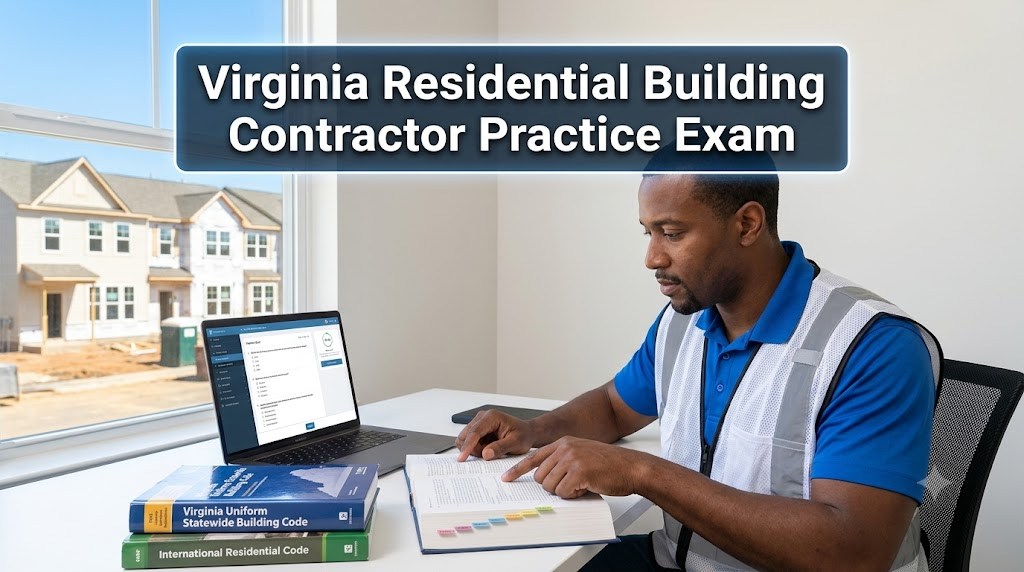
Additional Information
What the Course Entails and Exam Details
The RBC exam does not represent a traditional "course" provided by the state, but rather a robust assessment of your technical knowledge gained through experience and study of reference materials.
To succeed, candidates must master a wide spectrum of residential construction topics based largely on the International Residential Code (IRC) and Virginia modifications.
The core syllabus covers essential skills starting from initial site work, including layout, excavation, and foundational systems.
You must demonstrate a deep understanding of structural elements, specifically framing techniques, floor systems, wall systems, and roof assemblies.
Furthermore, the exam evaluates proficiency in completing the structure, encompassing insulation, ventilation, exterior finishes, windows, and doors.
Specialized areas such as masonry construction, safety regulations, print reading, and plan analysis are also pivotal components of the required knowledge base.
What to Expect in the Final Exam
Understanding the format of the Virginia RBC exam is essential for managing your time and anxiety on test day.
The examination is administered by PSI Services LLC and is a timed, multiple-choice assessment.
In total, the technical trade section contains 80 questions.
You are allocated 160 minutes to complete this portion, which averages to exactly two minutes per question.
The passing score requirement is 70 percent, meaning you must answer at least 56 questions correctly.
A critical advantage for this exam is that it is "open book," allowing you to reference specific, approved codebooks and technical manuals during the test.
How to Study and Exam Centers
Effective study for an open-book exam requires a unique approach centered on navigation rather than pure memorization.
Your primary goal should be learning how to rapidly locate information within the approved reference books, such as the International Residential Code.
Begin by thoroughly tabbing your reference books according to major chapters and key tables to minimize search time during the exam.
Utilizing comprehensive Virginia Residential Building Contractor practice tests is arguably the most valuable preparation strategy, as it familiarizes you with the wording style of the questions and builds your pacing.
When you are ready to test, you will need to schedule your appointment directly with PSI.
This is done through their online portal or by phone after you receive approval from the Virginia Department of Professional and Occupational Regulation (DPOR).
PSI maintains multiple dedicated testing centers conveniently located throughout the Commonwealth.
Key testing center locations include Richmond, Roanoke, Vienna, Virginia Beach, and Lynchburg.
Ensure you bring proper identification and only the specific, unmarked or highlighted codebooks allowed by PSI regulations.
Job Opportunities from the Course
Obtaining your VA RBC license unlocks diverse and lucrative career opportunities within the booming Virginia housing market.
Most notably, this credential is required to operate as an independent Residential Building Contractor, allowing you to bid on and manage your own construction projects.
Licensed individuals are highly sought after to fill critical roles such as Residential Project Manager, where they oversee entire developments from inception to completion.
You might also pursue a career as a Construction Superintendent, managing daily on-site operations and coordinating trade subcontractors.
For those with an eye for detail, the license provides an excellent foundation for becoming a licensed Home Inspector or a Code Compliance Officer for local municipalities.
Additionally, many contractors utilize this license to specialize as a remodeling and renovation expert, focusing on high-end residential improvements and additions.
Frequently Asked Questions
Reviews
5.0
Based on 0 reviews
Leave a Review
No reviews yet. Be the first to review!