
Visual Optics Practice Test
$69.00
- Buy to unlock unlimited access to all Quiz questions and Answers in this Quiz.
- After purchase you can print a PDF of the whole quiz at any point. The PDF will contain the questions and the correct answers.
About this Exam
Are you ready to advance your career in the dynamic field of eye care? The Visual Optics Practice Test is an essential preparatory tool designed for aspiring opticians, ophthalmic technicians, and optometry assistants. This exam serves as a rigorous simulation, validating an individual’s understanding of how light interacts with the human eye and corrective lenses. It is specifically tailored to build confidence and accuracy in crucial calculations and concepts before challenging official professional certification exams, such as those offered by the American Board of Opticianry (ABO) or similar regulatory bodies. If your goal is to master the physics of vision and secure a foundational credential in the optical industry, this is your critical first step.
Ready to test your knowledge?
Buy Now to Access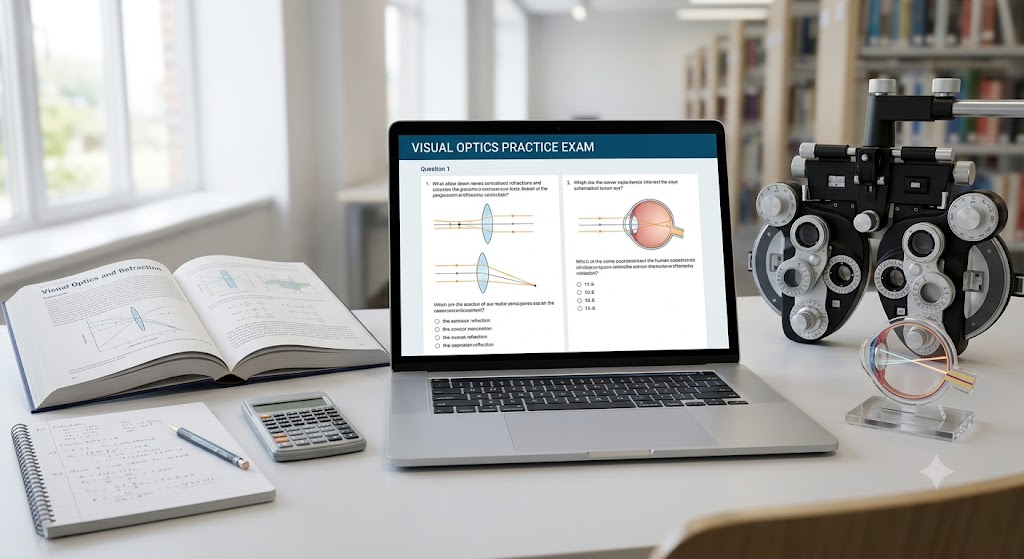
Additional Information
What the Course Entails and Exam Details
A thorough understanding of visual optics requires combining the principles of physics with anatomy. This practice test ensures mastery across several core domains. Candidates must demonstrate proficiency in geometric optics, including the behavior of light during refraction and reflection. You will delve deeply into ocular anatomy and physiology, specifically understanding how the cornea, crystalline lens, and retina process light. A substantial portion of the curriculum focuses on identifying and correcting refractive errors such as myopia, hyperopia, astigmatism, and presbyopia. Additionally, you will master optical calculations, which includes understanding lens prescription transposition, vertex distance compensation, and prism applications.
What to Expect in the Final Exam
While specific formatting may vary slightly depending on the official certifying organization, a standard visual optics exam is a comprehensive assessment of both knowledge and application. Typically, these are computer-based tests consisting of 70 to 100 multiple-choice questions. Candidates are usually allocated between 90 minutes and two hours to complete the section, emphasizing the need for quick and accurate critical thinking. The questions are often scenario-based, requiring you to interpret a patient’s prescription and calculate the correct lens parameters. A passing score is generally set around 70%, emphasizing the importance of diligent preparation. Scratch paper and non-programmable, standard optical calculators are usually permitted during the assessment.
How to Study and Exam Centers
Effective preparation for the visual optics exam combines theoretical review with consistent practical application. The most successful strategy involves utilizing targeted practice tests to become familiar with the formatting, timing, and phrasing of the questions you will encounter. We recommend creating visual diagrams of the eye to understand light pathways and committing all essential optical formulas to memory. Actively solve calculation problems manually rather than relying solely on memory aids. Official visual optics examinations are typically administered in secure environment, computer-based testing facilities such as Pearson VUE centers or authorized academic institutions. Be sure to schedule your official exam well in advance through your chosen certification board’s online portal.
Job Opportunities from the Course
Mastering visual optics unlocks numerous diverse career pathways within the expanding medical and retail vision care sectors. Employers place a high value on certified professionals who possess a verified understanding of optics. Potential career paths include:
Certified Optician
Ophthalmic Technician
Optometric Assistant
Optical Laboratory Technician
Vision Care Sales Representative
Contact Lens Fitter
Optical Store Manager
Frequently Asked Questions
Reviews
5.0
Based on 0 reviews
Leave a Review
No reviews yet. Be the first to review!