
VSBA Virginia Apprentice Beekeeper Practice Exam
$69.00
- Buy to unlock unlimited access to all Quiz questions and Answers in this Quiz.
- After purchase you can print a PDF of the whole quiz at any point. The PDF will contain the questions and the correct answers.
About this Exam
The VSBA Virginia Apprentice Beekeeper program represents the critical first step on the ladder to becoming a Master Beekeeper, a distinguished certification pathway administered by the Virginia State Beekeepers Association (VSBA). It is specifically designed to confirm and validate the foundational knowledge and practical competence of individuals who have already begun their journey into keeping bees. Unlike introductory courses, the Apprentice level is a certification of expertise gained through both study and hands-on experience. The ideal candidate has maintained their own colonies, worked alongside a mentor, and developed a keen understanding of hive dynamics and honey bee biology. Achieving Apprentice status proves to the VSBA that you possess the core skills necessary to successfully manage a bee colony through a season, paving the way for advanced study and career opportunities in the field.
Ready to test your knowledge?
Buy Now to Access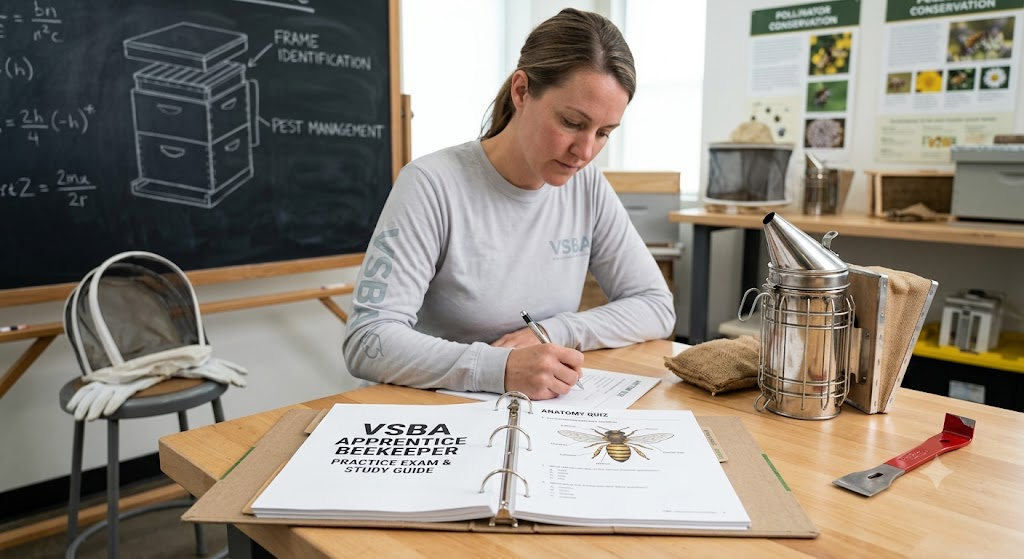
Additional Information
What the Course Entails and Exam Details
While the VSBA offers educational resources to support the Apprentice level, there is no single mandatory "course" that you must complete before testing; rather, the requirement is the equivalent of one year of beekeeping experience. The exam is the gateway to certification, which tests your mastery of essential concepts and applied skills. To prepare for this examination, you must study the official textbook, the 2007 edition of "First Lessons in Beekeeping" by Dadant & Sons. The body of knowledge you must command is extensive and includes: in-depth honey bee biology, such as anatomy, caste systems, and life cycles; a thorough understanding of the function, name, and proper use of all standard beekeeping equipment, including a smoker and various hive tools; fundamental, season-specific colony management techniques; the accurate identification of common bee diseases, parasites, and pests; and a basic overview of relevant local and state beekeeping regulations. You are expected to demonstrate knowledge that goes beyond rote memorization, showing you can apply these concepts in a practical setting. To challenge the exam, you must preregister and prepay with the VSBA.
What to Expect in the Final Exam
The final certification exam for the VSBA Virginia Apprentice Beekeeper level is a rigorous, two-part evaluation composed of both a written examination and a practical, hands-on test. You cannot achieve certification without passing both components.
The written portion is taken during a designated VSBA membership conference, where you must demonstrate your comprehension of the core subject matter. This test typically includes a combination of multiple-choice, true/false, and matching questions drawn directly from the required text and supplementary materials. Furthermore, a unique and critical component is a "situational" essay question, which asks you to articulate practical solutions to a specific beekeeping scenario, challenging your ability to think critically and apply your knowledge to solve real-world problems.
The practical examination is split into outdoor and indoor evaluations, where you must prove your technical proficiency. In the outdoor component, you will be observed by examiners while you perform key tasks: you must demonstrate the ability to light and maintain a smoker effectively, properly work a live beehive, locate key items such as the queen (or her signs), and correctly identify the different castes of bees and various types of brood. The indoor portion focuses on recognition and taxonomy, where you will be asked to identify specific beekeeping tools, common hive pests, and different stages of bee development in visual exhibits. Although the exact passing threshold can vary by conference, a strong understanding of all topics—often a mastery score of around 80%—is expected for this first-level certification, ensuring that every certified Apprentice possesses a solid foundation.
How to Study and Exam Centers
Preparation is paramount for success, and your primary study source must be the official textbook, "First Lessons in Beekeeping" (2007 edition). To build upon this, the VSBA encourages reviewing additional texts such as "Honey Bee Biology and Beekeeping" by Dewey Caron and "The Biology of the Honey Bee" by Mark Winston. Active engagement is key; create detailed flashcards for key biological terms, equipment names, disease symptoms, and pest identifiers. Your practical experience is your greatest asset: devote time to practicing your hands-on skills in your own apiary, specifically refining your ability to quickly and safely light a smoker, handle frames, and identify queens. Furthermore, joining a local VSBA-affiliated beekeeping club and seeking out a mentor can provide invaluable feedback and expose you to various management styles. Utilize study guides and practice quizzes, if available through the VSBA or your local club.
It is critical to note that the VSBA Virginia Apprentice Beekeeper exams are not administered online or at general third-party centers like Pearson VUE. They are conducted exclusively in person during the VSBA's semi-annual membership conferences. These conferences are held at various locations throughout Virginia. Therefore, you must monitor the official VSBA website for upcoming conference dates and locations, preregister for the exam, and pay the associated fees well in advance of the event. To take the practical exam, you must arrive equipped with your own beekeeping veil or suit.
Job Opportunities from the Course
Earning your VSBA Virginia Apprentice Beekeeper certification is a significant milestone that formalizes your foundational expertise and validates your commitment to responsible beekeeping. This designation, while an entry-level professional milestone, serves as a gateway to several rewarding career paths and entrepreneurial ventures within the field of apiculture. It immediately distinguishes you from hobbyists and demonstrates to potential employers that you have the confirmed skills needed for professional roles. Some of the career paths that this certification can unlock or support include:
Apiary Assistant or Technician: Working under the guidance of a Journeyman or Master Beekeeper at a commercial honey production or pollination services company.
Seasonal or Commercial Beekeeper: Employment in larger-scale beekeeping operations, managing multiple apiaries for honey harvest or crop pollination.
Hivelady/Hiveloop Manager (Service Beekeeper): Managing hives for clients who wish to support pollinators but may not have the expertise to do so themselves.
Beekeeping Retail and Supply Sales: Using your expertise to work in a beekeeping supply store, providing knowledgeable advice to beginning beekeepers.
Community Education or Outreach: Assisting local clubs or environmental organizations in presenting foundational beekeeping workshops and talks.
Entrepreneurial Beekeeper: A key step in turning your private apiary into a recognized business venture, selling honey, wax products, or nucs.
Most importantly, achieving this level is the mandatory prerequisite for advancing to the VSBA Journeyman, Master, and Master Beekeeper levels, which are essential for those pursuing top-tier professional positions, high-level research, or specialized commercial consulting.
Frequently Asked Questions
Reviews
5.0
Based on 0 reviews
Leave a Review
No reviews yet. Be the first to review!